
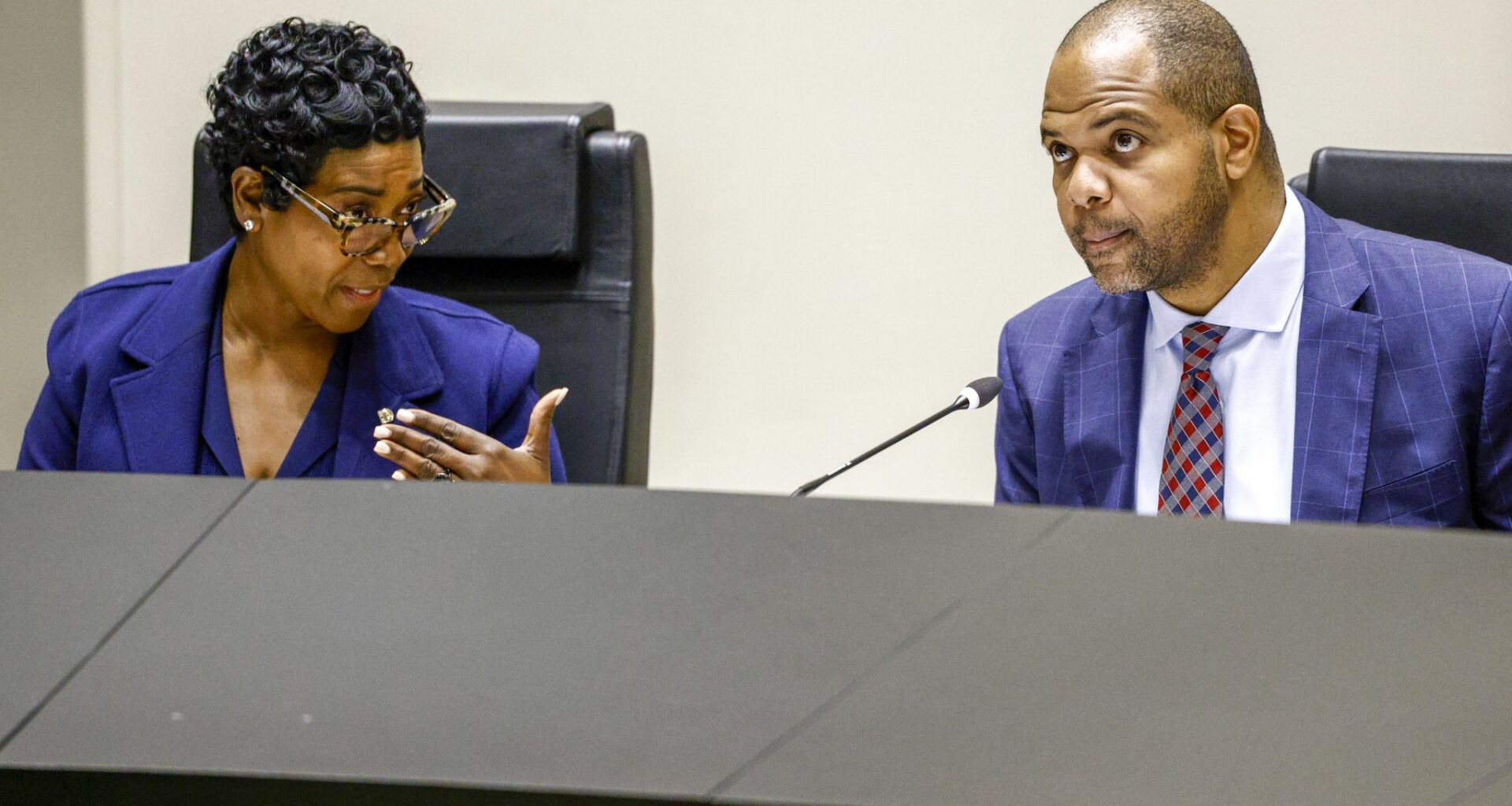
Dallas City Manager Kimberly Bizor Tolbert talks with Mayor Eric Johnson during a City Council meeting in April at City Hall.
Elías Valverde II/The Dallas Morning News
Can Dallas still compete?

That’s the question confronting local leaders after a series of high-profile departures rattled a city whose image has long been built on growth, ambition and swagger.
“The knives are out for our city,” Mayor Eric Johnson said last week.
Article continues below this ad
His warning reflects an intensifying scramble in North Texas for prestige and influence. Neighboring cities that once played supporting roles are now winning marquee projects that once seemed destined for Dallas.
The Mavericks and Stars put that shift on full display when they announced plans to leave downtown.
Now, a larger debate has broken out about whether Dallas is moving quickly enough in a region where it no longer stands alone. The stakes reach from City Hall to downtown and Dallas’ place in North Texas.
Is City Hall spending too much time fighting?
For some civic leaders and residents, the problem isn’t that Dallas lacks resources. It’s that it lacks alignment.
Article continues below this ad
Sana Syed, a downtown resident and former City Council candidate, told council members Wednesday that Dallas’ recent losses were not isolated events.
“Downtowns rarely die from a single blow,” she said during the public comment segment. “They fade when vision is replaced by complacency, when short-term politics outweigh long-term stewardship.”
Her complaints echoed a frustration that surfaced throughout the meeting: that the council has become too distracted by internal fights and too slow to act as neighboring cities aggressively pursue businesses, investment and major projects.
Council members have traded barbs on social media, while supporters packed council chambers wearing shirts urging leaders to “save City Hall” or move employees into a “safe City Hall.”
Article continues below this ad
Tensions escalated after a 9-6 council vote in March directing city staff to study relocating government functions from the aging downtown building.
At the end of Wednesday’s meeting, Johnson urged council members to stop questioning one another’s motives and focus on making decisions as suburbs make inroads.
“We have a serious, serious situation on our hands,” he said. “We are in a very cutthroat competition.”
Johnson was also a target of criticism. Several speakers said Dallas had been dealt a series of blows under his watch, pointing to the departures of AT&T, Neiman Marcus and other employers.
Tom Leppert, who was mayor from 2007 to 2011, said the larger issue is execution.
Article continues below this ad
“We lost AT&T because we didn’t respond” quickly enough, he said. “We’ve got to prove that we can not only make promises but keep those promises.”
Former Dallas Mayors Mike Rawlings, from left, Laura Miller and Tom Leppert pose for a photo after a news conference opposing charter propositions in October 2024 outside the AT&T Performing Arts Center.
Chitose Suzuki/Staff Photographer
Former Mayor Mike Rawlings voiced similar concerns, describing Dallas as suffering from a “crisis of confidence.”
He said the city does not lack assets, but accountability.
“Anybody kind of blaming something else, be it our confidence or regionalism or whatever, is not really taking accountability and doesn’t understand how business works,” he said.
Article continues below this ad
Former Mayor Laura Miller said Dallas’ governmental structure is holding the city back.
In a D Magazine column, she said Dallas should be governed by a strong mayor rather than its current council-manager system in which the council sets policy and a city manager runs daily operations.
That arrangement, she wrote, has created a vacuum that developers have filled, giving them outsized influence at City Hall.
A city spokesman did not return a request for comment Friday.
What will downtown look like?
For many, the road to changing Dallas begins downtown.
Article continues below this ad
“Dallas has done well,” said Dallas County Commissioner John Wiley Price, whose district includes downtown. “This council has done well in terms of making sure that growth of downtown Dallas is on the plan.”
A day after the Mavericks identified the former Valley View Mall site as its next home, about 100 people gathered to help shape downtown’s future.
Jennifer Scripps, president and CEO of Downtown Dallas Inc., said her advocacy group was working on the next downtown plan, expected this fall, focused on mobility and better links among nodes within the loop.
Scripps cited projects to grow the residential population already underway, including a new Dallas ISD pre-K through 12 campus south of downtown, as evidence that the area’s evolution is continuing.
The goal, she said, is to make downtown a place where more people choose to live, not just work. This also means adding 3,000 to 4,000 hotel rooms to support the new convention center.
The momentum is real, Scripps said, not simply “mindless boosterism.”
“All we need to do is focus,” she said.
Can Dallas fend off the suburbs?
A look inside the Dallas City Counci chambers.
Tom Fox/Staff Photographer
As for Dallas’ standing in the region, some see a city losing its edge. Others see one with enormous advantages still intact.
Fehmi Karahan, who helmed the $10 billion Fields development in Frisco, said Dallas’ suburban neighbors often appear more unified and efficient.
He said Plano City Council members, all elected at-large, vote from a citywide perspective rather than representing individual districts.
Karahan said Dallas can continue to grow, but only if it improves execution and takes better care of major assets.
“Take UT Southwestern,” he said. “You’re on Harry Hines and there’s potholes. Everywhere.”
Others say Plano, Frisco and Irving have benefited from faster decision-making, unified political leadership and large redevelopment sites.
Dallas boosters say the city still has what’s needed to remain the region’s center of gravity as competition cranks up around it.
They point to the $3.7 billion redevelopment of the Kay Bailey Hutchison Convention Center, planned parks, financial services growth and other projects reshaping the city.
Supporters also note advantages that remain firmly in Dallas’ corner: the region’s largest population, major cultural institutions, two major airports and billions of dollars in planned investment.
“We’re doing it every day,” said Linda McMahon, CEO of the city-affiliated Economic Development Corp.
While declining to discuss specific prospects, McMahon said the city continues to attract interest from companies exploring expansion and relocation opportunities.
She highlighted efforts to position Dallas as a technology and manufacturing hub, including a visit soon by a South Korean delegation touring Pegasus Park and other sites.
“I’m optimistic about the future of the city of Dallas, because we are the name brand, we are the region,” she said.
Who gets the next big win?
Arlington mayor Jim Ross poses with an AEW championship belt after the announcement of a pay-per-view event in 2025 at Globe Life Field
Elías Valverde II/Staff Photographer
For Arlington Mayor Jim Ross, the issue isn’t Dallas versus the suburbs. It’s that North Texas no longer revolves around a single city.
Ross said he recently joined Johnson and Gov. Greg Abbott for dinner with FIFA President Gianni Infantino at the Governor’s Mansion, a reminder that civic leaders across the region often work together even as their cities chase major projects.
“I see Eric, we give each other a big hug,” Ross said of Dallas’ mayor.
Dallas’ recent business losses, he said, are less about mistakes by the city than the continued expansion of North Texas.
Companies increasingly weigh schools, public safety, neighborhoods and civic leadership alongside financial incentives when deciding where to invest, he said.
Arlington, Ross noted, has attracted 13 new North American or global headquarters in the past five years by cultivating relationships and creating an environment in which businesses feel welcome.
Ross said Dallas is no longer the only obvious choice for major projects, but rejected the idea that the city is somehow falling behind.
“Dallas is going to be just fine,” he said.
Still, he left no doubt that he and others are eager for opportunities.
“If the Mavericks and the Stars want to change their minds on anything,” Ross said, “Arlington is still open for business.”
Dallas City Council member Paula Blackmon said Dallas still has the strengths that helped make it the region’s dominant city, including its global brand, transportation network and ability to reinvent itself.
“We need to figure out how to get our groove back,” she said.
The new North Texas
City Hall under fire: Business leaders, former mayors and residents say Dallas’ biggest challenge isn’t a lack of assets, but a lack of focus, execution and alignment as rivals gain ground.
Downtown’s next act: Supporters see billions in planned investment and a growing residential base, but empty office towers and recent departures have intensified pressure to remake the urban core.
No longer the only game in town: Plano, Frisco, Arlington and other suburbs are landing big projects and employers once expected to go to Dallas, forcing leaders to confront what it will take to keep the city competitive.