
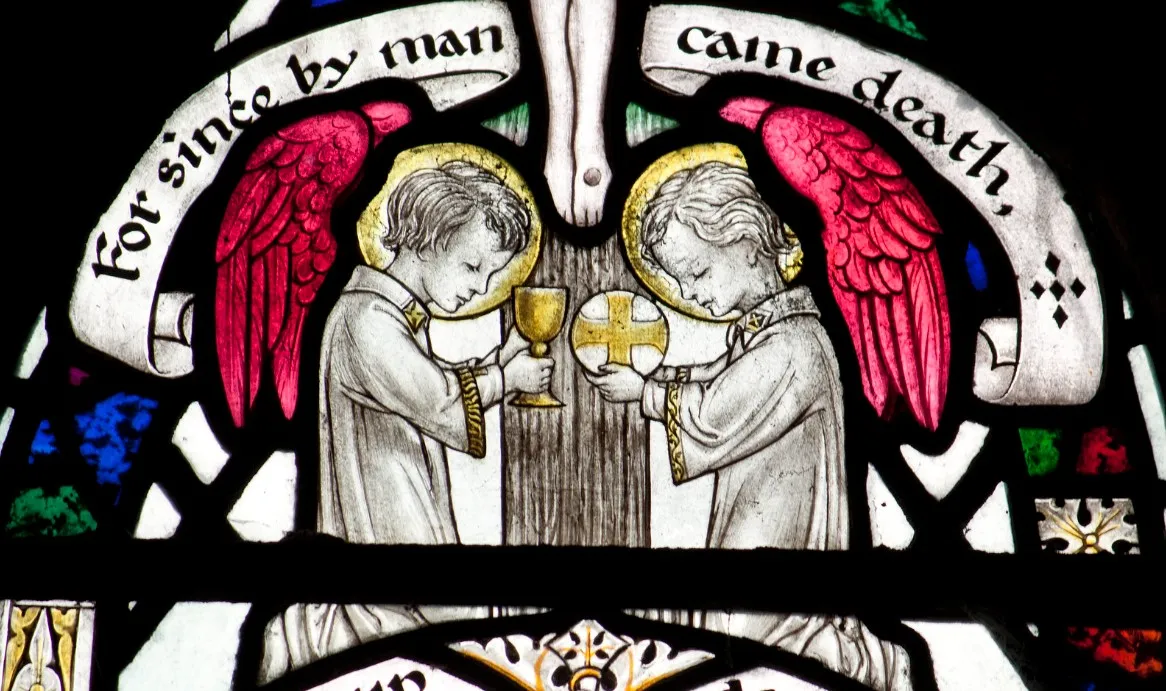
The Corpus Christi feast, established in 1264, celebrated the Eucharist with public processions and biblical plays in England. Suppressed during the Reformation, the Eucharistic processions were gradually permitted again after Catholic Emancipation.
By Sam Linley, June 6, 2026 – EWTN Great Britain
Few feasts were as visible in medieval England as Corpus Christi. The feast was instituted by Pope Urban IV in 1264, following the visions of St Juliana of Liège and the work of St Thomas Aquinas, who composed the office and hymns that the Church still sings. The Thursday after Trinity Sunday was set aside to honour the Real Presence of Christ in the Eucharist. It took root quickly in England.
After Mass, the Blessed Sacrament was carried in procession through the streets, with the trade guilds walking in order behind it. Houses along the route were dressed in green boughs. It was also the occasion for the great mystery cycles. Guilds in York, Chester, Coventry and Wakefield staged scenes from the Bible, from the Creation to the Last Judgement, which were performed on wagons drawn through the city. The York cycle alone ran to forty-eight plays. These were exercises in catechesis for a largely illiterate people, the Gospel made visible. Kings even came to watch them; Richard III saw the Coventry plays in 1485, just weeks before the battle of Bosworth Field.
But then the Reformation, which recast the nation’s understanding of the Eucharist, could not leave untouched a feast built entirely upon it. The Solemnity of Corpus Christi was abolished as a feast in 1548, under Edward VI. The plays lingered a little longer, with scenes honouring Our Lady cut away to suit the new orthodoxy. The York cycle was performed for the last time in 1569. What had been the most spectacular public devotion in the land was gone within a single generation.
Even after Catholic Emancipation, this did not change. The Roman Catholic Relief Act of 1829, which allowed Catholics to hold many public office positions, expressly forbade Eucharistic processions and the wearing of religious habits in public.
When the International Eucharistic Congress met in London in 1908, the closing procession of the Blessed Sacrament around Westminster Cathedral became a national controversy. Protestant societies invoked the Emancipation Act, the King received letters of protest, and the government pressed Cardinal Bourne to call off the procession. It eventually went ahead without the Sacrament, with some religious carrying the habits they were forbidden to wear. The law was, in truth, barely enforced; Corpus Christi processions were already held in a number of English parishes, but the episode showed how easily public Catholic devotion could still be made to give way.
Today, Eucharistic processions are lawful and unremarkable. On the feast itself, the Blessed Sacrament is carried through Liverpool and London and a hundred smaller places with absolutely no controversy. And yet the recovery has met with a completely different reception. Eucharistic processions today often meet indifference rather than hostility. The crowds do not jeer, as they once might have; mostly, they do not even notice. The danger now is not suppression but obliviousness, a public square that has forgotten how to recognise what is being carried past it.
Our mission today is clear: we are no longer defending our right to hold processions and bear public witness to our faith, but are actively called to proclaim the risen Lord, present under the form of bread, to a world marked by indifference and unbelief. Like the medieval guildsmen who, despite challenges, committed themselves to celebrating the Body of Christ in public, we continue this ancient tradition not out of convenience but out of conviction that the Eucharist is worthy of public devotion.
On this solemnity, let us ask that the Eucharistic Lord would open the eyes of those who pass Him by. May St Thomas Aquinas, who gave the feast its words, and St Juliana, who first sought it, pray for the Church in this land, that we may adore in public what we believe in our hearts.
Sam Linley is a staff writer and content creator for EWTN Great Britain.
Get EWTN Great Britain
in your inbox.
Post Views: 14