
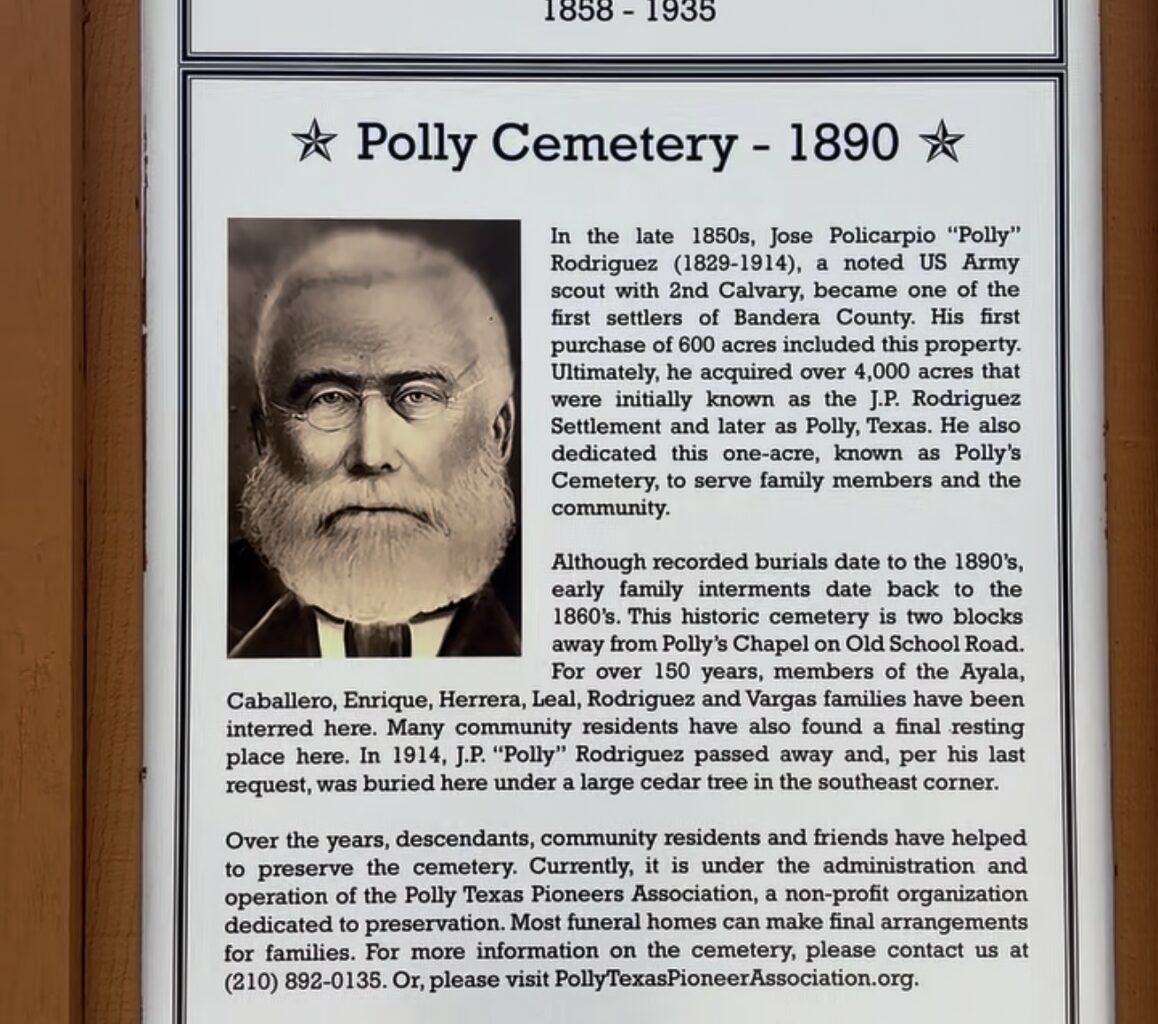
A church, a school house and a cemetery are about all that remain of a once-thriving, 4,000-acre Tejano frontier community founded outside San Antonio in 1858.
Today, the timeworn community fixtures sit almost entirely preserved — restored, as I later found out — as if the people for whom they were first built simply ran out to run an errand and still intend to return.
This settlement is known as Polly, Texas, and it’s located just outside of Bandera in the Texas Hill Country. Though it’s only a few miles from Texas Highway 46, it has a way of making you feel like you’re the only soul around for miles, standing in the same place where people who are long gone once lived, hoped worked and ultimately left.
Some call it a “ghost town,” which is understandable. The sacrosanct stone church, a wide-open cemetery, and the little schoolhouse feel like evidence of past lives, connecting you to a history that’s easy to miss if you’re not in the know. While evidence of other frontier town settlements from the area’s first German Texans shines today, this historic Tejano community is mostly hidden by history.
It was founded by Jose Policarpio “Polly” Rodriguez along Privilege Creek in 1858. Rodriguez was many things: a frontiersman, a surveyor and a scout for the United States Army, a Texas Ranger and even a Methodist minister. He purchased some of the land and obtained the rest through a land grant. He brought several different families to the area, where they farmed and ranched along a river valley. At the time, the community also had a general store and a post office.
The descendants of Polly himself and the small community’s original families began restoring the area in 2013, according to San Antonio businessman and head of the Polly Texas Pioneer Association, Rudi R. Rodriguez.
I got lost a couple of times driving through the rocky, dusty roads of Bandera County. Official signs point visitors toward the chapel and cemetery, but the schoolhouse can be harder to find.
I walked alone through the church pews of Polly’s Chappel. It’s now a wedding venue. According to a state plaque near its entrance, it was built “with his own hands” in 1882. He and others preached there.
Then, two blocks away, was the cemetery, where Polly himself was interred in 1914. The community, known officially at the time as the J.P. Rodriguez Settlement, didn’t last much longer. Amid the Depression, it seemingly withered away until family members and descendents eventually began restoring it. The settlement officially dissolved in 1935.
Finally, the one-room school house, where young children were sent to school in their best uniforms and learned the fundamentals of the time. An American flag stands proudly outside, and on the inside, hang educational posters, and even pictures of the class of 1904.
Though it’s not Fredericksburg, or Bandera-proper, it is a historical spot that’s off the beaten path and deserves some exploration.
Below are more photos of Polly, Texas.