
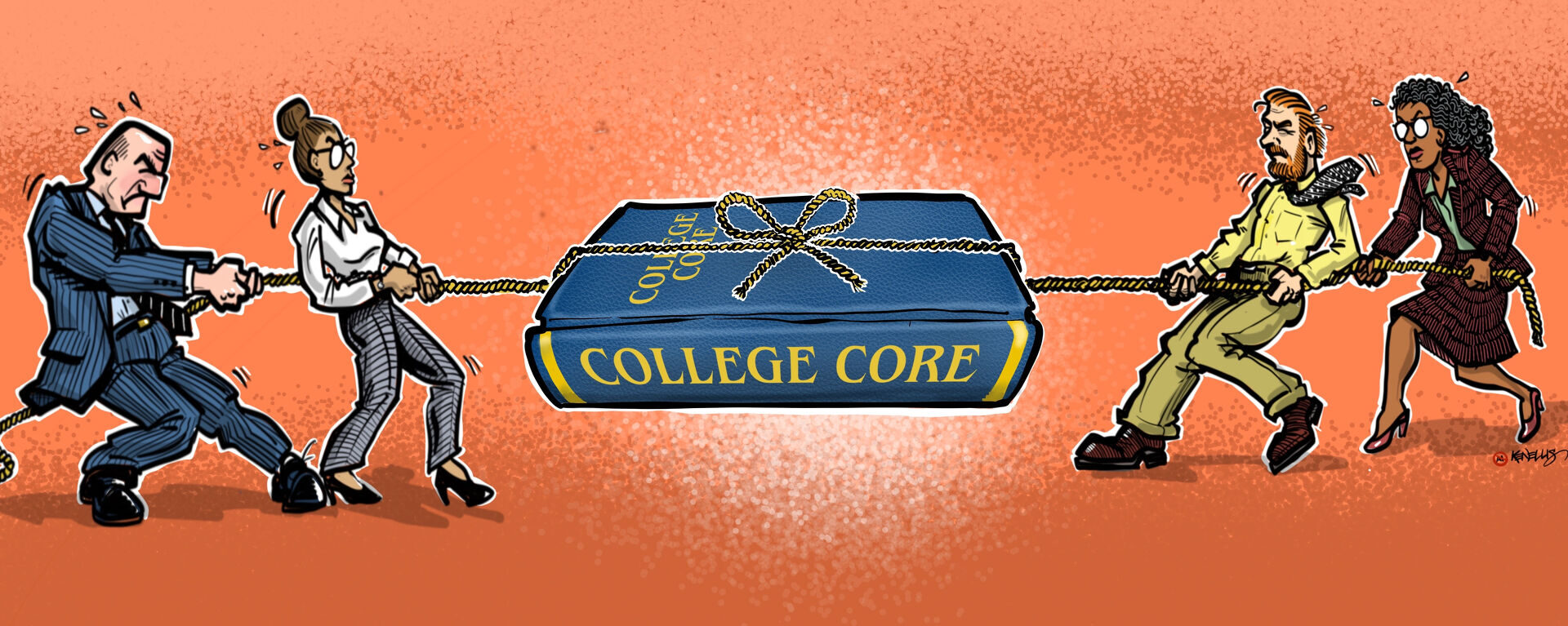
Some Texas faculty are at odds with Republican lawmakers over the future of the core curriculum in public higher education.
Illustration by Ken Ellis
Under a new state law and a conservative push in higher education, Texas’ public colleges and universities are reviewing almost 13,000 courses in the core curriculum to ensure they are “foundational” — but many institutions aren’t saying how they’re making that call.
Their interpretations could reshape instruction across the state: The core directly influences what professors teach, what students learn, and which departments get the tuition dollars that follow.
“A lot of people believe, implicitly and explicitly, that the core communicates what the institution values,” said Randy Bass, vice president for strategic education initiatives at Georgetown University. “It’s almost impossible to separate the core from the culture wars in Texas, that’s for sure.”
Article continues below this ad
WE ASKED: Do Texas students and faculty think ‘indoctrination’ is happening in higher ed?
Republican lawmakers passed Senate Bill 37 last year amid growing public skepticism about the worth of a college degree and allegations of liberal “indoctrination” in the classroom.
The law widened the rift between GOP legislators wanting more oversight and many faculty members worried about losing their academic freedom. Their pushback softened the bill, so that it didn’t include an explicit charge to curb instruction on specific topics. But political influences have already shaped many universities’ internal policies.
In the past six months, the Texas A&M University System has banned race and gender “ideology” from its core curriculum, the Texas Tech University System has removed core and lower-level courses “centered on” gender identity and sexual orientation, and the University of Texas System has told professors to teach “both sides” of all issues and avoid “controversial subjects” when they aren’t “germane” to course material.
Article continues below this ad
Still, more changes are likely by the end of 2026 at schools in those systems, plus other community colleges and public universities across Texas. To meet the mandate of SB37, their boards have to certify by Jan. 1, 2027, that their offerings in general education emphasize usefulness in life and the workforce.
A new state committee is also reconsidering standards for the core — and with recommendations due to the governor’s office ahead of the 2027 legislative session, many faculty are bracing for more sweeping reforms with less room for ambiguity.
“Anyone who cares about the core is concerned about the potential for problems,” said David Shattuck, a University of Houston associate professor who sits on the faculty council’s curriculum committee. “That’s not to say that we know there are going to be problems, but you have to worry when people mess with something as important as the core curriculum. And they’re messing with it to be sure.”
What’s in the Texas core?
Texas’ general education is 42 credit hours, or 14 courses. While some public colleges and universities have requirements that make their curricula different, they all have to meet the same basic standards set by the Texas Higher Education Coordinating Board.
The state’s core is broken up by “component area,” which are broader categories of study. Courses in each area have to help students with a particular learning objective. Those are: critical thinking skills, communication skills, empirical and quantitative skills, teamwork, personal responsibility and social responsibility.
This is what Texas requires in terms of component areas and the number of required credit hours:
Communication, 6
Mathematics, 3
Life and physical sciences, 6
Language, philosophy and culture, 3
Creative arts, 3
American history, 6
Government/political science, 6 (one course on the U.S. Constitution and a second on the Texas Constitution)
Social and behavioral sciences, 3
Component area option, 6 (Two additional courses that satisfy the prior categories or core objectives, as chosen by the institution)
Uncertainty on campus
University and college boards are currently scouring their core curricula to see if they meet SB37’s charge to be “foundational and fundamental to a sound postsecondary curriculum” and “equip students for participation in the workforce and the betterment of society,” among other criteria.
Article continues below this ad
Aside from placing those standards on a checklist, the state has largely left the implementation up to individual schools.
HIGHER ED: Notable Aggie alumni warn politics is reshaping university leadership
David Troutman, the Texas Higher Education Coordinating Board’s deputy commissioner for academic and workforce initiatives, said that for now, the state isn’t providing any guidance to institutions. But he said he recognized that faculty might see a certain course as “foundational” while administrators or state leaders do not.
“We’re really wrestling with that right now, because faculty are the agents who are teaching the learning outcomes for that course,” he said.
The Houston Chronicle asked Prairie View A&M University, Sam Houston State University, Texas A&M University, Texas Southern University, Texas Tech University, University of Houston and University of Texas at Austin to outline their processes in the SB37 reviews – including how they were assessing and applying the standards.
Article continues below this ad
While the schools described their processes at different stages, the Chronicle largely received general statements about the makeup of the groups conducting the reviews and ongoing efforts to comply with state law. Texas Tech and Prairie View also described their former processes in detail.
UT-Austin officials shed some light on its approach to SB37, however. Spokesperson Mike Rosen said the university is seeking “a rigorous and cohesive curriculum based on what all students most need to learn in their first years of college.”
Texas A&M University System officials also provided a more concrete update at a May meeting of the board of regents, though they still didn’t clarify exactly how they were defining SB37’s criteria.
Over the spring semester, review committees at each A&M institution considered whether individual courses were a good investment for students, vice chancellor for academic affairs James Hallmark said. Those groups included faculty, administrators, staff and external members such as industry representatives.
Hallmark expected to receive the committees’ decisions by June 1 so he could prepare them for the board’s approval in September. Some courses will be eliminated from the core “for a variety of reasons,” he said.
Article continues below this ad
“One of the big pushes of the general education review that is coming from the commissioner of higher education, Wynn Rosser, is that the general education should be general, that it should be establishing that foundation,” Hallmark said. “And much of our core curriculum over time has evolved to a point where we have way too many courses in the core curriculum, too many options, such that it is very highly specialized.”
UH Chancellor Renu Khator said in a January update that the provost and general counsel had completed a preliminary review. Earlier, she had said that it would separate courses into three categories: meets conditions, doesn’t meet conditions and partially meets conditions.
She said that UH was starting to seek feedback from professors, including the faculty council’s curriculum committee.
“The University of Houston’s core curriculum is and has been aligned with the standards set by the Texas Higher Education Coordinating Board, which establishes requirements for all public institutions of higher education in Texas,” a UH spokesperson said in a statement. “Curriculum review is an ongoing and continuous process. Specific to SB 37, we’re awaiting further guidance from THECB, which is expected later this year.”
Competing views
A students holds signs supporting teacher’s ability to instruct freely as Texas A&M students and faculty gather to support academic freedom on the campus of Texas A&M University in College Station, Thursday, Jan. 29, 2026. In late 2025, the university system approved a policy to restrict faculty from advocating race and gender ideology.
Jason Fochtman/Houston Chronicle
Professors previously took the lead on curricular decisions through groups called faculty senates, but SB37 also dissolved those advisory bodies. While most Texas universities recreated them as new groups called faculty “councils,” they’re smaller and more limited in power.
Under the previous process, many of the faculty senates would review course additions, changes and deletions to make sure that they fit into broader subjects and specific learning outcomes — like critical thinking and personal responsibility — set by the Texas Higher Education Coordinating Board. They would then go to the provost for final approval.
ALSO READ: UH, HCC re-form faculty advisory groups — but some worry they won’t have a seat at the table
Dale Rice, a Texas A&M associate professor of practice who sat on a 2014 committee to reform the core, said the group took its responsibilities seriously. He said that effort produced courses that appealed to both conservatives and liberals and that featured both classical and newer, forward-looking texts.
“Contrary to an awful lot of public opinion and political opinion, the faculty were not ideological when they did this,” Rice said. “We did not want to police content.”
But some critics say that approach made the core too big, diluting the point of the core itself as something essential for every student to know.
Critics also argue that general college education should go back to the “basics,” meaning canceling topics they see as niche or rife with liberal “indoctrination.”
“I think students do not want their time wasted. They come to a university to be educated so they can function in the world,” said Sherry Sylvester, a distinguished senior fellow at the Texas Public Policy Foundation, a conservative think tank. “They’re not paying to read (the anti-racism scholar) Ibram Kendi.”
Shattuck, who said he was speaking on his own behalf and not as a representative of UH, said that he’s less worried about the institutional reviews than he is about the statewide committee assessing the requirements for general education — particularly that the state will require history courses with a particular worldview or make the core more uniform across institutions.
That could mean fewer options for students and less faculty freedom in designing their courses. In Texas, no public college or university’s core looks the same, and currently, some have hundreds of course offerings for students to choose from.
“Faculty are completely in the dark on the process, and to the extent we’ve heard anything it has been through the rumor mill,” said Daniel Morales, president of UH’s chapter of the American Association of University Professors, a group that advocates for faculty’s academic freedom. “That’s a concern because faculty are no longer in control of the core curriculum at a research university.”
Not a ‘recruiting tool’
Former state Sen. Brandon Creighton – now chancellor of the Texas Tech system — wrote SB37 in response to concerns about the rising cost of college. The core requires students to take 14 courses, and at roughly three semesters, they alone would average about $16,000 at state universities.
While the law asks the schools to consider workforce needs as well as the costs on students, some experts say the loudest conversations about the reviews have centered on the teaching of controversial topics.
“The national narrative about what matters in higher education has shifted,” said George Kuh, professor emeritus of higher education at Indiana University Bloomington. “The bully pulpit just isn’t talking much about outcomes. They’re talking about a wide range of things, many of them politicized and to meet a point of view that does not have, in my mind, the learner of primary interest.”
Many students are ambivalent on the issue, but some inevitably see core requirements as an annoying checklist or a waste of money. Others see it as an opportunity to take classes that meet their interests or introduce them to new ones.
Gage Biles, a UH freshman, said that he wants to have the engaging discussions that are offered by the courses under fire.
“A lot of people are saying that high school doesn’t teach you this, college will,” he said. “But now college is not teaching it because they’re removing all those classes.”
Some faculty in the humanities, social sciences and liberal arts have a vested interest in keeping their courses in the core — and they are the ones who are more likely to teach the controversial topics at issue. Many professors want to teach classes that incorporate their research and expertise, and inclusion in the core can increase course enrollment.
Changing landscape: UH to drop religious studies as major due to low enrollment
Troutman said that some faculty will have to grapple with the fact that their courses won’t survive as electives if they don’t make the core under the new standards.
“General education curriculum should not be a recruiting tool for majors,” Troutman said. “It’s not about the department, it’s not about the professor. It’s about what the students need, what Texas students need.”
The size of the core will also come into play for the statewide advisory committee, which is made up of 14 faculty members and administrators from some of the state’s two- and four-year institutions.
SB37 calls for the group to consider methods for determining the components of the core, and for condensing the number of required courses at institutions. Some states have only 30 required hours, and with 42, Texas has among the highest in the nation, Troutman said.
But Andrew Koch, CEO of the John N. Gardner Institute for Excellence in Higher Education, warned “too broad a brush” to Texas’ core college education could do major damage.
A nuanced approach could do some good: It’s possible that controversial philosophy courses might help improve graduation and workforce outcomes for computer science majors, for example.
“My advice, if you asked, would be that we don’t throw the baby out with the bathwater,” he said. “I think if you lean in too much into potentially politicizing the culture wars on this, you will have missed the opportunity to serve your students really well.”