
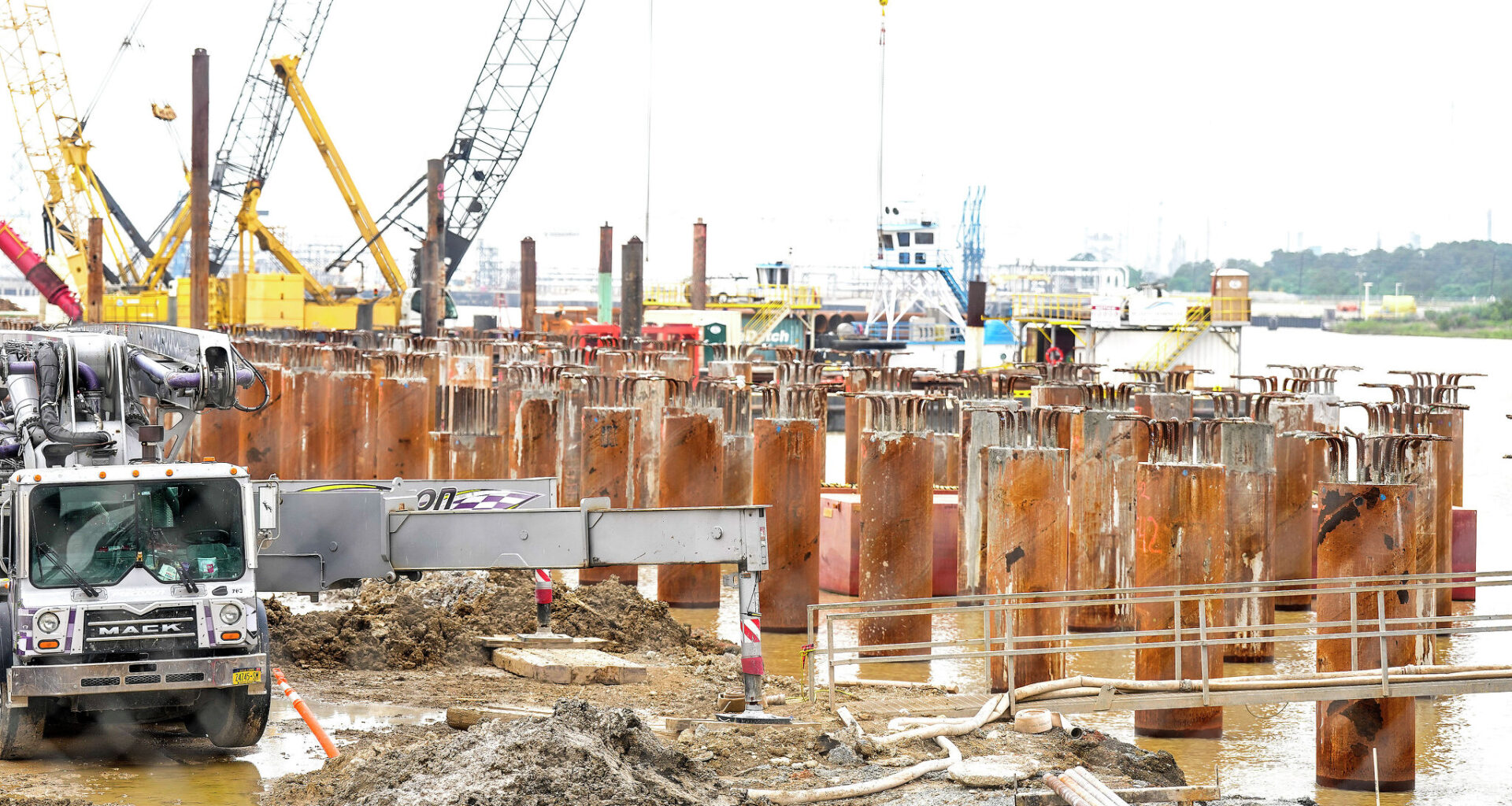
A new terminal under construction as part of the Port Houston’s Project 11 expansion at the Port Houston Bayport Container Terminal on Tuesday, May 7, 2024, in Pasadena.
Karen Warren/Staff photographer
Bulldozers work on the Project 11 Port Houston expansion at the Port Houston Bayport Container Terminal on Tuesday, May 7, 2024, in Pasadena.
Karen Warren/Staff photographer
Col. Rhett Blackmon, commanding officer and chief engineer for U.S. Army Corps of Engineers Galveston District, answers questions during a press conference regarding to the the $1 billion Ship Channel expansion on Thursday, June 22, 2023 at Judson Robinson Sr. Community Center in Houston. Residents are concerned over potentially contaminated dredge spoils from the project being dumped within communities in Pleasantville and Galena Park.
Yi-Chin Lee/Staff photographer
Newspaper clippings show stories from when an earthen levee holding back silt and oily water dredged from the Houston Ship Channel broke Friday, May 6, 1957, and flooded a 40-block area in the nearby Pleasantville addition.
Houston Chronicle Archive
Newspaper clippings show stories from when an earthen levee holding back silt and oily water dredged from the Houston Ship Channel broke Friday, May 6, 1957, and flooded a 40-block area in the nearby Pleasantville addition.
Houston Chronicle Archive
A newspaper story urges residents to get typhoid shots after an earthen levee holding back silt and oily water dredged from the Houston Ship Channel broke Friday, May 6, 1957, and flooded a 40-block area in the nearby Pleasantville addition.
Houston Chronicle Archive
The U.S. Army Corps of Engineers is scrapping a plan to dump much of the sludge it dredges up from the Houston Ship Channel onto sites near the historically Black Pleasantville neighborhood, opting instead to deposit the waste offshore, according to a letter Port Houston sent local officials this week.
The letter, dated June 2, said the Army Corps’ own design process led to the revision. For years, the federal agency had planned to pipe the slurry of mud and water it pulled up during Project 11, a billion-dollar project to help the channel fit larger ships, into disposal sites in residential communities. There, the sludge would be held in by levees made of soil.
The agency now plans to move the material it dredges from the project’s final two segments, between Sims Bayou and Turning Basin, into a disposal site “located in the Gulf, approximately two nautical miles outside the Galveston Entrance Channel,” the local port authority said.
Article continues below this ad
HISTORY: As Houston Ship Channel expansion looms, residents demand toxicity tests of dredging dumps
The Corps’ about-face comes years after community groups assembled the Healthy Port Communities Coalition to push back against the federal government’s previous plan to reopen two long-defunct disposal sites called Glendale and Filterbed, among other Project 11 decisions.
These sites sit on either side of Houston’s historic Pleasantville neighborhood, which was conceived during segregation as the nation’s first master-planned community for middle-class Black residents. Glendale is in Pleasantville proper, while Filterbed sits nearby in an area known as Denver Harbor/Port Houston.
“I’m really glad for the news we received, but at the same time understand that there’s still other communities that will continue to have concerns,” said Bridgette Murray, a Pleasantville resident and founder of the group Achieving Community Tasks Successfully.
Article continues below this ad
Traumatic memories
The placement areas, which look like artificial hills against Houston’s flat topography, carry traumatic memories for some generational families in the area.
In 1957, one of the levees of the Glendale mound collapsed, sending a flood of oil-filled silt and water into “a 40-block area of the addition” and damaging at least 100 homes, according to Houston Chronicle articles from the time. City health officials advised typhoid shots for victims, and homeowners said the sludge was a corrosive substance that left many of their possessions useless.
“When you live in a community where we can point to examples of failure at those dam sites, and you have a structure that has been inactive for nearly 60 years, the last thing you want to do is see it be reopened and then live with that concern that it could happen again,” Murray said.
Army Corps spokesman Bobby Petty confirmed that the agency’s current design analysis had settled on the offshore site for disposal, but he said the shift was not triggered by community concerns.
Article continues below this ad
“Public and stakeholder input is part of major civil works delivery, but the placement determination is grounded in the project’s technical, environmental and cost analysis,” Petty said.
Tracy Stephens, member of Achieving Community Tasks Successfully, shows a field at Flagship Drive and Lanewell Street on Monday, June 20, 2023 at Pleasantville in Houston. Residents believe this field has been inactive for dumping but are concerned this field will become the dumping site for potentially contaminated dredge spoils from the Ship Channel expansion project.
Yi-Chin Lee/Staff photographer
Tension over sludge safety
Since the Project 11 plans first dropped, Ship Channel residents from Pleasantville and elsewhere have been pushing back against the strategy of depositing any dredged slurry on land, worried about the toxins it might contain given the heavy industry along the Ship Channel segments tapped for expansion.
They also demanded soil testing of the sludge in many of the Ship Channel’s existing sites used for dredge spoils. While Glendale and Filterbed have been inactive for decades, sludge mountains in other communities like nearby Galena Park are still actively used for placement of routine dredge material.
Article continues below this ad
Experts with the Healthy Port Communities Coalition disagreed with the Corps and Port Houston officials both on the science, and on the need for on-site testing.
PUSHBACK: Ship channel locals are worried about sludge from port expansion. Now, they want an external review
In 2024, Naomi Yoder — then a researcher at Texas Southern University’s Bullard Center — presented the group’s work accessing dredge sampling data and conducting their own tests near the on-land sites. Yoder said they had “already identified pollutants at deeply concerning levels in the sludge to be dredged in the Ship Channel for Project 11, and at the base of the berms of three dredge spoil dumps.”
In response, Army Corps spokesman Carlos Gomez countered that there was “no evidence of contamination or discharges at any of the dredged material placement areas that would pose a hazard to human health.”
In the June 2 letter, Port Houston’s external affairs officer Kerrick Henry clarified that the Army Corps’ reversal on Project 11 plans did not apply to the channel’s ongoing maintenance.
Article continues below this ad
“Most dredged material is placed in placement areas near the dredge location,” Henry said. “The requirements and best options for each dredging project vary and will rely on the federal standard to use the least cost, environmentally acceptable solution.”
Still, the channel’s chief infrastructure officer, Lori Brownell, sent the Army Corps a separate letter about the Glendale and Filterbed sites in May. In it, Brownell detailed how local authorities hope to work with the Army Corps to permanently retire the Glendale and Filterbed sites near Pleasantville.