
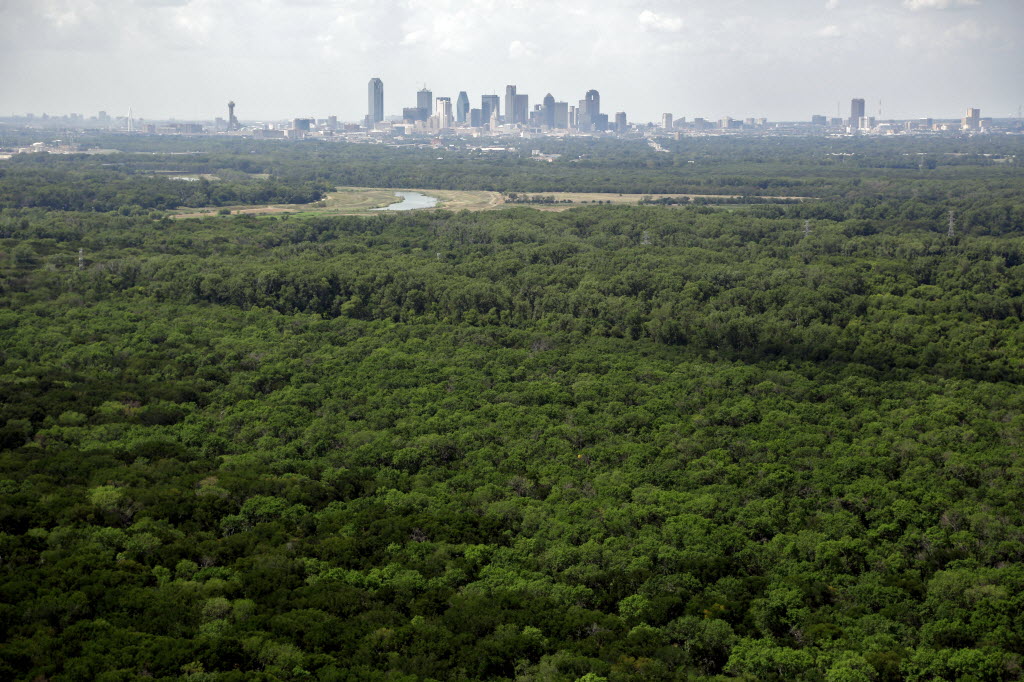
Southeastern Dallas is where residential neighborhoods meet some of the best natural beauty the city has to offer.
Vast green areas like the Great Trinity Forest and McCommas Bluff provide a scenic retreat for neighborhoods like Pleasant Grove and Buckner Terrace, which underpin the area.
Here’s our guide to southeastern Dallas:
Population: 168,079
Median age: 30
Median income: $58,170
Unemployment rate: 3.9%
For ages 18-24 (roughly 10.9% of the population)
For ages 25+ (roughly 56%)
53,442 units; 49,855 occupied (93%)
Median home value: $191,650
Median rent: $1,323.50
Compiled by staff researcher Rachel Friend. Data from U.S. Census Bureau, American Community Survey 2024 5-Year Estimates Subject Tables, Tables S0601, S1501, S1903, S2301, DP04
Settlements in the area now considered Pleasant Grove date back to the 1840s, according to the Texas State Historical Association. The area didn’t get its name until the 1880s, when a teacher named the local school Pleasant Grove after its location among cottonwood trees. The school’s name then passed onto the community it was in.
The nearby town of Kleberg began in 1850 and was originally a stage stop where two wagon trails crossed, according to a Dallas County Historical Marker. It became a farming community about 10 miles southeast of central Dallas. The area was eventually connected to the railroads in 1881.
The Pleasant Grove area remained relatively sparsely populated until after World War II when a post-war housing boom grew the population from 120 to 3,500 between 1943 and 1952, according to TSHA. This growth also brought businesses.
While Pleasant Grove was an unincorporated area for much of its history, Dallas began annexing parts of it in the late 1940s, according to TSHA. By 1962, the entire area was part of the city of Dallas. Kleberg, which had been incorporated in 1956, was annexed by Dallas in 1978, according to a Dallas County Historical Marker.
Garibaldi Bazaar: This historic Hispanic market has more than 200 vendors and hosts various events throughout the year, according to its Facebook page. It moved from its longtime site in 2025, but later reopened at a new location in southeastern Dallas.
Food writer Imelda García contributed to these selections.
In May 2026, Dallas City Council approved $16 million for the Trinity Forest Spine Trail, which is part of a broader project to connect 50 miles of trails in a loop around Dallas. This 9-mile section was planned to connect White Rock Lake to the Great Trinity Forest via southeastern Dallas.