
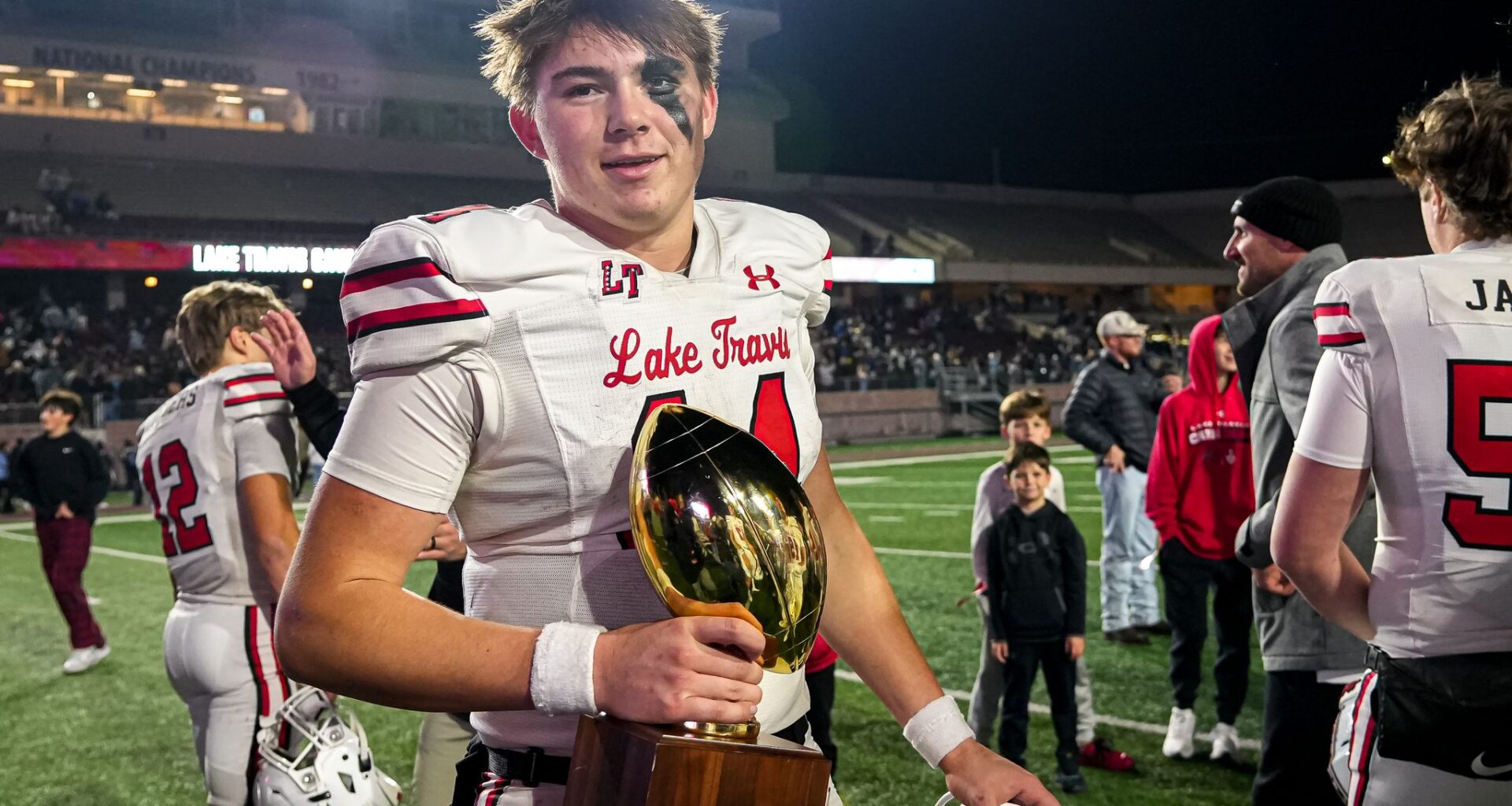
A two-sport star for Lake Travis High, Luke McBride and his family traveled throughout the country to gain an edge in sports.
Aaron E. Martinez/Austin American-Statesman
Stephanie Mullinix knows where her paychecks go.

There are groceries to be paid for. Household bills and gas and clothes for her three children — and volleyball. Mullinix is one of a growing number of parents shelling out thousands of dollars for out-of-school athletic competitions and training, all in hopes of becoming successful varsity athletes with a chance to compete in college.
Article continues below this ad
“If we don’t pay, there will be 15 other parents who will pay the costs to have their girls play,” Mullinix, a public educator in the Austin area the past 23 years, told the American-Statesman.
Her 13-year-old daughter, Phallyn, has developed into an excellent player for her travel volleyball club, CTX Juniors Volleyball in Buda. Over the past two years, though, the family has spent about $8,300 in fees, which did not include the cost of going to tournaments in Dallas and Houston.
Stephanie Mullinix and her daughter Phallyn have missed family functions while Phallyn has been on the road for volleyball tournaments. Phallyn hopes to play varsity volleyball at Hays High,
Stephanie Mullinix/Proto courtesy of Stephanie Mullinix
The goal is for Phallyn to make the varsity team once she enrolls in 2027 at Hays High, a Class 6A school with more than 2,300 students. And the dynamic is not rare in the Austin area, or the U.S., where millions of families pay for travel sports and extracurricular training.
Article continues below this ad
Llano takes the field as the Yellowjackets prepare to take on the Yoakum Bulldogs in the Class 3A Division I UIL State semi-final at the Pfield in Pflugerville, Dec. 12, 2025.
Sara Diggins/Austin American-Statesman
Baylor Bears wide receiver Josh Cameron (34) pulls the ball in for a first down against Texas Longhorns in the second quarter of an NCAA college football game, Friday, Nov. 25, 2022, in Austin, Texas.
Ricardo B. Brazziell / American-Statesman
Rylen Darter, golfer from Taylor High School. Faces off the Field, Thursday, May 21, 2026.
Aaron E. Martinez/Austin American-Statesman
Lake Travis setter Adyson Davis (16) sets up her teammate for a hit as Lake Travis and Dripping Springs face off in Dripping Springs, Tuesday, Sept. 23, 2025.
Mikala Compton/Austin American-Statesman
Adyson Davis (fifth girl from left) was a longtime varsity volleyball player at Lake Travis. She will enroll at the University of Arkansas and study sports management.
Photo by Brian Davis
Mullinix, 48, said her family has cut out several vacation plans to enhance Phallyn’s potential athletic future. While the price is sometimes hard to pay, she and her ex-husband and his parents have combined to make it work for Phallyn.
Studies show more and more parents are working just to give their children a shot at varsity or collegiate athletics — even if most varsity athletes never play past the high school level. Across the country, families who support their kids in youth athletics spent $1,016 in 2024, a five-year increase of 46% from 2019, according to the Aspen Institute’s latest parent survey in partnership with Louisiana Tech University and Utah State University.
Article continues below this ad
The Aspen Institute, a global nonprofit attempting to drive change through leadership development and policy programs, estimates that parents spend more than $40 billion annually in various fees to let their children play club sports and receive private lessons.
It puts a strain not only on families’ budgets, but their planning. For Mullinix, Christmas holidays “have been rearranged” because of schedule problems around volleyball.
But it’s unlikely that youth volleyball players — or football, tennis, golf and baseball student-athletes — can make a college roster without having private lessons, Mullinix and other parents told the Statesman.
Phallyn Mullinix, 13, has become an excellent volleyball player while playing for CTX Juniors in Buda. She aspires to play on the varsity volleyball team in 2027 at Hays High School
Stephanie Mullinix/Photo courtesy of Stephanie Mullinix
MORE: LBJ trainer who had heart transplant gets honorary degree
Article continues below this ad
MORE: Luke Hawley leads All-Central Texas boys soccer team
Eight families interviewed said they have paid close to five figures or more for their children’s amateur sports careers. That’s just the price to be competitive at some of the area’s high schools.
“As much as I hate to say it, your athlete will not get all the way there without some private coaching along the way,” said Brian Davis, another volleyball parent.
Davis, 49, estimates he and his wife Debbie paid more than $10,000 a year on his daughter Adyson’s athletics as she became a varsity starter for Lake Travis High. She graduated this year and passed on a collegiate volleyball career, but will continue her academic journey at the University of Arkansas. Davis, a former sportswriter for the Statesman, likened producing a high-level high school athlete with hopes of a scholarship to climbing a pyramid.
Article continues below this ad
“Over the years, some kids will stop climbing, others will fall back, more will just fall off and disappear completely,” said Davis, who maintained the instruction his daughter received was invaluable. “Interests change, athletes’ bodies change, school, boyfriends, whatever, gets in the way. It all plays a role.”
So, is it worth it to pour finances into an industry that offers no guarantees your child will succeed in the end? It just depends on who you ask.
Taylor High champions tell different stories
At another public high school in Central Texas, Taylor athletes offer a glimpse into the tough choices parents make.
Article continues below this ad
Rylee Michna, a senior, won the individual Class 4A state tennis championship in girls singles for the fourth straight year. Rylen Darter, a freshman, won the individual 4A girls golf tournament.
Their journeys toward individual success are strikingly different.
Darter, a 6-foot-1 phenom, has had lessons and played in various tournaments across the country for about 10 years. Ruston Darter said his daughter recently was invited to play in the High School Golf National Invitational July 11-13 at the Pinehurst (N.C.) Resort and County Club. He estimated it will cost he, his wife Jennifer and Rylen about $4,000 for three rounds of golf.
Rylee Michna of Taylor High School holds up her trophy after winning the Class 4A state tennis championship for the fourth straight year.
Monee Michna/Photo by Monee Michna
“Rylen started to go to the range with me when she was about 5 or 6,” Ruston Darter said. “I saw potential in her back then, but you never know about kids because sometimes they’ll burn themselves out. For that reason, we tried to encourage her to play other sports, too. Golf is probably the most expensive sport in terms of equipment, tournament fees and travel. It adds up pretty quickly.”
Article continues below this ad
MORE: Round Rock dominates All-Central Texas girls soccer team
MORE: Henry Talarico leads Westlake in All-Central Texas golf team
Ruston joked he knows enough about golf “to be dangerous” because he worked at various courses. When asked if golf has taken a chunk out of the family bank account, he put a positive spin on it.
“I’ve always taken notice of the life lessons along the way,” Darter said. “Sports will give you ups and downs in life, but it teaches you.”
Article continues below this ad
As for her future, Rylen said she aspires to play college golf and in the LPGA someday.
Michna, meanwhile, left a legacy on the high school tennis scene that can never be topped. Not only did she go 4-for-4 in winning state tournaments, she finished high school with an overall record of 99-1.
Yet Michna hasn’t been highly recruited by college tennis teams and she did not get a college scholarship offer that matched her success in school. Her mother, Monee, said her daughter’s lack of experience in club tournaments and national competition is held against her.
Is a scholarship the only mark of success? Michna walked across the stage with four gold medals around her neck at Taylor’s graduation and a sash that read “Valedictorian” of the senior class. The straight-A student will enroll at the University of Texas this fall and major in environmental science. She will continue to play tennis, even if she doesn’t land an athletic scholarship.
Article continues below this ad
Rylen Darter, golfer from Taylor High School. Faces off the Field, Thursday, May 21, 2026.
Aaron E. Martinez/Austin American-Statesman
“I wish I had more access at the tournament level,” Rylee Michna said. “There was maybe one decent tournament to attend each month, so it would have allowed for my game to develop more and for me to become a better player if I had easier access to tournaments or even hitting partners.”
However, simply paying for more training, more coaching, more games is not an option for everyone.
Paying a hefty price to keep their kids in sports
The Austin area has always been rich in talent at its public schools. But what about those who don’t live in the area’s most affluent zip codes?
Article continues below this ad
Low-income families with aspiring athletes spend roughly $600 per year, according to Youth Sports Business Report. That hardly scratches the surface of a club team that might charge between $3,000 and $10,000 in registration fees.
The report, which surveyed more than 1,800 parents nationwide, shows that while sports participation is up for many demographics, it’s down for the lowest-income families — falling almost 5% from 2016-17. The gap in participation rates between high- and low-income children is growing as well, the report notes.
Jon Solomon, research director for the Aspen Institute Sports & Society Program, said there is another reason the gap has expanded in the past two decades. He said there is has a “disengagement” at the community level because recreational programs, which are often free to the public, have not been given proper funding to exist any longer. The need for local coaches, volunteers and youth leagues has decreased.
That has forced many families to transfer time and money to high-dollar club teams, private lessons and travel ball. And the gold is not necessarily for their children to earn an athletic scholarship for college.
Article continues below this ad
“Some parents feel that if they don’t put their kids in travel ball at an early age, then how are they going to make the high school team?” Solomon said.
Manor New Tech head coach Derrick Lewis, displaying the Titans logo in the school gym, led LASA to a winning record last year after going 2-8 in 2022. He played wide receiver for three NFL teams and took over at New Tech earlier this year.
Rick Cantu/American-Statesman
Manor Tech head football coach Derrick Lewis, who had a successful college career before embarking on a 10-year career in the NFL and abroad, has seen a fair share of low-income athletes prosper after they graduated from high school.
“There are only a few camps out there that are not only worth the money, but the kids will walk away with an experience that can apply to their skill set,” Lewis said. “There are also camps that are pure money grabs and you must be able to recognize the difference.”
Article continues below this ad
The Manor area for years has had a median family income below the national average, per the U.S. census. Yet high schools in and around the city have produced recent star athletes such as Jamal Shead (who now plays for the NBA’s Toronto Raptors), Tahj Brooks (NFL’s Cincinnati Bengals) and Princely Umanmielen (NFL’s Carolina Panthers).
There is some added recognition that comes from participating in pricey camps, but Lewis said elite talent will oftentimes rise regardless.
“I’ll say this, though: There are many trainers in the (Austin) area who have a Rolodex of coaches who will notify a college coach if they recognize a kid has a specific skill,” Lewis said.
MORE: Bo Ogden, Rylee Michna named Athletes of the Year by GASF
Article continues below this ad
Learning the difference between money grabbers and legitimate coaching
Few are more intimately aware of the costs to bring a child from youth sports through a competitive high school and to an athletic scholarship better than Joe Devine. His son, Regents quarterback Jack Devine, has come a long way since he joined an Austin youth club when he was 5 years old.
Joe Devine forked over $125 for his child to “have fun and receive instruction” before trying his luck with Pee-Wee football. Since then, the family’s missed vacations and purposeful planning helped Jack, who will be a senior at the private school this fall, earn a football scholarship to play at San Diego State in 2027.
Regents quarterback Jack Devine in action during the 2024 season.
Jagger Lowe/Special to American-Statesman
The 52-year-old father gave some eye-popping dollar figures when speaking about his son’s decadelong journey of training and instruction:
Article continues below this ad
• $20,000 for travel and lodging;
• $5,000 for various team registrations;
• $4,000 for equipment and uniforms;
Article continues below this ad
• and $5,000 for healthcare to “maintain peak conditioning” during the season.
Did Devine ever feel like he was being overcharged?
“Absolutely!” he said. “You have to figure out which ones are the money grabbers and which ones will provide legitimate instruction.”
Spike McBride, who also raised a varsity quarterback at a notable Central Texas high school, said it took time to navigate those processes.
Article continues below this ad
“I was able to get a feel for which trainers and/or events were money grabbers and which were truly about developing the players,” McBride said. “The true champions for developing kids are charging a very modest amount of money, especially for this Lake Travis area, and the money-grab trainers are overcharging and providing limited development.
“This same thing can be said for the organizations that are about development and those that are turning into pay-to-play travel ball.”
As an example, McBride said one former Major League Baseball player charges $175 a lesson but only teaches for 45 minutes.
MORE: Vandegrift lineman turns allergy trauma into advocacy
Article continues below this ad
MORE: Cedar Park’s Trae Hill named Central Texas offensive player of the year
Higher costs on the horizon
In many ways, the hard choices these parents face worked out for Spike McBride and his son Luke.
“We sacrificed many family trips and used that time and money to attend the baseball travel tournaments and yearlong training,” Spike, 57, said.
Article continues below this ad
A two-sport star for Lake Travis High, Luke McBride and his family traveled throughout the country to gain an edge in sports. Club baseball teams he played for competed in 10 different states, from Oklahoma to California; Washington to Mississippi and South Carolina.
Spike McBride said his family has spent close to $60,000 over the past 11 years on travel fees, camps and training for baseball and football to give Luke a leg up on the competition.
Lake Travis Cavaliers quarterback Luke McBride (14) warms up ahead of the Cavs’ Class 6A Division I second-round playoff game against the Brennan Bears at Matador Stadium in Seguin, Nov. 21, 2025.
Sara Diggins/Austin American-Statesman
“Luke’s mom, Jennesa, and I understood that all the sacrifice was to set Luke up to be the best possible version of himself,” he said. “There were many winter breaks that we stayed home to ensure Luke did not miss training.”
Article continues below this ad
Recently, Luke McBride became the 12th quarterback from Lake Travis High School to earn an athletic scholarship at the Division I or Football Bowl Subdivision level when he signed to play at Coastal Carolina. That training might have been necessary just to have him start for the elite Lake Travis football program, which has produced a Heisman Trophy winner and top NFL draft pick Baker Mayfield as well as a slew of Texas Longhorns.
Spending and time sacrifices aren’t done yet, though. Luke’s little brother, Spike, has played baseball for three years and Spike Sr. said the family has already absorbed a hefty price tag for his younger son to continuing playing.
“Spike started at age 7 and he is now three years into (out-of-school sports) and we have spent about $10,000 over that time with spring, summer, and fall ball baseball,” he said.
He predicts he’ll spend more on his younger son. And Solomon, of the Aspen Institute, spoke similarly, saying the price of club sports, lessons and traveling team will increase simply because of yearly inflation.
Article continues below this ad
Most of the parents interviewed by the Statesman don’t appear to lament these costs, even if their kid may never go pro. Still, Devine had advice for parents who think they can pay their way to a sports scholarship.
“I knew (my son) was an above-average player, but I never would have predicted him becoming a Division I athlete,” he said. “Therefore, we didn’t do a ton of camps. Maybe one per summer. It wasn’t until his seventh- and eighth-grade years, when his crazy work ethic started to show …
“Jack did this on his own accord and still does to this day. Kids have to want this. Therefore, if you don’t see an almost a maniacal work ethic and joy for the game, save your money on this stuff and spend it on other worthwhile endeavors with the family.”
Article continues below this ad