
In the past two weeks, the FBI field office in Dallas and its satellite office in Fort Worth announced the arrests of almost 300 people suspected of exploiting children online.
The partnerships with local police also led to the rescue of 90 children. While the state and federal investigations go on, agents involved in the two operations are sharing details with NBC 5.
The FBI Dallas’ satellite office in Fort Worth partners regularly with the city’s police department to investigate crimes. The partnership now includes Operation Wolf Pack.
“What we sought to do is really address crimes against children violators in the Fort Worth area. We want to address crime here and now,” Chris Maffei, the supervisory special agent in Fort Worth said. “We wanted to focus on people who had a privileged position, access to children, or have had previous convictions for something either resulting in them being a sex offender or something similar.”
The operation, the first under the Longhorn Violent Crime Task Force, started in January. Investigative work between the FBI and Fort Worth police led to the takedown in March.
The so-called pack of agents and officers arrested 15 men suspected of producing, downloading or sharing child sex abuse material.
They seized 150 electronic devices suspected of containing the images and video. They also rescued one child.
“And for all of these search warrants that we did, we anticipated, even if we didn’t believe a child was there, we thought that it could be. And so we had victim services partner with us,” Maffei said.
The Fort Worth police department’s K9 Copper was another key partner. He’s trained to smell a chemical component in electronic storage devices that can contain critical evidence.
Allen, Frisco, and Rockwall police departments and the Collin County Sheriff’s office all had their electronic detecting canines on the job, too.
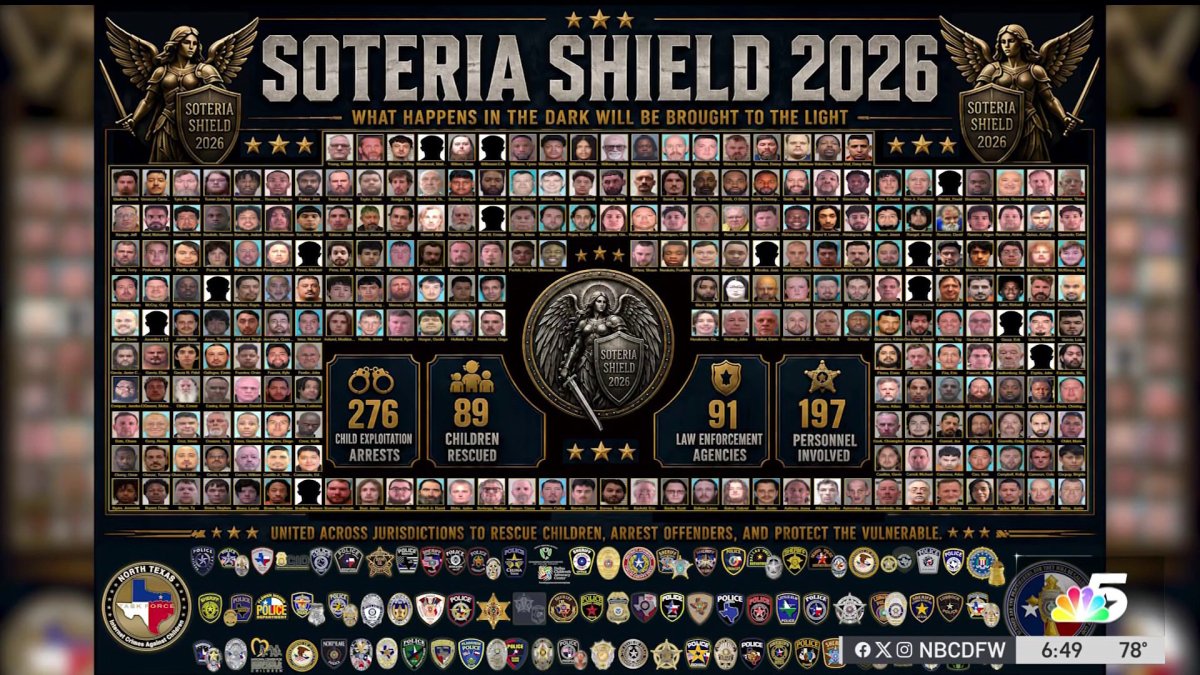
While Operation Wolf Pack was underway, federal agents in Dallas were at work, too, on Operation Soteria Shield. The operation was jointly managed by the FBI Dallas Division, Dallas Police Department, Plano Police Department, Wylie Police Department, and Garland Police Department.
“Soteria Shield is an annual operation that FBI Dallas leads in conjunction with dozens of our state and local partners in northern Texas to address the threat from online child sex predators and to rescue those children from victimization,” Clay Kempf, supervisory special agent at FBI Dallas said.
Operation Soteria, named after a Greek goddess of safety, deliverance and protection from harm, brought together 91 law enforcement agencies and almost 200 officers across Texas. During March and April, they arrested 276 people and rescued 89 children.
“Some of them we knew were sharing the child sex abuse material, which we call CSAM. Others we had reason to believe that they may be what we call a hands-on offender. So, actually, sexually abusing a child. Others could be enticing individuals, minor individuals in chat rooms, online spaces designed for children,” Kempf told NBC 5.
Lengthy prison sentences are the ultimate goal of the operations, and so is public awareness.
The FBI wants the community to know that it’s out there patrolling online spaces to keep children safe.
“And for me, I can definitively say without a doubt, this is absolutely the most righteous work that we do in the FBI,” Kempf said. “Now, all the work that we do is important. All victims deserve justice. And I don’t want to diminish any of the other programs that we have in the FBI. But when you think about the victims in these investigations, our children, which are our future and really our most vulnerable populations, I think that really underscores the importance of the violent crimes against children and trafficking mission that we have.”
The FBI says, the most important advice for parents is to have open and ongoing conversations about safe and appropriate online behavior.
“We’d love to live in a world where everyone was aware, everyone was savvy, and we could really put ourselves out of business. I just don’t think we’re quite there yet,” Kempf said.