
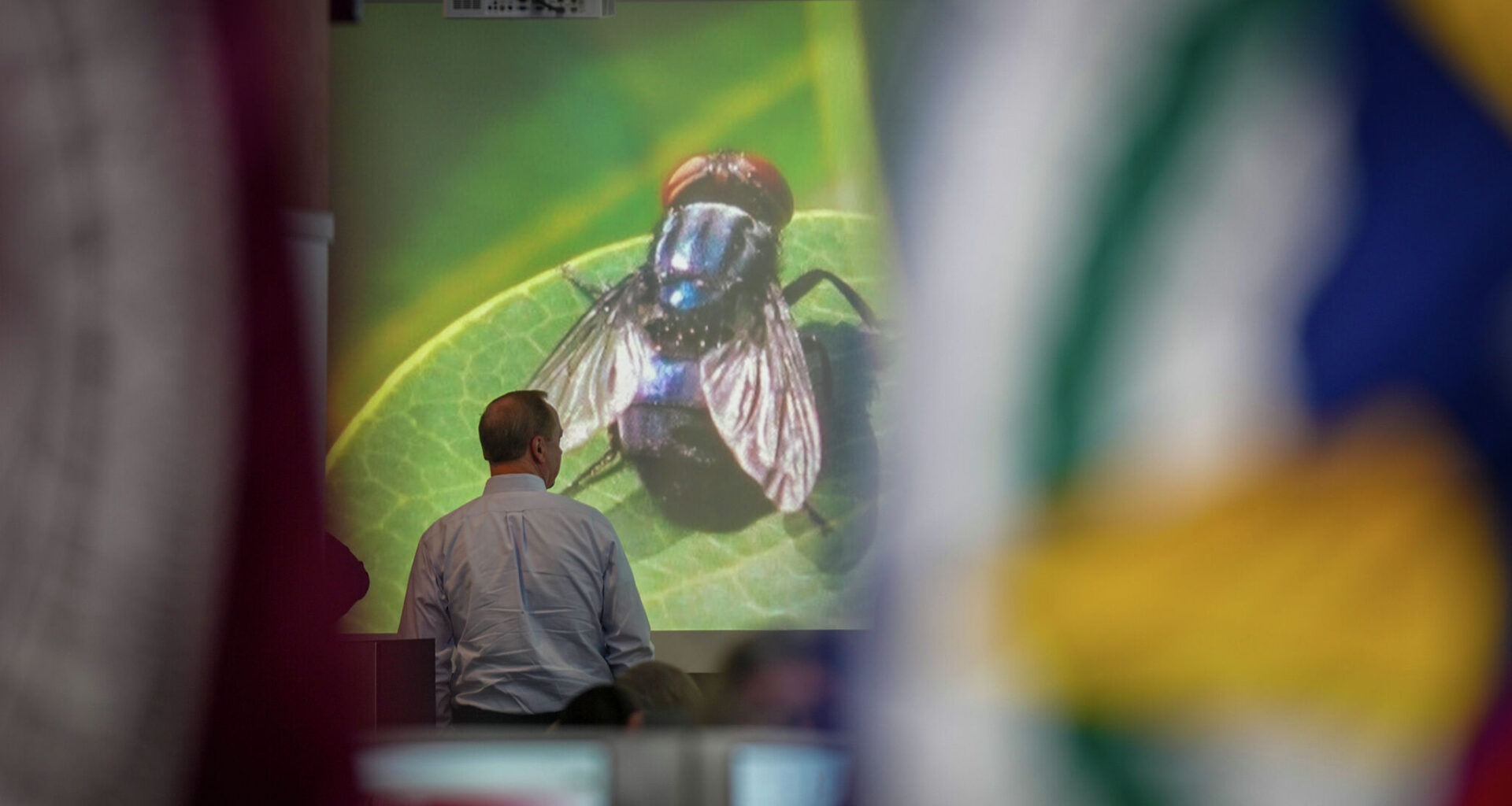
An official with Texas A&M AgriLife Extension works at the State Operations Center during Texas’ response to the New World Screwworm in Austin on Friday, June 5, 2026.
Jay Janner/Austin American-Statesman
The number of Texas’ New World screwworm cases has doubled from two to four and now covers three counties, U.S. officials confirmed on Monday.
The U.S. Department of Agriculture detected the New World screwworm in two more Texas animals — a calf in La Salle County and a dog in Andrews County. An Andrews County veterinarian submitted samples from the infected dog, and early reports suggest it was recently in Mexico, federal officials said.
The New World screwworm is a flesh-eating pest that endangers livestock, pets, wildlife and, in rare cases, people, according to the USDA. Calves in Zavala County accounted for Texas’ first two cases in 60 years last week.
Article continues below this ad
IN PHOTOS: Inside Texas’ State Operations Center as officials battle New World Screwworm
“While we address these instances that require immediate attention and continue to sample suspected cases, we are simultaneously working to eradicate the pest entirely,” Dudley Hoskins, the under secretary for marketing and regulatory programs, said in a statement.
Epidemiological tests are ongoing for both of the latest cases, according to the USDA. Gov. Greg Abbott on Monday said he activated the full use of state resources to combat the screwworm, which burrows into animals’ tissue and cause severe wounds, suffering and economic losses, according to the USDA.
“The protection of our ranchers, livestock producers, deer breeders and the Texas economy from this pest is a top priority,” Abbott said in a statement. “We have eradicated the pest before, and we will do it again in close cooperation with our federal partners.”
Article continues below this ad
The screwworm was most recently a perennial livestock killer in the United States between the 1930s and 1960s, but it began approaching the country again after it was seen in Mexico in 2024. At the federal level, President Donald Trump on Monday appointed Texas A&M Board of Regents member John Bellinger as a senior advisor for New World screwworm preparedness.
Bellinger is a cattleman, co-founded a biotechnology research company called Food Safety Net Services and serves as the CEO of food exporter Agri-West International and a real estate company called Bellinger Development, according to the USDA.
“John’s roots in Texas where New World screwworm is at ground zero, and his private sector experience in the related food safety and cattle industries, will help the administration advance our response and protect U.S. livestock,” U.S. Secretary of Agriculture Brooke Rollins said in a statement.
For each new case in the U.S., state and federal officials will create a 20-kilometer “infested zone” with quarantines, controlled movement and increased surveillance, according to the USDA. They’ll also ramp up trapping efforts along the U.S.-Mexico border, monitor and manage wildlife and reach out to local producers, veterinarians and other community members, federal officials said.
At Abbott’s direction, the Texas Division of Emergency Management requested the following six agencies to report to the Texas State Emergency Operations Center — the Texas Animal Health Commission, the Texas Parks and Wildlife Department, the Texas A&M AgriLife Extension Service, the Texas A&M Veterinary Medical Diagnostic Laboratory, the Texas Department of Agriculture and the Texas Department of State Health Services.
Article continues below this ad
Federal and state officials have started releasing millions of sterile flies to stem the infestations, and a South Texas facility that will breed more sterile flies is scheduled to open next fall. Two planes were set to dump them over a “response zone” in Texas on Monday, federal officials said.
A total of 75 people are responding on the ground, and hundreds more across the country are helping with lab diagnostics, treatment, logistics, air operations and more, according to the USDA.
Hoskins, the USDA under secretary, urged animal owners to remain vigilant, check their animals closely and report anything that seems suspicious.
“Together, we can protect our livestock, our communities and the health of animals nationwide,” he said.
Article continues below this ad
This is post includes previous reporting by Benjamin Wermund.