
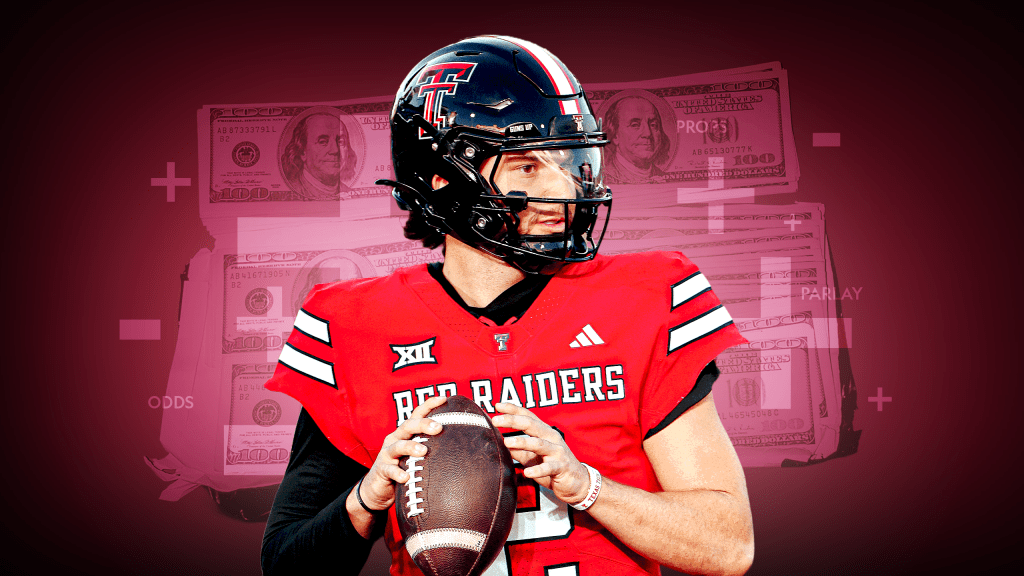
Lubbock County (Texas) District Court judge Ken Curry on Monday granted Texas Tech quarterback Brendan Sorsby a temporary injunction that orders the NCAA to declare him immediately eligible.
At the same time, per the judge, Sorsby can’t participate in game-day activities during the first two games of the Red Raiders season.
Judge Curry held that Sorsby would suffer irreparable injury, meaning an injury that monetary damages can’t remedy, if he was denied “the elite coaching, training resources, camaraderie and regimen that only being a member of a Division I college football team can provide.”
Along those lines, the judge emphasized how Sorsby needs to be eligible to “build the skills necessary to maximize his own success.”
The ruling is a major victory in Sorsby’s quest to play for the Red Raiders this fall. Absent a successful appeal by the NCAA, Sorsby will play another season of Division I college football for what would be the highly sought transfer player’s third school.
Sorsby’s eligibility situation is unique and problematic. The 22-year-old, who reportedly received a $5 million deal to join Texas Tech as a transfer from Cincinnati in January, is away from the Red Raiders for treatment of gambling addiction. He has admitted to betting on his own college team, Indiana, in 2022. The NCAA, like other major sports leagues, considers that type of infraction as grounds for a permanent disqualification.
Sorsby has sued the NCAA for breach of contract and breach of the duty of good faith and fair dealing. He contends the NCAA has unfairly handled his gambling addiction with respect to his eligibility. Sorsby accuses the NCAA of “stonewalling” a decision on his reinstatement, though the NCAA says Texas Tech didn’t submit its reinstatement request to the NCAA until after Sorsby filed his lawsuit.
Sorsby also takes issue with the expansiveness of NCAA requests on his betting, including bank accounts, credit card statements, Venmo transactions, phone logs, texts and social media posts, and argued a live interview would have “interrupted his residential treatment.”
The NCAA has maintained it followed ordinary procedures and highlights the extensiveness of Sorsby’s betting, which allegedly included thousands of wagers totaling about $90,000 from 2022 to 2026. The NCAA also asserts that Sorsby has used other people and accounts in others’ names to bet, including in Texas—where sports betting is illegal and technically a misdemeanor crime.
NCAA rules prohibit athletes from betting on sports and are primarily intended to protect the integrity of athletic competitions. Those rules are also designed to discourage athletes from partaking in a sports betting culture where data suggests numerous college students wager on sports.
This culture is a reflection of the U.S. Supreme Court’s ruling in Murphy v. NCAA (2018), where the Court ruled it was unconstitutional for Congress, through the Professional and Amateur Sports Protection Act of 1992, to compel states to deny sports betting when there was no accompanying federal standard.
A few years ago, the NCAA released a study finding that 67% of college students living on campus had engaged in sports betting, 41% had bet on their school’s teams, and 35% had used a student bookmaker. As more states have legalized sports betting—it is now legal in 39 states, along with Washington, D.C., and Puerto Rico—and as sports prediction markets have become popularized over the last year with a legal age of 18, it stands to reason that the rate of wagering by college students is likely on the rise.
Sorsby’s eligibility despite placing thousands of bets will likely attract criticism that the court ruling undermines the NCAA’s anti-gambling rules. It could open the door to other athletes who run afoul of NCAA rules because of gambling to adopt Sorsby’s playbook and sue.
Adopting that line of reasoning, the NCAA in a statement criticized the ruling.
“The NCAA strongly disagrees with the court’s ruling in Sorsby’s case and is deeply concerned about the damaging, far-reaching and broadly destabilizing ramifications of this outcome—which undermines and corrupts the integrity of sports,” the statement read. “The NCAA is committed to supporting student-athlete mental health but must continue to aggressively defend against actions that defraud college athletics and threaten competitive integrity, such as betting on one’s own sport.”
In hiring Jeffrey Kessler, Sorsby has retained a top sports litigator for his case against the NCAA. Kessler, who secured a 9-0 victory at the U.S. Supreme Court in NCAA v. Alston and played an instrumental role in the House settlement, has been an effective advocate against the NCAA. Kessler’s track record of success continues with Sorsby, whose gambling problem and history of betting on his own team make him a difficult client through which to raise legal arguments.
To be clear, Monday’s ruling does not create legal precedent that impacts other college athletes. The ruling, which, as an injunction, is a non-final order and can be appealed by the NCAA, applies only in one county in Texas. It does not bind other courts that preside over similar cases. That means a judge in another state could review a case involving a different college athlete who was deemed ineligible for betting on their own team and, unlike Judge Curry in Lubbock County, rule in favor of the NCAA.
Separately and via the NCAA’s internal disciplinary process, the NCAA recently denied an eligibility appeal Texas Tech filed with the NCAA on Sorsby’s behalf. The court-ordered injunction, however, means Sorsby can return.
Had Sorsby lost his petition for an injunction, he might have petitioned the NFL to hold a supplemental draft this summer. The NFL has not held such a draft since 2023 and, under the collective bargaining agreement, is under no obligation to conduct one.
The NFL might have concerns about welcoming a player who has a gambling addiction and has bet on his own team. Even if the NFL were to conduct a supplemental draft, NFL teams might be wary of drafting Sorsby. An NFL team that selects a player in the supplemental draft forfeits a choice in the same round in the following year’s college draft.
If the NFL declined to hold a supplemental draft, Sorsby could have in theory sued the NFL on antitrust grounds. However, as Sportico recently explained, he’d have faced long odds.
Sorsby’s legal issues are not limited to NCAA eligibility. He is also a defendant in a breach of contract lawsuit brought against him by the University of Cincinnati in an Ohio federal court. The school claims that Sorsby breached an 18-month NIL agreement with the school by transferring to Texas Tech earlier this year.