

Christopher Ray, senior vice president and provost, has a vision for UNT Health Fort Worth: double the number of students over the next five years.
“North Texas is one of the fastest-growing regions in America, and I feel very strongly that the world needs more of what we provide,” Ray said at a UNT System Board of Regents meeting in February. “I do not want to be diluted out of our communities, so we have to be prepared to grow.”
But to grow larger, UNT Health is streamlining its academic structure.
The health science institution moved from six colleges to four June 1, after eliminating the College of Public Health and College of Health Professions and shifting their programs into remaining colleges at UNT Health. No academic programs were cut, according to a news release.
The UNT System Board of Regents unanimously approved the reorganization in February.
UNT Health will restructure from six colleges to four starting June
Under the new structure:
Public health programs and the Physician Assistant Studies program moved into the Texas College of Osteopathic Medicine.
The doctor of physical therapy, Master of Science in lifestyle health sciences and Master of Science in clinical nutrition programs moved into the UNT System College of Pharmacy, which was renamed the UNT System College of Pharmacy and Health Professions.
The other three remaining are Texas College of Osteopathic Medicine, College of Nursing and College of Biomedical and Translational Sciences.
University officials described the decision as a way to reduce duplicated services, save money and prepare UNT Health for long-term growth. The new structure is expected to save about $600,000 a year in administrative personnel costs, according to board materials.
The savings come from streamlining administration, not layoffs, Ray said in an email to the Fort Worth Report. By moving related programs into larger academic units, UNT Health reduces duplicated administrative work and avoids the need to fill a vacant dean position.
Pushing to expand
Ray said the reorganization grew out of four priorities: serving Texas and students, creating budget flexibility, future-proofing healthcare education and preparing for growth.
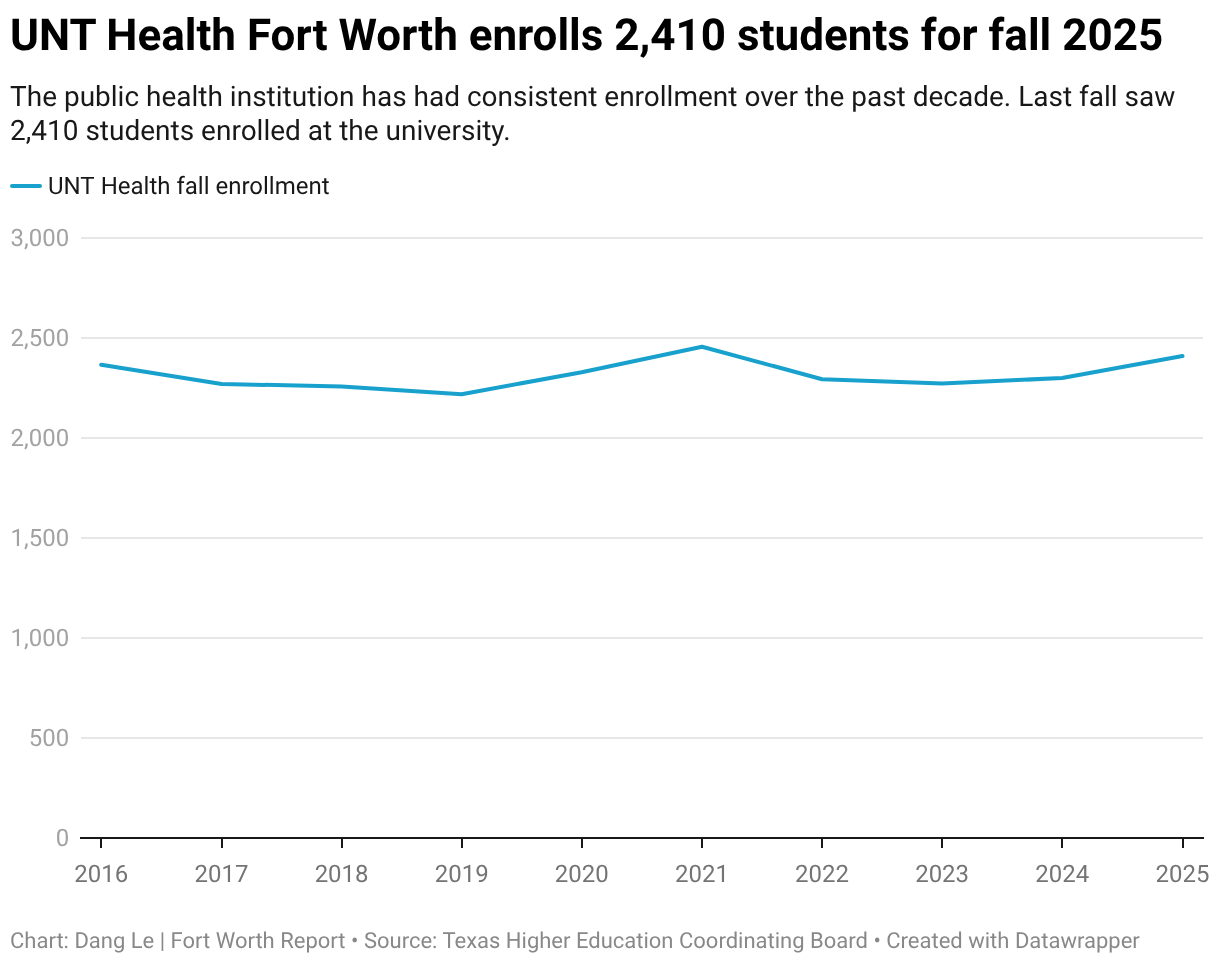
UNT Health President Kirk Calhoun told regents in February that UNT Health’s enrollment grew nearly 6% in the past year. Its Division of Academic Innovation, which focuses on online, hybrid and continuing education, grew at about 28% annually.
In fall 2025, UNT Health enrolled 2,410 students, according to the Texas Higher Education Coordinating Board data.
Making growth sustainable
UNT Health previously relied on state support to launch programs, including its College of Nursing. But Ray said the institution cannot assume future growth will be funded the same way.
“We’re not always going to be able to do it the way we’ve done in the past,” he said.
Ray and Calhoun framed the reorganization as more than a cost-saving measure. They described it as part of a broader strategy to grow enrollment, expand healthcare programs and create stronger pathways across the university system.
 UNT Health Fort Worth President Kirk Calhoun speaks at a panel about medical innovation at Tarrant County College Trinity Campus on Dec. 2, 2025. (Maria Crane | Fort Worth Report/CatchLight Local/Report for America)
UNT Health’s previous six-college structure created “operational silos” that strained resources, duplicated services and limited the institution’s ability to respond to enrollment changes, according to board materials.
The structure left colleges with separate governance and administrative systems that often did similar work independently, Ray said in the email. That included committees handling similar academic issues and duplicated support processes across colleges.
The new structure groups related disciplines into larger colleges with shared leadership and support systems. Ray said the shift should improve coordination and give UNT Health more flexibility to respond to enrollment and workforce needs.
It also better reflects how healthcare workers are trained and how they practice, Ray said. Students had asked for more opportunities to work across programs by training with and learning from one another, he told regents.
“If we can train our practitioners how they practice, that’s a differentiator for us,” he said.
Looking to the future
UNT Health’s growth strategies extend beyond Fort Worth.
In May, regents cleared the way for an off-campus instructional site at UNT Dallas, where UNT Health is set to begin offering nursing courses in fall 2027.
The program allows students in the pathway to earn two bachelor’s degrees — one in public health and one in nursing — in four and a half years.
The nursing program expansion also illustrates a problem that plagues many healthcare programs, Ray said: difficulties in finding clinical training space. Calhoun called the scarcity of the right clinical sites UNT Health’s Achilles’ heel.
Before regents approved the Dallas site, UNT Health officials said they had been in talks with potential partners near the campus, including the Dallas VA Medical Center and C.V. Roman Health Center.
The growth push comes as Texas faces a widening healthcare workforce gap. State workforce researchers projected Texas could be short more than 57,000 registered nurses by 2032.
Ray said the university is already looking beyond the Dallas nursing program to other potential UNT System partnerships. Asked whether the model could expand into other fields, he pointed to programs such as physical therapy and pharmacy as other programs that could benefit from partnerships.
“This is our first of many presentations like this,” he said.
Dang Le is the higher education reporter for the Fort Worth Report. Contact him at dang.le@fortworthreport.org.
The Fort Worth Report partners with Open Campus on higher education coverage.
The Report’s higher education coverage is supported in part by major higher education institutions in Tarrant County, including Tarleton State University, Tarrant County College, Texas A&M-Fort Worth, Texas Christian University, Texas Wesleyan University, the University of Texas at Arlington and UNT Health Science Center. At the Fort Worth Report, news decisions are made independently of our board members and financial supporters. Read more about our editorial independence policy here.
At the Fort Worth Report, news decisions are made independently of our board members and financial supporters. Read more about our editorial independence policy here.
This <a target=”_blank” href=”https://fortworthreport.org/2026/06/07/to-double-in-size-unt-health-fort-worth-cuts-colleges-from-6-to-4/”>article</a> first appeared on <a target=”_blank” href=”https://fortworthreport.org”>Fort Worth Report</a> and is republished here under a <a target=”_blank” href=”https://creativecommons.org/licenses/by-nd/4.0/”>Creative Commons Attribution-NoDerivatives 4.0 International License</a>.<img src=”https://i0.wp.com/fortworthreport.org/wp-content/uploads/2021/04/cropped-favicon.png?resize=150%2C150&ssl=1″ style=”width:1em;height:1em;margin-left:10px;”>
<img id=”republication-tracker-tool-source” src=”https://fortworthreport.org/?republication-pixel=true&post=592077&ga4=2820184429″ style=”width:1px;height:1px;”><script> PARSELY = { autotrack: false, onload: function() { PARSELY.beacon.trackPageView({ url: “https://fortworthreport.org/2026/06/07/to-double-in-size-unt-health-fort-worth-cuts-colleges-from-6-to-4/”, urlref: window.location.href }); } } </script> <script id=”parsely-cfg” src=”//cdn.parsely.com/keys/fortworthreport.org/p.js”></script>