
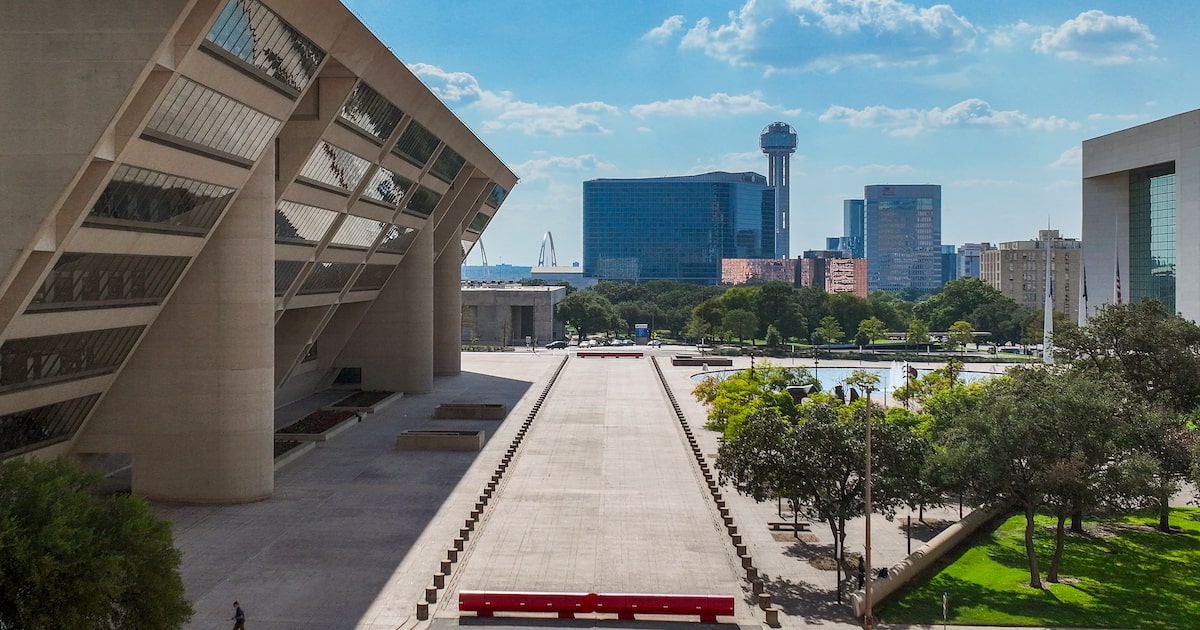
The recent proposal to relinquish Dallas City Hall for greener pastures is alarming on many levels. This proposal demands rigorous scrutiny, careful reflection, and a thorough assessment of costs to taxpayers, not hasty action. The American Institute of Architects, Dallas has identified four reasons to exercise patience and thorough analysis before making the major decision to abandon our iconic City Hall.
First, no decision regarding the future of the building should be made by the City Council until a comprehensive, transparent study of the building’s current issues is completed. It is imperative that the costs of renovation and modernization of City Hall be rigorously researched and compared to those associated with demolition, acquisition and renovation costs of an existing facility, or construction costs for a new facility.
This type of analysis takes time and talent from experts in design, engineering and construction, not rushed briefings and City Council committee meetings. The public deserves to know that decisions involving the expenditure of tax dollars and future bond dollars are being made with complete information, not years-old estimates and off-the-cuff speculation.
Secondly, it has been suggested that acquiring an existing office tower downtown would be a cost-effective solution for a new city hall. Our city’s recent track record of performing due diligence and renovations of an existing office building have not been encouraging, as witnessed by the debacle at the 7800 N. Stemmons building.
Opinion
Furthermore, it should be noted that every high-rise office building downtown is about 40 years old. If one was purchased and renovated, it would likely have many of the same issues as our current 50-year-old City Hall, including outdated HVAC, mechanical, electrical, elevators, roofing and waterproofing, increasing occupancy costs far beyond simple interior renovations. Additionally, leasing space in a multi-tenant office building would present significant security issues to be overcome.
Once renovated, city staff would be burdened with frequent elevator rides as commercial office tower floorplates would be approximately a third of the size of the floorplates at City Hall, requiring departments to be divided over multiple floors.
Third, the suggestion to demolish an internationally renowned public building to make way for private development and, possibly, a basketball arena is suspect, if not preposterous. Civic landmarks are not fungible assets to be replaced by private entertainment venues.
The value of City Hall as a symbol of democracy, history and architectural achievement far exceeds any hypothetical benefit of an arena in this location. If the city of Dallas decides to assist the Mavericks in obtaining the 30 to 40 acres they desire, there is plenty of land around the new convention center without demolishing City Hall. The May 21, 2025, convention center design briefing to the Dallas City Council shows over 30 acres of unplanned land between the new convention center and City Hall.
Finally, Dallas City Hall, completed in 1978, is widely recognized as a masterpiece of modern architecture and stands among the greatest public buildings designed by I.M. Pei. Its bold sculptural form, innovative engineering and dignified civic presence exemplify Pei’s vision of architecture that serves both function and public aspiration. To consider its demolition is to disregard a work of enduring cultural and architectural value.
The building’s creation in 1978 marked a pivotal moment in Dallas’ history, as the city sought to move forward from the shadow of the Kennedy assassination. City Hall was conceived as a symbol of renewal and progress, embodying the community’s determination to redefine itself and project a forward-looking identity. Its historical context amplifies its importance as a civic landmark.
Dallas City Hall stands as a testament to the city’s resilience, ambition and commitment to public excellence. We have an extraordinary opportunity to re-imagine City Hall and its surrounding plaza to meet the evolving needs of modern municipal governance and public life.
The Dallas City Council must reject any precipitous action to vacate or demolish this irreplaceable landmark and instead undertake a thorough, expert-led study of its future, ensuring the best use of taxpayer dollars while respecting the legacy of one of the most significant buildings in our city.
Willis C. Winters, Fellow of the American Institute of Architects, is director emeritus of the Dallas Park and Recreation Department. Tipton Housewright, FAIA, is the former president of the AIA Dallas.