
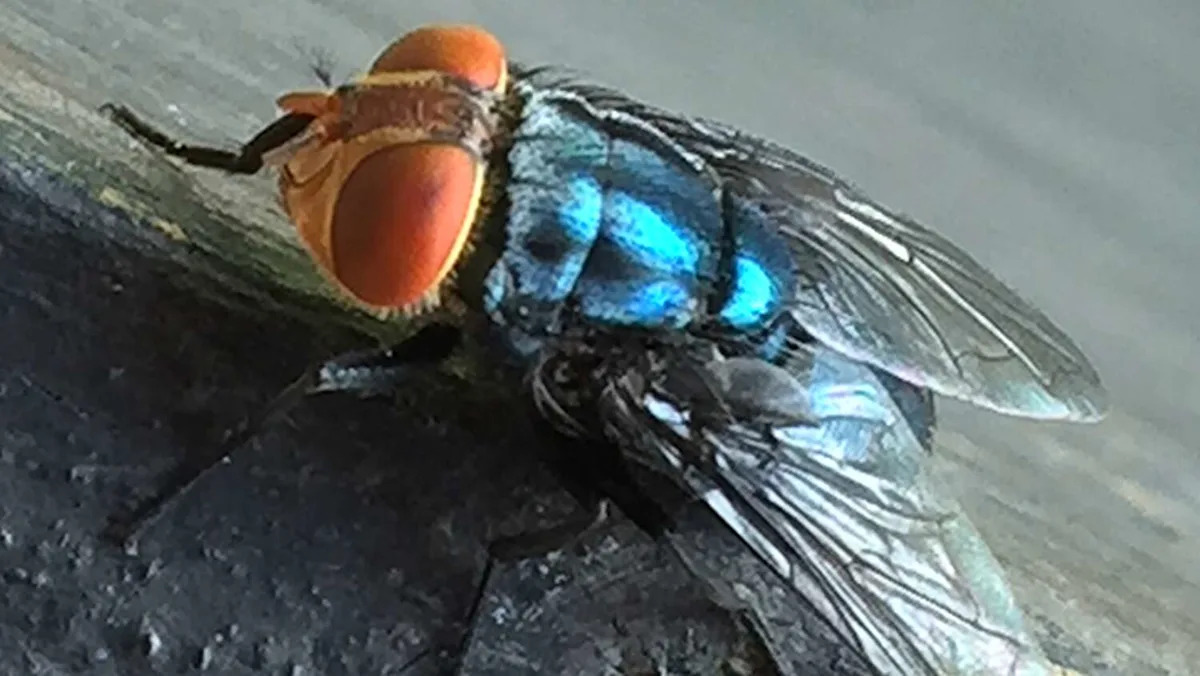
Texas and the U.S. Department of Agriculture are waging war against the New World Screwworm as detections of the deadly pest continue to increase.
However, the U.S. currently lacks sufficient sterile flies to stop the spread of the flesh-eating pest, which could cost the economy billions of dollars. New screwworm cases are already being detected, including a recent infection in a goat in the Texas Hill Country, U.S. Agriculture Secretary Brooke Rollins said Monday, June 8, during a news conference with Gov. Greg Abbott in Kerrville.
What do Texans need to know about the New World Screwworm and how it could affect them, their livestock and their pets? Read on to learn more.
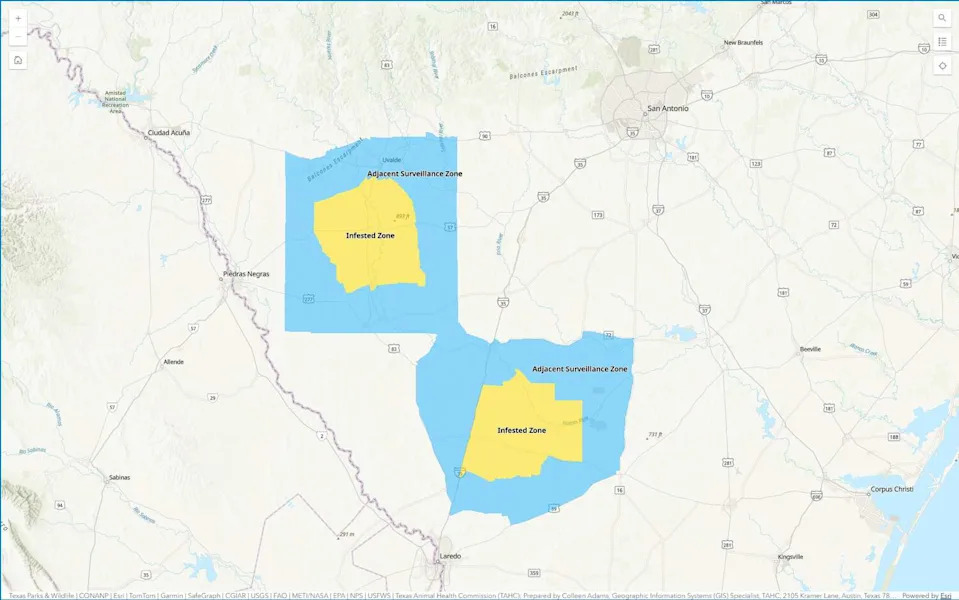
Shown are the four Texas counties currently under a quarantine due to confirmed detection of the deadly New World Screwworm as of June 8, 2026. Currently, La Salle, Uvalde, Webb and Zavala counties are under quarantine, meaning animals cannot be moved out of those counties without an inspection by the Texas Animal Health Commission. (Courtesy Texas Animal Health Commission)
New World Screwworm detected in a Gillespie County goat on Monday
Monday marked the latest confirmation of a New World Screwworm infection in Texas. This time, the flesh-eating pest was discovered in Gillespie County, the Hill Country county that’s home to idyllic towns like Fredericksburg and Luckenbach. USDA scientists confirmed the infection shortly before Rollins and Abbott addressed the press at the newly opened Knipling-Bushland U.S. Livestock Insects Research Laboratory in Kerrville.

Texas Gov. Greg Abbott, left, and U.S. Agriculture Secretary Brooke Rollins deliver updates on the presence of the New World Screwworm in the United States during a news conference at the Knipling-Bushland U.S. Livestock Insects Research Laboratory in Kerrville on Monday, June 8, 2026. As of Monday, USDA had confirmed five screwworm infections, including in a goat from Gillespie County. (Courtesy the Office of the Governor)
Two additional cases of New World Screwworm confirmed on Sunday
Monday’s confirmation of a new infection in the Hill Country follows the weekend confirmation of two additional cases – one in a calf in La Salle County, deep in the Texas ranchlands about 100 miles southwest of San Antonio, and another in a dog from Lea County, New Mexico. However, officials believe the New Mexico case is related to travel to Mexico and not an independent migration of the pest, Rollins said. The first screwworm detection was confirmed on June 3. Currently, four Texas counties are under quarantine due to the pest: La Salle, Webb, Uvalde and Zavala.
What is Texas doing to respond to the New World Screwworm?
On Monday, the governor issued a statewide disaster declaration, activating the state’s emergency operations center, which will be “staffed 24/7/365” and focused on combating the New World Screwworm. Abbott also announced the launch of a new inspector certification program. Additionally, the USDA is ramping up efforts to produce sterile flies at a facility in Edinburg in the Rio Grande Valley. However, the United States currently lacks sufficient sterile flies to effectively combat the pest.
“We don’t have enough to do the complete push, but we do have enough to manage the growth and development in Texas,” said Dr. Scott Hutchins, the USDA’s undersecretary of research, education and economics.
Currently, officials are importing 200 million flies per week from laboratories in Panama and Mexico, and 100 million are being produced at the Moore Air Base in Edinburg. However, the facilities aren’t expected to reach their combined goal of 500 million sterile flies per week until next summer, at the earliest.
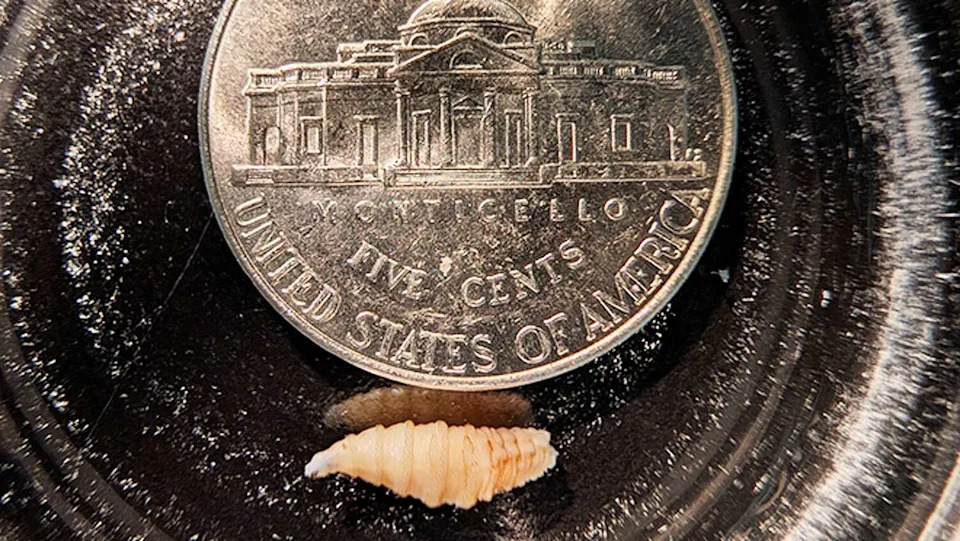
A New World Screwworm maggot is seen compared to an American nickel coin to show its size. (Courtesy Center for Disease Control and Prevention)
Can New World Screwworm infect pets?
Yes. Aside from large livestock such as cattle, horses and pigs, New World Screwworm can infect pets – especially those that spend any time outdoors. Abbott encouraged pet owners to inspect their pets regularly and seek veterinary care promptly.
“Here’s what Texans can do right now: check your animals daily. Check for wounds, even small wounds,” Abbott said, adding that residents should report suspected infections of pets or wildlife to state officials.
What should you be on the lookout for in your pets or livestock?
Officials with Texas A&M’s Veterinary Medicine and Biomedical Sciences Department say there are a few things to watch for, such as visible larvae in a wound, wounds that worsen quickly, the foul odor of decaying tissue and swelling or irritation around a wound. Infestations can occur in wounds as small as a tick bite or in sensitive areas, such as the navel of a newborn animal, a surgical site incision, or inside the nose or mouth.
What should you do if you suspect your pet or livestock animal has New World Screwworm?
Abbott urges Texans to report suspected New World Screwworm infections to the Texas Animal Health Commission’s 24-hour hotline at 1-800-550-8242 as soon as possible. Suspected infections in wildlife should be reported to the Texas Parks and Wildlife Department at 512-389-4505.
But officials added that there’s “no need to panic,” and the screwworm poses no threat to the American food supply.
“This is something that is detectable. This is something that is preventable. This is something that is treatable,” said Michael Schmoyer, associate administrator of the Animal and Plant Health Inspection Service of the USDA. For more information, visit screwworm.gov.
This article originally published at Texas launches ‘war’ on screwworm: What to know about the deadly pest.