
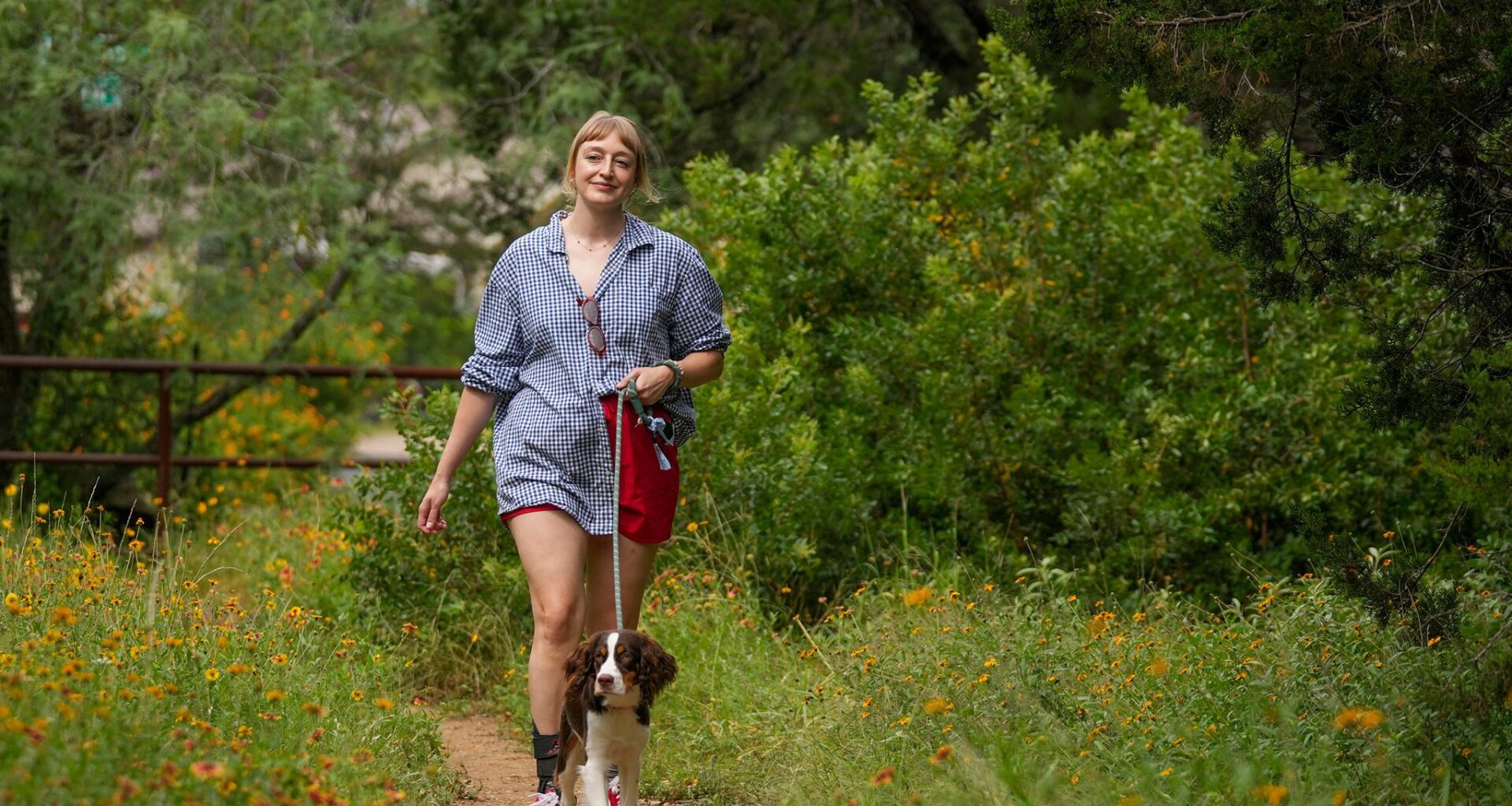
Lily Angelle, who was 33 last year when she had a stroke, walks her dog, Meadow, at the Stephenson Nature Preserve in South Austin. She has regained many of her abilities through physical therapy.
Jay Janner/Austin American-Statesman
Lily Angelle was in the middle of making a presentation on Zoom in February 2025 when she felt a pain shoot from the back of her head to the front. The 33-year-old ultramarathoner who does marketing for “Austin City Limits” felt overwhelming sudden fatigue.

She told her husband, “I feel so weird,” but he didn’t really understand her. She repeated herself. She was slurring her words.
Article continues below this ad
Patti Muck holds her daughter Lily Angelle’s hand while in the hospital after a stroke.
Provided by Lily Angelle
Lily Angelle, who was 33 last year when she had a stroke, poses for a photo at the Stephenson Nature Preserve in South Austin.
Jay Janner/Austin American-Statesman
Lily Angelle, who was 33 last year when she had a stroke, walks her dog, Meadow, at the Stephenson Nature Preserve in Austin.
Jay Janner/Austin American-Statesman
Angelle began losing the ability to control the right side of her body. When she tried to raise both arms, her right arm wasn’t working well. “As I tried to get to the car to go to the ER, my right leg was gone,” she said. She had to be wheeled into the ER.
Angelle was having a stroke. “I never thought I would be having a stroke,” she said. “I considered myself super active and healthy.”
Angelle didn’t have any of the common risk factors for stroke:
Article continues below this ad
Being 65 or older
Taking birth control with estrogen
Smoking or vaping
Obesity
Diabetes
High blood pressure
A history of heart problems or family heart problems
Having preeclampsia during pregnancy
Having early onset menopause
Family history
Angelle had torn an artery in her neck earlier. Doctors believe it was probably from cracking her neck, which she said relieved the neck strain from hunching over a laptop all day. Once that artery tore, a blood clot moved up her neck to the brain.
Recovering from a stroke
Patti Muck helps her daughter Lily Angelle read the menu while in the hospital at St. David’s Medical Center.
Provided by Lily Angelle
Angelle went to St. David’s South Austin Medical Center. “It was very scary because they rushed me right back,” Angelle said.
Article continues below this ad
Her husband James’ quick thinking to go to the ER gave her the best fighting chance to recover. She received clot-busting medication immediately. Time matters when giving the medication, though the window to receive it has increased beyond the initial four hours.
Imaging showed the torn artery, but the artery was tiny and could heal on its own. She was transferred to St. David’s Medical Center, which has a comprehensive stroke center.
Once she could leave the hospital, she went to St. David’s Rehabilitation Hospital to relearn how to walk and use her right hand again.
“She’s really brave,” said Angelle’s mother Patti Muck. “I can’t imagine what it feels like.”
Article continues below this ad
Muck moved from Houston to help take care of her daughter.
Some of Angelle’s goals included being able to pick up a fork to feed herself and being able to type and use her phone. She thought if she did the work, she would be 100% healed with no deficits. She soon learned it would be a long road and she might not ever be fully healed.
“In the early stages of recovery, things are very hard,” Angelle said.
Doing the work
After inpatient rehab with St. David’s, Angelle did intensive outpatient therapy five days a week with Centre for Neuro Skills. At that time, three months after the stroke, she still needed someone to stand beside her while she walked with a cane.
Article continues below this ad
“Intensity matters at the beginning stages,” said Jess Price, a physical therapist who worked with Angelle at the Centre for Neuro Skills. “There’s a high potential for big arc of improvement initially,” she said. “We don’t like to squander that.”
Gains still can be made at any time, but they are not as significant after six months to a year, Price said. Being younger can also be a benefit because of the brain’s ability to create new pathways.
“Sometimes we can get patients really, really close to where they were before,” Price said.
Price had Angelle do exercises to strengthen her right leg and improve her walking gait. Angelle lost the connection between her brain and foot to be able to tell where her foot is.
Article continues below this ad
One of Angelle’s goals was to be able to walk her dogs on uneven trail surfaces. Price had her walk on foam mats with a bunch of objects underneath them to mimic a trail. They had her walk on a treadmill with bands that the therapist would pull from different directions to replicate walking a dog.
Angelle was a “ray of sunshine” in the sessions, Price said. “She worked so hard.”
“What every one of these patients goes through, it’s life-altering; it’s emotional not just for her but for the family,” Price said.
Life forever changed
Lily Angelle works on strengthening her hands during rehab after the stroke.
Provided by Lily Angelle
With hard work, Angelle returned to work in June 2025. She now walks using an ankle brace. There still is some brain fog and things take longer to do. She doesn’t think she’ll be able to do long-distance running again, but she recently walked a 5K. She doesn’t trust herself to drive yet because of the brain fog.
Article continues below this ad
“I am a different person,” she said, “but there are parts of me before the stroke that still exist.”
She does not crack her neck anymore. If she’s feeling stiff, she rolls her head from side to side or does shoulder shrugs and gentle stretching.
“It’s been a very emotional journey,” Angelle said. “Sometimes I have really good weeks. I feel positive about how far I’ve come; other weeks I am so sad.”
She’s learned to slow down and ask for help, which was something she was not good at before the stroke.
Article continues below this ad
She continues to do physical therapy. “I want to keep improving.”
Lily Angelle, who was 33 last year when she had a stroke, wears an ankle brace while walking her dog, Meadow, to help stabilize her foot.
Jay Janner/Austin American-Statesman
Know the signs of a stroke
Article continues below this ad
Balance (loss of balance dizziness or headache)
Eyes (blurred vision, double vision or peripheral vision problems)
Face (one side of the face is drooping)
Arms (weakness in an arm or a leg)
Speech (difficulty speaking or understanding words)
Time (time to call for 911 immediately to get help)