
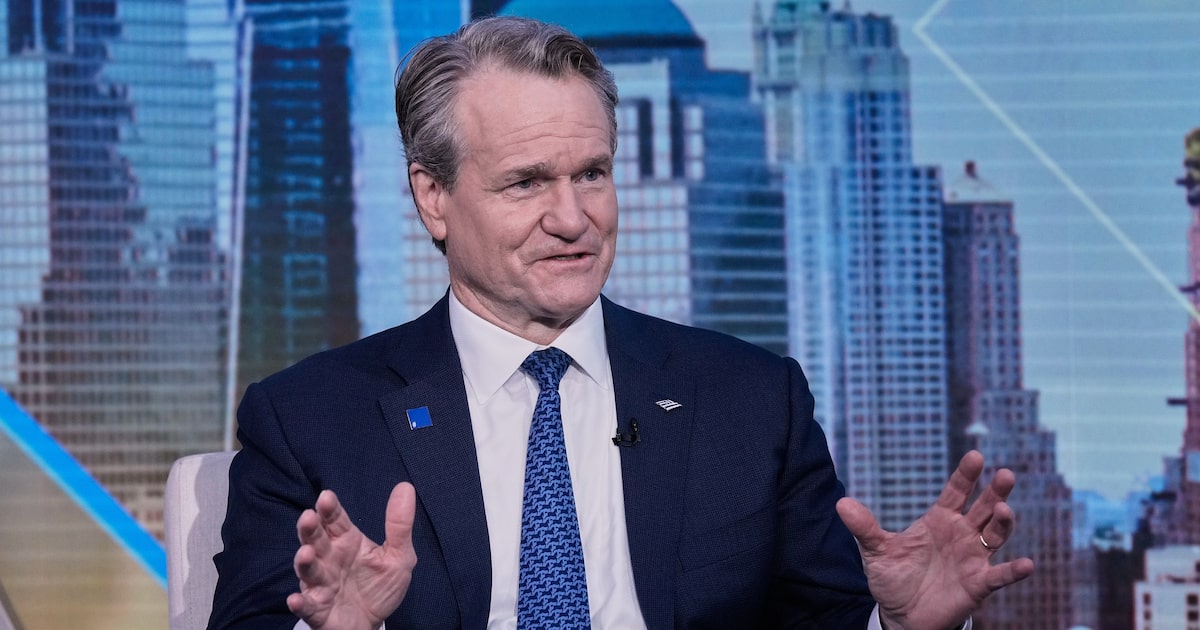
North Texas’ relentless growth makes it a “big market” for Bank of America, according to CEO Brian Moynihan, with the region’s expansion and diverse economy making it ripe for the kinds of banking deals that have taken hold in recent months.
Currently, the U.S.’s second-largest bank maintains over 14,000 employees across 121 locations here. Bank of America has extended nearly $9 billion in commercial loans to businesses in the region, holding $125 billion of the $173 billion in total Lone Star State deposits.
Texas — and the ever-expanding Dallas-Fort Worth economy — “is a great market for us [that] has been growing,” Moynihan told The Dallas Morning News in a wide-ranging interview.
Related
Not incidentally, others have taken notice. Amid a thaw in the regulatory environment, D-FW has also become a magnet for out-of-state institutions swallowing up local names like Comerica, Veritex and Vista Bancshares.
Business Briefing
Absent a financial crisis, regulatory restrictions prevent systemically important financial institutions like Bank of America from pulling off their own deals to purchase smaller regional banks, Moynihan explained to The News.
However, he gave his own take on the recent merger mania sweeping D-FW banks.
“If I’m an enterprise that’s in a slower growth area, and I can see that faster growth area, and I can acquire it and get the savings out, you’ll be consolidating,” Moynihan said. “So you’re going to see this go on across banking, because the scale needed is high.
“The added thing is the Dallas-Fort Worth area is a faster-growing market. So … if I’m going to spend my capital, I spend it where it’s going to grow,” the CEO added.
“We know that because we’ve been in this market for a long time, and we like it a lot, it’s a big market for us.”
‘Intellectual powerhouse’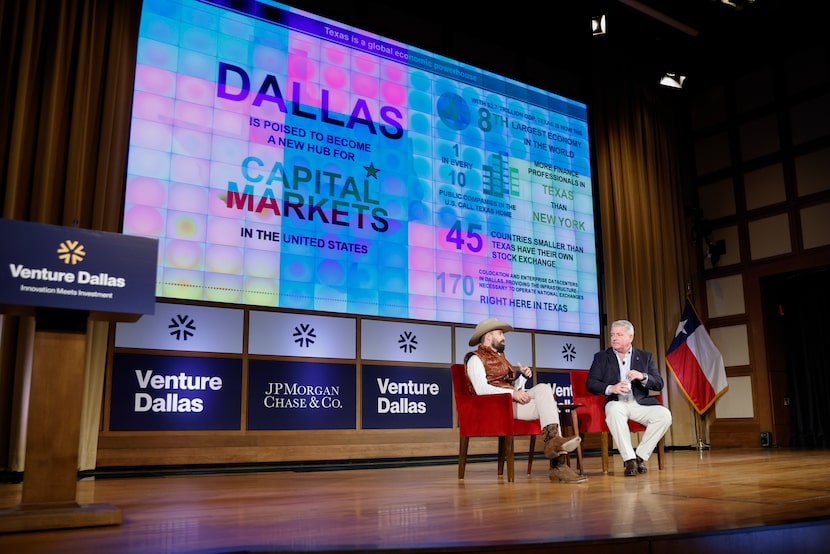
Texas Stock Exchange CEO Jim Lee (right) speaks with Perot Jain partner Aaron Pierce during the 2024 Venture Dallas annual conference at the George W. Bush Presidential Center, Wednesday, Oct. 30, 2024, in University Park.
Elías Valverde II / Staff Photographer
The emergence of financial services as a regional economic driver — punctuated by the arrival of the New York Stock Exchange, Nasdaq and the nascent Texas Stock Exchange — has been one of the major storylines of D-FW’s expansion.
However, the technology sector has been just as consequential, steadily adding to the aggregate number of new jobs in the region. The boom has been powered in large part by data centers mushrooming across the area’s landscape.
Although much of the attention has been focused on the emergence of D-FW as a financial powerhouse, Moynihan said North Texas is a magnet for innovation and technology — the likes of which has fueled the AI boom driving up the number of data facilities being constructed.
For that reason, Moynihan suggested the success of Y’all Street could be less dependent on where companies decide to list their stocks, or where they trade, and more so on the technological know-how that powers the global financial system.
The D-FW workforce has access to “a more broad economy, great schools, etc. But I think this interesting thing is … how many technology people we have working there,” Moynihan said.
Tech workers “are paid well, they help generate an economy, good housing, go out to restaurants,” among other things, he said.
Years of consolidation and electronic trading have made human intervention in stock trading increasingly obsolete — and making technology more central to financial services.
“If you go to the New York Stock Exchange and look, there’s five empty rooms there,” he said, speaking about the Big Board’s cavernous Wall Street trading floor that used to be dominated by human traders.
“It’s all electronic movement of the transactions,” he added.
As a result “you want those big technology coding jobs. There’s $200,000-$300,000 jobs you want” that run various financial functions like back office, risk management, cybersecurity, among others, Moynihan added.
Pointing to the number of patent approvals in D-FW, he called the region an “intellectual powerhouse.”
According to Dallas Innovates, D-FW ranked tenth out of 250 metros among patent filings in the latest week. And since at least 2000, the metroplex has been granted well over 1,600 patents per year, according to FRED, the St. Louis Federal Reserve’s economic database, an emblem of how much tech innovation takes place locally.
“So if the implication is that ‘if we don’t become the trading hub of America, we failed,’ I wouldn’t focus on that,” Moynihan said. “Focus on ‘are we a great place for people?’ Locate a lot of people who want to have a good quality of life.”

Rumors of the demise of brick-and-mortar shopping may have been greatly exaggerated.
 Companies bring work opportunities to Texas State Technical College at job fair
Technical college is bridging skills gap among companies as North Texas grows.