
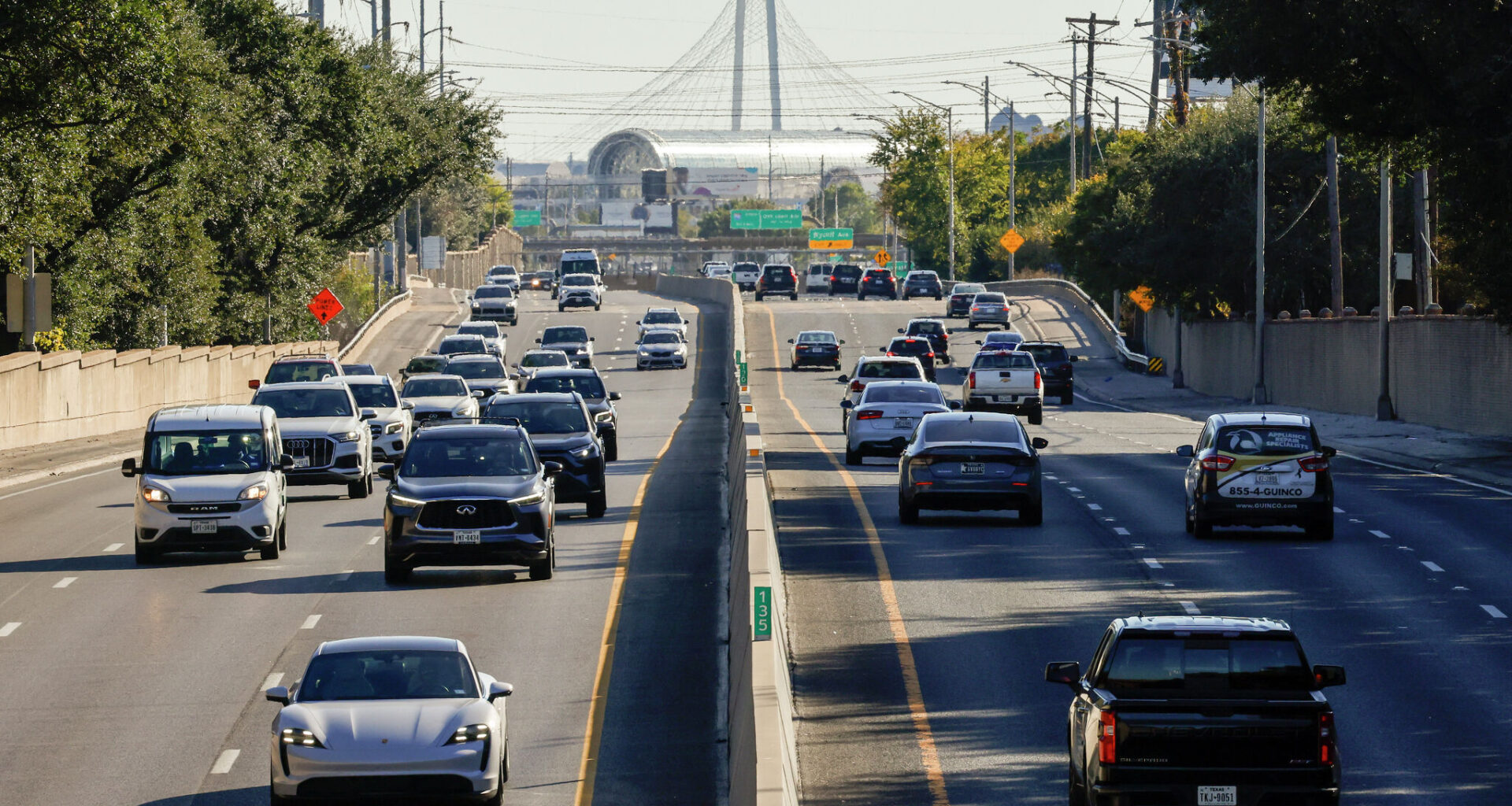
Traffic flows along the Dallas North Tollway near Lemmon Avenue, Wednesday, Nov. 20, 2024, in Dallas.
Elias Valverde II/Dallas Morning News
When it comes to North Texas toll roads and the billing system, some residents experience frustrating scenarios. From late fees to dynamic pricing, toll roads continue to be a hotspot for misinformation and confusion.

When motorists receive a toll bill, they often see pages of abbreviated words and numbers, time stamps, toll ownership breakdown and transactions – overwhelming.
How can North Texans better understand their toll bill? Here’s what we found out.
Article continues below this ad
Who operates the toll roads in North Texas?
When the time comes to send invoices to drivers, the North Texas Toll Authority is in charge of billing for all entities, even the region’s Texas Department of Transportation.
NTTA and TxDOT entered a tolling services agreement in 2014, which allows the NTTA to handle all billing- and customer service-related tasks. The contract is automatically renewed every five years as long as both parties agree to the extension.
NTTA owns eight of the 17 major toll roads in North Texas, broken down to five toll roads, two bridges and a tunnel.
Article continues below this ad
The other nine are owned by the Texas Department of Transportation. Managed, or TEXpress, lanes run parallel to the general lanes of specific highways and interstates. These roads include Interstates 30, 35E, North Tarrant Express 35W, Lyndon B. Johnson 635, 635E and North Tarrant Express 820, and State Highways 114,183 and Loop 12. Although TxDOT owns all of the managed lanes, operations for LBJ 635, NTE 820 and NTE 35W are conducted by a private company known as .
A comprehensive outline of which entity owns a specific toll road is provided on the side of each bill, along with road abbreviation explanations.
Related: Where does my toll money go? Five most common misconceptions about the NTTA
What does a toll bill look like if I drive on both NTTA and TEXpress roads?
The total amount due for the month sits in bolded letters at the top of the bill and represents the sum total for all toll roads driven, no matter if they are owned by the NTTA or TxDOT.
Article continues below this ad
A breakdown of each trip will be presented in two separate sections for each transportation authority. For example, if a motorist drove on the President George Bush Turnpike on a Wednesday at 9 a.m., the trip transaction would appear under the NTTA Toll Roads section for the current billing period and count as one trip. If the driver were to reenter the turnpike on the same day but at a different time, it would count as a separate trip. The same goes for TxDOT managed lanes.
How can I tell which road generated a toll charge?
NTTA sends out monthly toll bills, either online or via mail, to alert customers of their outstanding balances. Each time a motorist passes through a gantry – the structure with the cameras – the time and price is recorded and a charge is created. One pass equals one transaction. Drivers will notice some roads have multiple gantries. This separates sections of the toll; so a driver might have entered the toll road only once but passed through two gantries, so their bill will feature two transactions for that day.
Toll users can see their different transactions, as well as the road’s management group, on their monthly invoice. NTTA and TEXpress roads appear on the same bill but are split under different sections.
Related: Toll Trap: How Texas’ explosive growth led to a toll-building spree
Article continues below this ad
The NTTA is in charge of billing for all transportation entities in North Texas.
North Texas Toll Authority
The NTTA is in charge of billing for all transportation entities in North Texas.
North Texas Toll Authority
The NTTA is in charge of billing for all transportation entities in North Texas.
North Texas Toll Authority
Why do toll prices vary?
Toll road officials said motorists using ZipCash, the pay-by-mail system, will pay up to 100% more than those using a TollTag. NTTA toll road prices are fixed rates, reviewed every two years and adjusted based on a variety of factors such as traffic, revenue needs, debt coverage, inflation and capital plans.
Article continues below this ad
TEXpress uses dynamic pricing. These managed lanes use equipment that measures the speed of traffic, making sure it stays flowing at 50 mph. Refreshing every five minutes, the system will adjust the prices based on the speed of traffic and increase it incrementally. During lighter traffic, toll prices on each segment can range between 15 to 35 cents, and 45 to 90 cents during rush hour. No price cap exists for the managed lanes.
Who is in charge of late fees?
Since NTTA handles payments for both themselves and TEXpress, the toll authority also deals with the late fees. Late fees are flat rates, not a percentage of the overall bill. A $10 fee will be applied to the total bill after one month of nonpayment, followed by a $25 fee for the second notice. Fees are capped at $35 total per bill, but can continue to accrue if a motorists continues to use the toll roads and not pay their bill.
For example, if your bill was originally $10, and you earned $35 in late fees after not paying for two months, your total bill would be $45. But if you were to keep driving the toll roads, your bill would now come out to be the old bill plus late fees plus new bill.
Article continues below this ad
A third notice will be sent with no additional late fees, but after three months of nonpayment, NTTA can send the bill to a third-party collection agency. Unpaid toll bills and habitual toll violators can suffer consequences such as blocking vehicle registration, issuing a citation for a Class C misdemeanor or vehicle impoundment.