
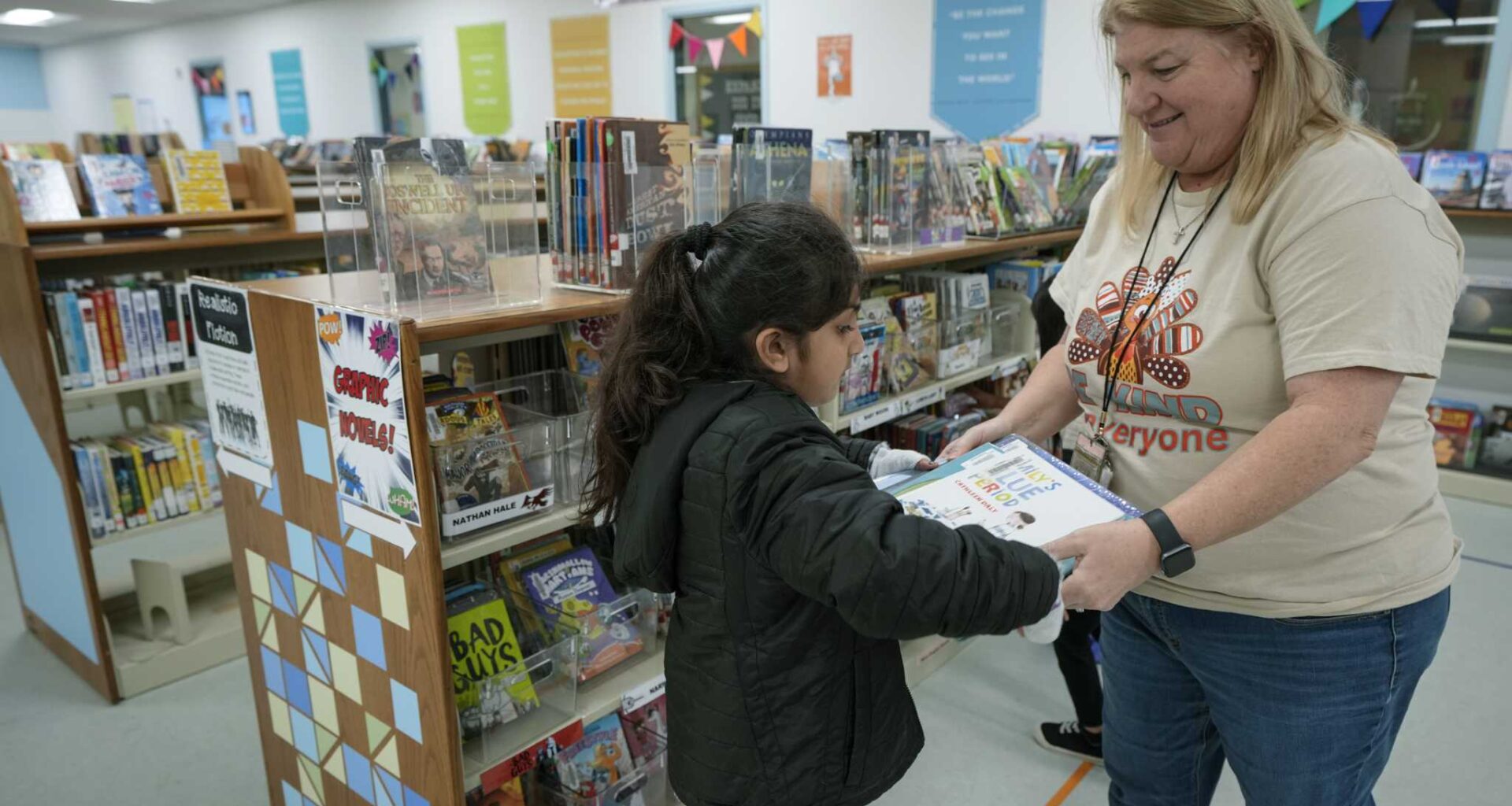
Second grade teacher Shannon Roberts helps Aniya Hasan with a stack of books in the library at Burnett Elementary School in Pasadena ISD on Wednesday, Nov. 20, 2024 in Houston. Pasadena ISD is modernizing their reading standards to include more of the science of reading in earlier grades. The schools are also partnering with CYCLE, a nonprofit that gives students free bikes if they reach their academic goals.
Brett Coomer/Staff photographer
Some Houston ISD students will skip entering kindergarten or first grade next year and will transition to a new “kinder bridge” program instead.
HISD’s new Kinder Bridge program will blend concepts from kindergarten and first grade to help students who are behind in reading reach grade level. By 2028, the district plans to require students to meet a reading benchmark before advancing to third grade, which it is calling a literacy promotion standard.
The state-appointed board of managers would have to approve the change in promotion requirements. In the 2024-25 school year, just under half of HISD’s third graders met grade level in reading, although it is unclear what benchmark the district would choose. HISD must improve student performance and its A-F accountability ratings to exit its state takeover.
Article continues below this ad
“We just know that some students need more time. So, what Kinder Bridge is is really an extra grade level in between kinder and first grade,” Deputy Superintendent Kristen Hole said on the district’s YouTube channel in May. “It’s kind of like a bridge that gives students one more year of learning, so that they have that extra time to prepare and to become really great readers.”
HISD said holding students back will help more of them learn to read by third grade, although retention efforts nationwide have produced mixed results.
GRADUATION: HISD seniors overcome adversity, change to graduate with over $341 million in scholarships, aid
How it works
Starting next year, students at all nine Future 2 campuses — the latest version of state-appointed Superintendent Mike Miles’ reform model — and some other campuses may opt in to offer the kinder bridge program.
Article continues below this ad
At those schools, students who are behind in reading will take another year of schooling between kindergarten and first grade. Students who score poorly on early literacy tests may be required to take the program. Other parents can opt their children in if their child attends a participating campus and has a May-August birthday; missed kindergarten; or was recommended for the program by a parent or teacher.
The bridge year will be more than a repeat of kindergarten for students, Hole said.
“We’re really looking at making sure that the student gets the most important instruction based on their literacy needs at the time that makes sense for them,” Hole told the board of managers at a May meeting.
Students who are behind after first grade will be invited to an intensive summer reading workshop, where literacy coaches will guide them over 22 days on phonics, spelling and early writing in small groups. Students who are below grade level in first grade will also receive additional instruction and resources during and after school.
FUTURE 2: 3 years into the takeover, HISD is embracing AI, evolving its signature NES reform model
Article continues below this ad
Improving reading gains
Educators and experts often mark third grade as a critical point for students learning to read. Starting that year, most instruction shifts from learning to read to reading comprehension.
Students who do not learn to read by third grade can fall behind across subjects and are much more likely to drop out of high school, said Delilah Gonzales, the director of field experience at Texas Southern University’s College of Education.
“When a child does not learn how to read slowly and effectively, by the time he hits third grade, he struggles. He struggles in math, he struggles in science, he struggles in social studies,” Gonzales said. “Everybody suffers when that child is not successful in pre-K through third.””
About 18 states have adopted some form of third-grade retention policies, according to education advocacy group ExcelinEd. The practices have been tied to reading gains in some states, including the “Mississippi Miracle,” and students who are held back often earn higher test scores.
Article continues below this ad
“I think it’s commendable that they’re doing this,” Gonzales said of HISD’s new program. “It’s not remediation, but it’s an opportunity for that child to get what he needs.”
Mixed evidence
Most states with retention policies hold back students in third grade, after they take their first state standardized test. HISD’s policy would retain students after second grade, the year before they take their first state reading exam.
Education advocacy group Community Voices for Public Education criticized the proposed promotion standard, saying it would hold back children based on test scores rather than their individual needs.
Article continues below this ad
Third grade retention is correlated with higher test scores, but those early gains often diminish in later years, according to a new study that analyzed Texas’s former reading test-based retention policy. In the study, students who were retained were also more likely to drop out of high school and earn lower wages after graduation.
The study, which analyzed students across Texas from third grade to age 26, found that third-grade retention increased absenteeism, violent behavior and juvenile crime while reducing the likelihood of high school graduation.
“Instead of aiding these struggling students academically, third-grade retention exacerbates behavioral problems, reduces educational attainment, and further lowers their earnings upon entering the labor market,” wrote Jiee Zhong, the study’s author and assistant professor of economics at Miami University.
“The disproportionately high retention rates among disadvantaged groups, coupled with lower high school graduation and earnings outcomes, suggest that retaining low-achieving students in third grade further deepens educational and income inequalities.”