
BEAUMONT — If any place in Texas should have the cheapest gasoline, it would seem to be Southeast Texas.
The Golden Triangle is home to one of the largest concentrations of refining capacity anywhere in the world.
Motiva’s Port Arthur Manufacturing Complex is North America’s largest refinery, capable of processing about 730,000 barrels of crude oil per day.
ExxonMobil’s Beaumont refinery can process more than 630,000 barrels per day, making it one of the largest refineries in the United States and ExxonMobil’s largest refinery.
TotalEnergies’ Port Arthur refinery adds another roughly 225,000 barrels per day of refining capacity. Together, the three facilities can process well over 1.5 million barrels of crude oil daily.
Those refineries produce gasoline, diesel, jet fuel and petrochemical feedstocks that are shipped across the United States and around the world.
Pain at the pump
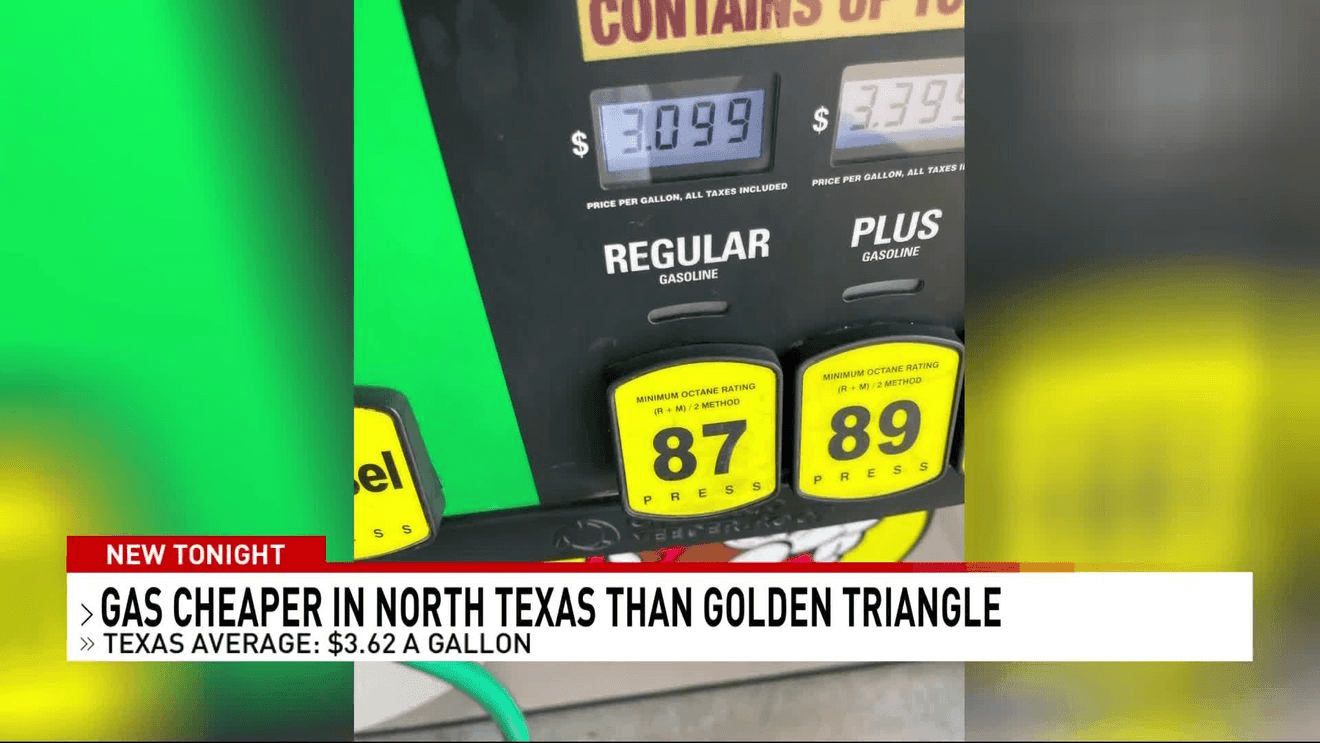
KFDM anchor Aaron Drawhorn filled up for $3.09 a gallon in Ennis, 35 miles south of Dallas, on Monday afternoon and noticed gas is currently cheaper in the Dallas-Fort Worth Metroplex.
AAA data shows drivers in Beaumont-Port Arthur are paying more for gasoline than drivers in the Dallas-Fort Worth Metroplex.
The difference: nearly a quarter per gallon.
Tuesday’s AAA survey showed regular gasoline averaging $3.71 per gallon in Beaumont-Port Arthur, compared to $3.48 in Dallas.
Fort Worth, Sherman and San Antonio are also averaging a quarter a gallon cheaper than the Golden Triangle.
So what’s going on?
“Houston or Southeast Texas, you might be closer to energy production, but pump prices are also shaped by many different things. It could be local demand, distribution contracts, station-level competition, operating costs,” said Daniel Armbruster with AAA Texas.
“There are so many factors that go into it. Of course crude oil is the biggest factor when you look at a gallon of gas,” Armbruster said.
Overall, when you’re looking at the market average right now, North Texas is faring a little bit better, but I would say for the most part, and it does fluctuate, Dallas Fort Worth tends to be a little bit more expensive than Southeast Texas I think if you average it out over five years.
The fuel made here doesn’t stay here
One of the biggest misconceptions about gasoline prices is that fuel should be cheapest where it is produced.
That’s not how the market works.
Once gasoline leaves a refinery, it enters a regional and global marketplace. Fuel is sold to distributors, transported through pipelines and terminals, and ultimately purchased by retailers who set prices based on wholesale costs, local competition and operating expenses.
In other words, a gallon of gasoline refined in Port Arthur may eventually be sold in Dallas, Atlanta or even overseas before a local station ever buys its next fuel shipment.
Dallas has more competition
Economists and energy analysts frequently point to retail competition as a major factor in pump prices.
The Dallas-Fort Worth metro area has thousands of fuel retailers competing for customers, including grocery chains, warehouse clubs, travel centers and independent stations.
That competition often squeezes profit margins and pushes prices lower.
The U.S. Energy Information Administration says differences in local competition can create significant price variations between cities, even within the same state.
Refinery towns aren’t protected from refinery issues
Ironically, living near a refinery does not shield consumers from refinery-related price increases.
When facilities undergo maintenance, experience operational disruptions or temporarily reduce output, wholesale fuel prices can increase throughout the region.
The Gulf Coast refining network operates as an interconnected system. A disruption at one major facility can affect fuel supplies and pricing across multiple markets.
Summer fuel costs more to make
Another factor is seasonal gasoline production.
Every spring, refiners transition from winter-blend gasoline to summer-blend gasoline, which is designed to reduce emissions during hotter weather.
The fuel is more expensive to produce and distribute.
At the same time, summer travel increases demand as families take vacations and hit the road.
Higher demand combined with higher production costs often leads to higher prices at the pump.
Global events affect local prices
Even though Southeast Texas is one of the energy capitals of North America, local gasoline prices remain tied to global oil markets.
Crude oil prices respond to worldwide supply and demand, geopolitical tensions, production decisions by major oil-producing nations and concerns about shipping routes.
Events occurring thousands of miles away can influence the cost of crude oil delivered to Gulf Coast refineries and ultimately affect prices paid by drivers in Beaumont, Port Arthur and Orange.
The bottom line
The irony is hard to miss.
Southeast Texans live beside some of the largest refineries on the continent.
Motiva’s Port Arthur refinery is the largest refinery in North America. ExxonMobil’s Beaumont refinery is the company’s largest refinery and among the biggest in the nation. TotalEnergies’ Port Arthur refinery remains a major producer of transportation fuels. Together, they help power the American economy.
But gasoline prices are determined by much more than geography.
Competition, wholesale fuel markets, refinery operations, seasonal fuel requirements and global crude oil prices all play a role.
That’s why drivers living in the shadow of some of the world’s largest refineries can still end up paying more than drivers hundreds of miles away in Dallas.