
Join us on a journey to better understand Houston, one question at a time. Sign up to get the Houston Explained newsletter in your inbox every Tuesday and Friday.
Houston has never wanted for musical excellence, and it was no different in the late 1960s when a Houston high school band director from the city’s Northside took a roomful of teenagers and turned them into the best stage band in America.
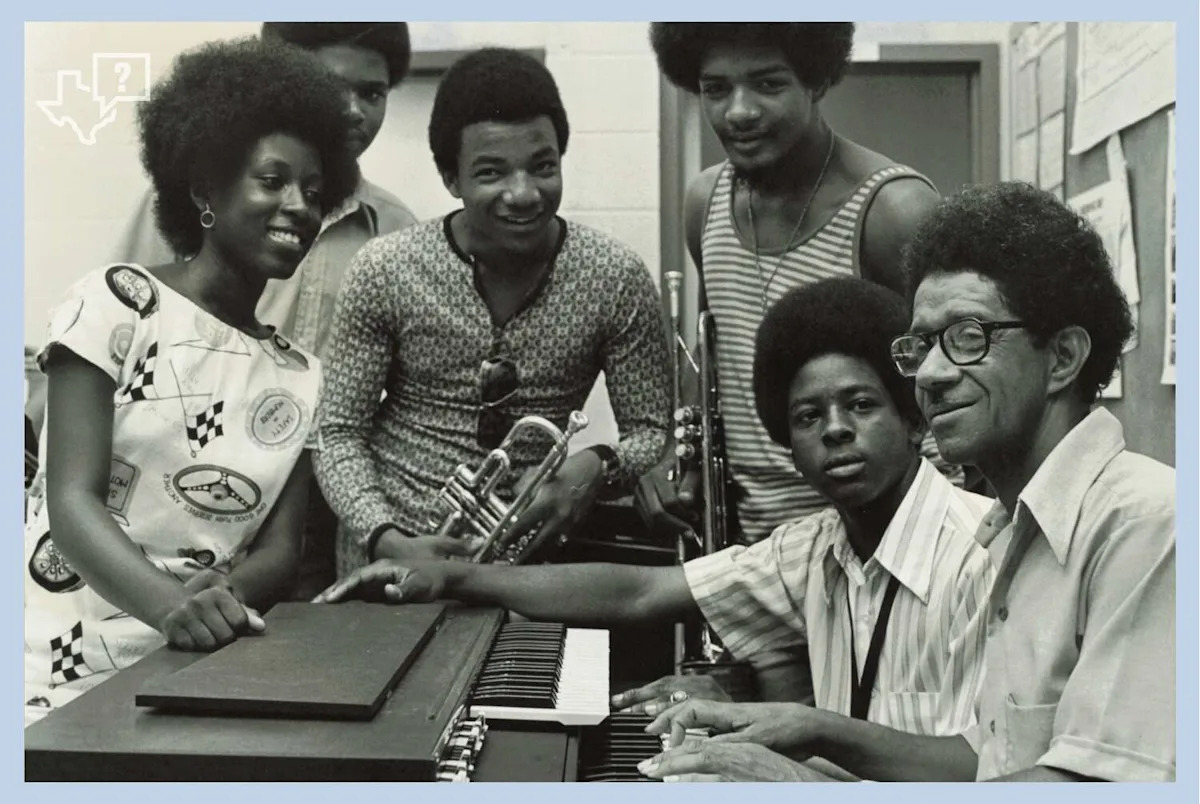
That director was Conrad O. Johnson, better known to his students as “Prof,” a musician who led the music program at Kashmere High School in Houston’s Kashmere Gardens neighborhood. With Johnson at the helm, the Kashmere Stage Band became a funk powerhouse, winning competition after competition (a panel of judges named them the best stage band in the country at the 1972 All-American Stage Band festival in Mobile, Alabama) and recording music that still raises the hair on the back of your neck, the horns screaming.
So how did a group of teenagers who could not even vote yet become one of the best musical acts to come out of Houston? It traces back to one decision Johnson made about the music his students would play, which set the Kashmere Stage Band apart from every other school band in the country.
How did a Houston high school band invent its own sound?
Johnson’s understanding of music ran deep.
Born in 1915 in Victoria, about 125 miles southwest of Houston, he had come up learning saxophone at Jack Yates High School before going on to play the city’s clubs and perform alongside young jazz players who would become Texas legends, among them, Illinois Jacquet and Arnett Cobb. And he was good enough that the Erskine Hawkins Orchestra tried to pull him onto the road.
But he chose to teach, and by the time he reached Kashmere, he had already built a career as a jazz instructor at other Houston schools.
At Kashmere, however, his jazz expertise blended with his students’ affinity for funk in a swirl of relentless rhythm that Johnson nurtured into a sound all the band’s own. He wrote original funk numbers for the band, encouraged his students to compose their own and built a repertoire that judges had simply never heard before.
Together, the Kashmere Stage Band went on to win 42 of its 46 competitions between 1969 and 1978 and record eight albums on Johnson’s own Kram label. The band even toured Europe in 1973 and Japan in 1975.
How the Kashmere Stage Band was rediscovered
When Johnson retired in 1978, the band retired with him, and for a while, the music it had made seemed destined to live only in the memories of the people who had played it.
The albums, although later popular with producers and crate-digging DJs, were pressed in small runs as fundraisers and handed out as souvenirs at competitions, which left only a scattering of copies in the world.
So, the full revival came in stages.
In 2006, the label Now-Again released Texas Thunder Soul 1968-1974, a compilation that put the band’s best recordings in one place. Two years later, a concert held by 30 original members, by then in their 50s, to honor Johnson, who was then 92, became the heart of “Thunder Soul,” a documentary narrated by Jamie Foxx that premiered at SXSW in 2010.
Johnson did not live to see it. He died in February 2008, within days of hearing his students play one last time.
But the legacy lives on in the most modern way possible. In 2017, one of their songs, “Kashmere,” was featured in the soundtrack for the action movie “Baby Driver.” And that same year, the original Kram albums, once rare pressings, arrived on streaming platforms, where a new generation can hear, with the tap of a screen, how a roomful of teenagers played their way into Houston’s musical canon.

What is your Houston question?
Subscribe
There’s more to Houston with the Chronicle. Subscribe today for just 25¢.
This article originally published at These Houston teenagers became the best stage band in America. Most people have never heard of them.