
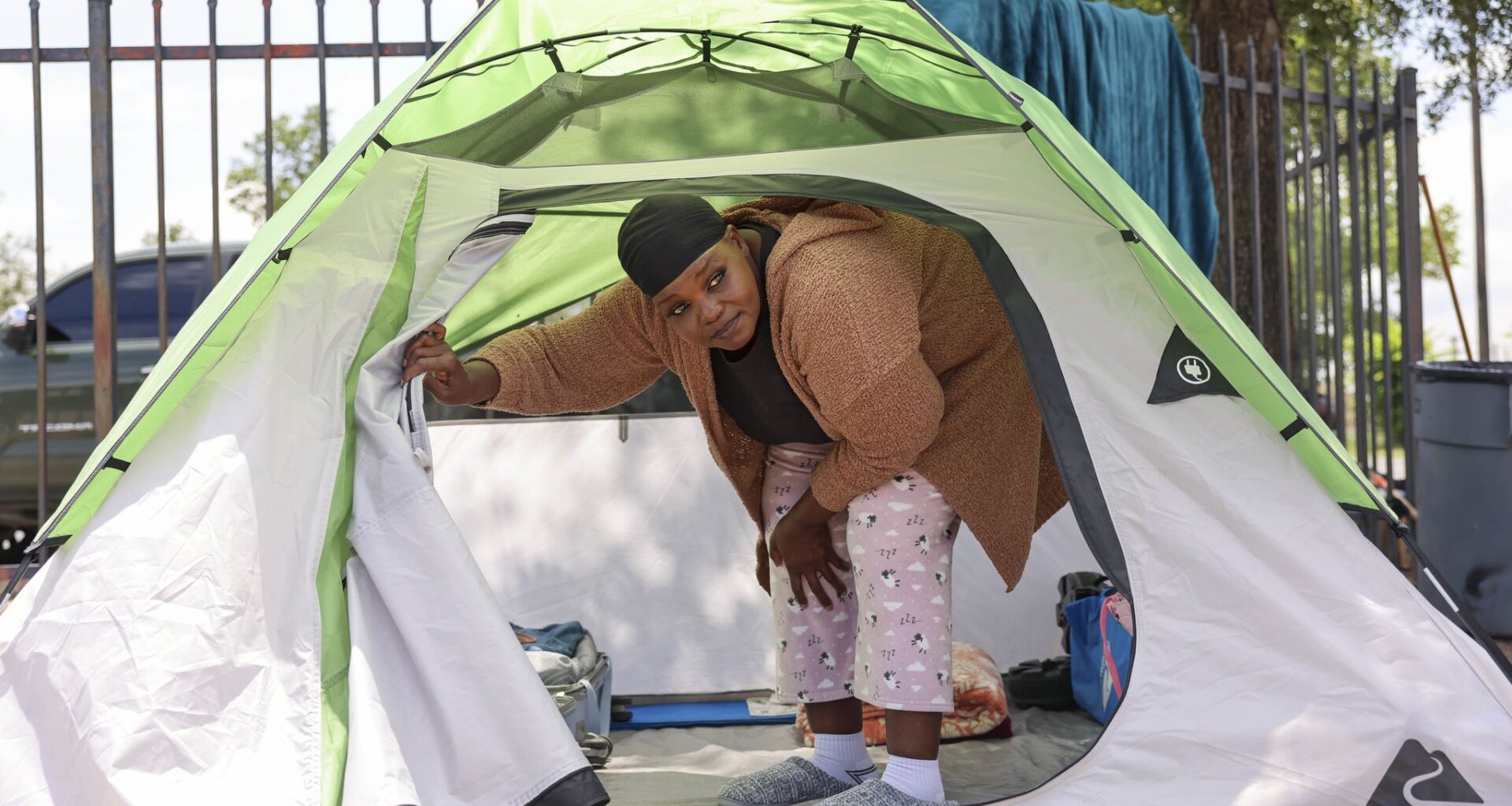
Less than a mile from where thousands of soccer fans will gather this summer for Dallas’ FIFA World Cup Fan Festival, Zonia Draught lives in a tent and hauls her belongings through the city in a blue wagon.

The 53-year-old says when she leaves South Dallas, she doesn’t feel welcome in the parks, sidewalks and public spaces in the city she’s called home for more than a decade.
“It’s like they target us,” Draught said. “Like we’re inferior. Like we’re not a part of the rest of the city.”
Public records reviewed by The Dallas Morning News show citations for sleeping in public more than doubled citywide last year. As Dallas prepares to host World Cup events, city leaders are touting dramatic reductions in downtown street homelessness and crime.
Article continues below this ad
But interviews with homeless residents, service providers and civil liberties advocates reveal a growing debate over how those gains are being achieved as the world turns its attention to North Texas.
Similar questions surfaced before Dallas hosted World Cup matches in 1994, when homeless residents sued the city over encampment clearances and enforcement of public sleeping bans.
More than three decades later, Dallas again finds itself balancing public safety, visible homelessness and its international image.
Housing Forward, the nonprofit that coordinates homelessness services across Dallas and Collin counties, says the city is demonstrating how enforcement and housing solutions can work together.
Article continues below this ad
“We are showing the nation what it looks like to actually manage your public spaces while also providing resolution to this issue,” Housing Forward President and CEO Sarah Kahn said.
But officials with Metrocare, a local mental health services nonprofit, and civil liberties advocates say increased enforcement can undermine trust and make it harder for people to find housing and work.
“The police and the county and the city have not included us, supportive service providers,” said Ikenna Mogbo, Metro Care’s chief housing officer. “They’re going back to the whack-a-mole.”
Enforcement and housing
Dallas police officers and city marshals issued 157 citations for sleeping in public in 2023. That rose to 218 in 2024 before more than doubling to 476 in 2025.
Article continues below this ad
Dallas police spokeswoman Allison Hudson said the increase coincided with several targeted enforcement operations and the launch of the department’s Homeless Outreach Team in 2025.
Downtown remained the largest concentration of enforcement activity. ZIP codes 75201 and 75202 accounted for more than 220 citations during the period reviewed by The News.
But enforcement extended well beyond downtown. Records show dozens of citations around Bachman Lake, White Rock Lake and Tenison Park. Through April, 18 sleeping in public citations had been issued in 2026. But because the figure reflects only the first four months of the year, it is not directly comparable to the full year totals from previous years.
Under Dallas city code, sleeping in public places such as streets, alleys and parks is prohibited and can be prosecuted as a Class C misdemeanor, carrying fines of up to $500 per offense.
Article continues below this ad
Before issuing a citation or making an arrest, officers are required to ask why the shelter was placed there, determine whether any legal defenses apply and provide an oral or written warning giving the person one hour to remove the shelter and their belongings.
Hudson said homelessness-related enforcement is not handled by a single unit and that officers routinely work alongside outreach workers, Housing Forward, mental health professionals and other service providers.
“DPD recognizes that homelessness is a complex issue that cannot be solved through enforcement alone,” Hudson said. “Our goal is to achieve sustainable outcomes whenever possible while maintaining safe public spaces for everyone.”
The increase in citations occurred during a period when city leaders were simultaneously expanding efforts to move people experiencing homelessness into housing.
Article continues below this ad
Last year, city leaders, law enforcement agencies, Downtown Dallas Inc. and homelessness service providers launched the Safe in the City initiative, a public-private effort aimed at improving public safety, reducing visible homelessness and revitalizing downtown.
The coalition announced on May 20 that violent crime downtown fell 12% in 2025 and another 16% year-to-date in 2026. Officials also reported an 89% reduction in downtown street homelessness and said every downtown encampment had been cleared.
Related: Dallas to open downtown police command center ahead of World Cup
Kahn said the effort was designed to go beyond simply moving homeless residents from one block to another.
The strategy combines homeless outreach, shelter placements, behavioral health services, permanent housing programs and an increased police presence downtown.
According to Housing Forward, more than 1,000 people have permanently exited homelessness through programs connected to the initiative.
Kahn rejects the idea that Dallas is simply pushing homeless residents into other neighborhoods.
Article continues below this ad
Sarah Kahn, president and CEO of Housing Forward, speaks as Housing Forward, on behalf of the All Neighbors Coalition, hosts the annual State of Homelessness Address at the Winspear Opera House in Dallas, Thursday, May 14, 2026.
Juan Figueroa/The Dallas Morning News
“The biggest misunderstanding now is that we’re just moving people out of downtown,” she said. “That is precisely what we are not doing.”
She said the city’s approach differs from efforts seen in other host cities that relied on temporary shelters or short-term measures ahead of major sporting events.
“As soon as we were named as a host city,” Kahn said, “our goal was to not let that happen in our community.”
Echoes of 1994
The debate surrounding homelessness and the World Cup is not new in Dallas.
In the spring of 1994, city officials moved aggressively to clear homeless encampments, particularly in and around downtown.
One of the most visible efforts came beneath Interstate 45 near downtown, where hundreds of people were living less than a month before World Cup matches began.
Police arrested people for sleeping in public and bulldozers rolled through the encampment in May 1994, according to The News’ archives.
The city argued the camp posed health and safety concerns. Advocates countered that Dallas was trying to present a cleaner image as international attention turned toward the city.
The dispute eventually landed in federal court.
Homeless residents sued the city, arguing officials were attempting to remove them from public view through encampment clearances and enforcement of Dallas’ public-sleeping ordinance.
A federal judge temporarily blocked enforcement of the ordinance, finding that insufficient shelter space effectively left homeless residents with nowhere else to go. The ruling was later overturned on appeal.
Related: Homelessness in Dallas, Collin counties down for fifth consecutive year
By 1995, Dallas was once again enforcing its ban on sleeping in public.
“We want the city to take a new direction and quit thinking of homelessness as being a crime,” longtime advocate John Fullinwider told The News in 1995.
Today, some advocates see familiar patterns emerging.
Trust gap
Mogbo, with Metrocare, credits Dallas with making major investments in homelessness programs in recent years, including supportive housing efforts and voter-approved bond funding.
He said earlier efforts to reduce downtown homelessness worked because law enforcement, housing providers and behavioral health organizations coordinated their work around helping people permanently exit homelessness.
He worries that pressure surrounding the World Cup is changing that balance.
Mogbo said citations and arrests can damage relationships that outreach workers spend months or years building.
At the same time, Mogbo stressed that Dallas has made real progress in recent years.
“The worst thing that’s happened to the momentum is having a big event like FIFA come in,” he said.
Civil rights advocates say that increased enforcement creates additional barriers for people already struggling to escape homelessness.
Nick Hudson, senior manager of policy and advocacy for the American Civil Liberties Union of Texas, said sleeping-in-public citations often lead to fines, warrants and other consequences that can make it harder for people to secure housing and employment.
He said cities across Texas have increasingly relied on enforcement after a 2024 U.S. Supreme Court ruling that gave local governments greater authority to punish people for sleeping in public.
But Hudson said homelessness remains fundamentally a housing problem.
“The only way to solve homelessness is with housing and resources, not with handcuffs,” Hudson said.
Competing visions
Kahn said that focusing solely on citations misses the larger picture.
“We don’t need to choose between having vibrant public spaces and a compassionate and results-oriented solution to homelessness,” she said. “We can do both and we are doing both.”
Housing Forward spokesman Joshua Kumler said homelessness is not a static population.
More than 10,000 households entered homelessness across the region last year, he said, meaning new people continue falling into crisis even as others move into housing.
For advocates, service providers and city leaders alike, the ultimate goal is the same: fewer people living outside.
The disagreement is over how to get there.
The world is coming
On a recent morning, volunteers with The Human Impact, a nonprofit that serves the homeless, gathered near downtown before heading into the streets to check on people living outside.
One man known as Snowman said he would soon move into what he called his “forever home” in Duncanville after spending years cycling between shelters and the streets.
Another said he expected to move into permanent housing after waiting more than a year.
Their stories reflect the progress homelessness organizations point to when defending Dallas’ approach.
But for people still living outside, the stakes feel far more immediate.
Draught, who stays in a tent near Fair Park, was recently released from the Collin County jail after serving time on a criminal trespass conviction. She acknowledged her past mistakes, but said they should not prevent her from rebuilding her life.
She tries to keep her tent and suitcase tidy. A small bucket serves as her shower, helping her wash her face each day and apply makeup. During detox therapy, she learned the importance of doing something every day that brings her a sense of normalcy and self-worth. For her, that means putting on makeup.
Like many people who spend their days and nights on the streets near Fair Park, Draught said she increasingly avoids places where she feels unwelcome, including some of the same public spaces visitors will soon encounter during the World Cup.
For city leaders and homelessness organizations, the coming tournament is an opportunity to showcase years of work reducing street homelessness and improving public safety.
For Draught, it feels different.
As Dallas prepares to open its arms to the world, she said many homeless residents feel like they are being asked to disappear.
“They make you feel like you don’t belong,” Draught said.