
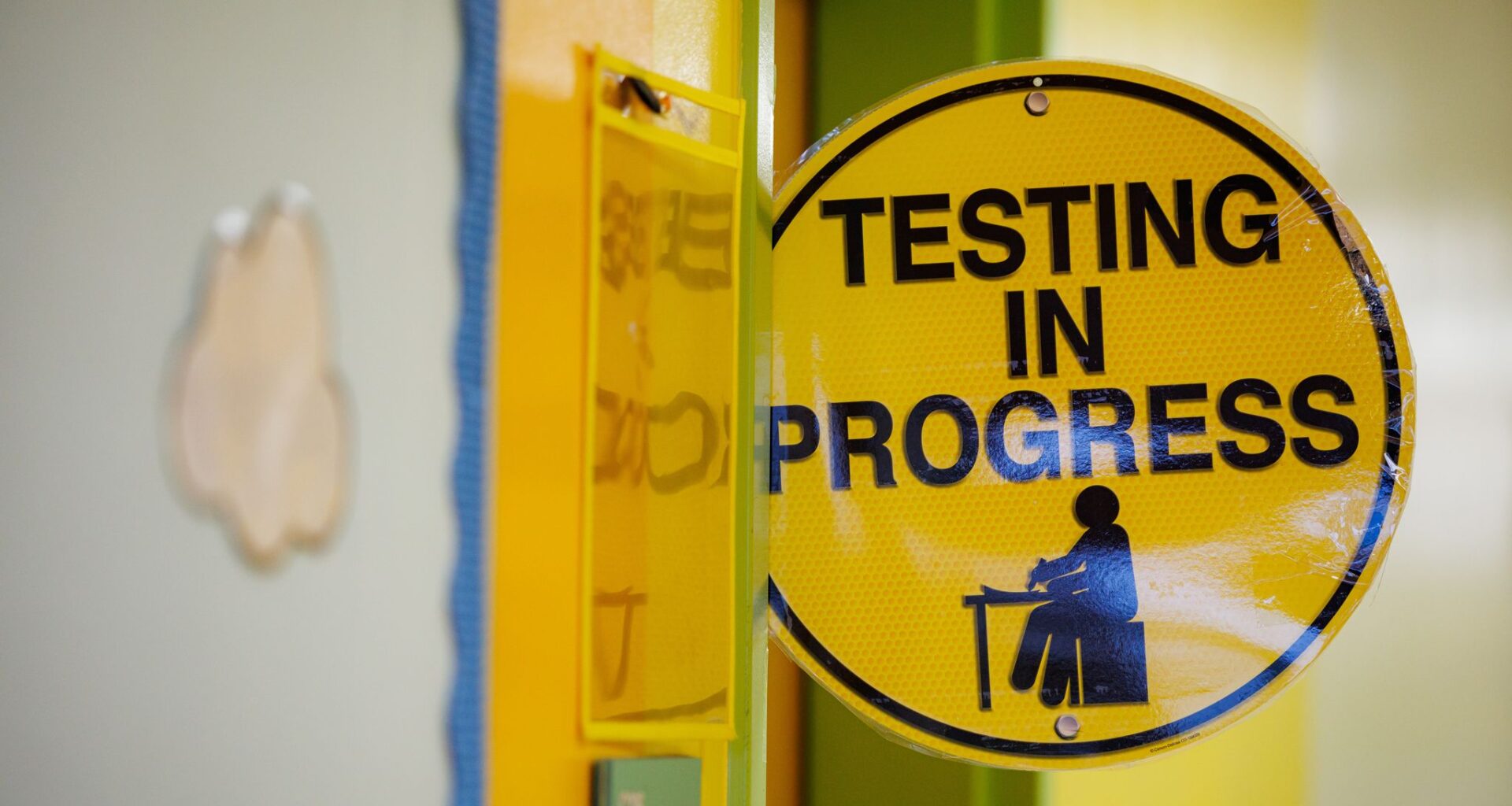
A sign indicating students are taking STAAR exams is displayed in a hallway at Arnold Elementary School in San Antonio on Thursday, April 2, 2026.
Sam Owens/San Antonio Express-News
San Antonio high school students showed sweeping improvement in reading and math on their 2026 state tests, reversing the decline in performance reported in 2025.

The Texas Education Agency released results from the 2026 State of Texas Assessments of Academic Readiness, or STAAR, end-of-course exams Wednesday. The exams measure student learning in five core high school subjects: Algebra I, Biology, English I, English II and U.S. History. Texas high school students need to pass all five tests to graduate, although there are some exceptions.
Article continues below this ad
Students across the San Antonio area improved in every subject area except U.S. History — which only dropped by one percentage point. The results match statewide trends of improvement.
Across Texas, student performance in Biology, English I and English II has now surpassed pre-pandemic levels, according to TEA. Like in San Antonio districts, the percentage of Texas students passing U.S. History exams dropped by 1 percentage point. Across the area TEA defines as Region 20, which includes Bexar County school districts and charters, passing rates dropped by 2 percentage points in the subject. Even with these slight drops, passing rates for U.S. History across the state, city and region all surpass 90%.
TEA annually rates schools with a letter grade, largely based on STAAR scores, although high school ratings also include measurements of college and career readiness. TEA is expected to release letter grades in mid-August, around the start of the next school year.
Article continues below this ad
“These results may also be reflective of the Legislature’s ban of cell phone use in classrooms, so that students are better able to stay focused on their schoolwork while at school,” Morath said in a statement.
North East Independent School District, which held off implementing a bell-to-bell cellphone ban until next fall following a yearlong stalemate with TEA, posted improvements with the rest of the state. The district’s students improved in all subject areas, including a 7-percentage-point jump in students passing Algebra I and a 5-point-increase in those passing English I from spring 2025 to 2026.
Article continues below this ad
In response to the STAAR scores, North East ISD Superintendent Anthony Jarrett praised his teachers and staff for driving the performance improvements across the district’s high schools.
“Particularly noteworthy are the double-digit and steady gains observed compared to the previous academic year,” Jarrett said in a statement Tuesday.
Results for the third- through eighth-grade STAAR exams will be made public on June 16.
Closing the gaps
Last year, most San Antonio school districts saw a drop in end-of-course exam passing rates in every subject except Biology. Results this year are vastly different.
Article continues below this ad
Data released Wednesday indicate students are gaining ground in reading and math, where students showed the most extreme improvements.
San Antonio-area districts recorded the largest gains in Algebra I. Passing rates for Algebra I rose by just over 7 percentage points from 2025 to about 80% in 2026. English I rates climbed by about 5 percentage points to roughly 69%.
Student performance in Biology and English II saw smaller gains. Biology passing rates rose by nearly 2 percentage points to 93% in 2026. The share of students passing English II exams rose about 1 percentage point, bumping pass rates up to about 71%.
Every district across the area marked improvements in Algebra I scores, except Schertz-Cibolo-Universal City and Somerset ISDs, which each saw passage rates drop by one percentage point.
Article continues below this ad
South San Antonio ISD students posted the biggest increase in Algebra I — a bump of 18 percentage points in students passing the test. This result exceeds its 7-percentage-point performance drop in students passing between 2024 and 2025. District high schoolers also improved passing rates by 11 percentage points in English I and 10 percentage points in English II.
East Central and Southside ISDs posted some of the most stark improvements in Algebra I from 2025 to 2026. Students in both districts posted a 12-percentage-point increase in passing rates.
Southside ISD improved the percentage of students passing end-of-course exams by 11 percentage points in English I and 6 percentage points in English II.
Continued writing challenges
One area where students did not mark improvement was on standardized essay test questions. The number of San Antonio students who scored a zero on the essay portions of the English I and II tests increased from 2025.
Article continues below this ad
Across the area, 45% of students scored a zero on expository composition and 38% received a zero on persuasive composition. The number of zeros exceeds both statewide averages and 2025 local student performance.
A classic essay, the STAAR expository writing portion requires students to clearly explain a topic with a thesis, several body paragraphs and a conclusion. For persuasive composition, students must defend a position through detailed evidence and by acknowledging a counter-argument.
Last year, 33% of San Antonio students scored a zero on expository composition and 36% scored a zero on persuasive composition — both one percentage point higher than state averages. Coming out of the COVID-19 pandemic, only 5% of students across the region scored a zero on the expository composition section in 2022.
Article continues below this ad
While TEA previously attributed the increase in zeros to a more difficult essay portion, some educators have expressed concerns that the agency uses artificial intelligence to grade the open-ended responses.