
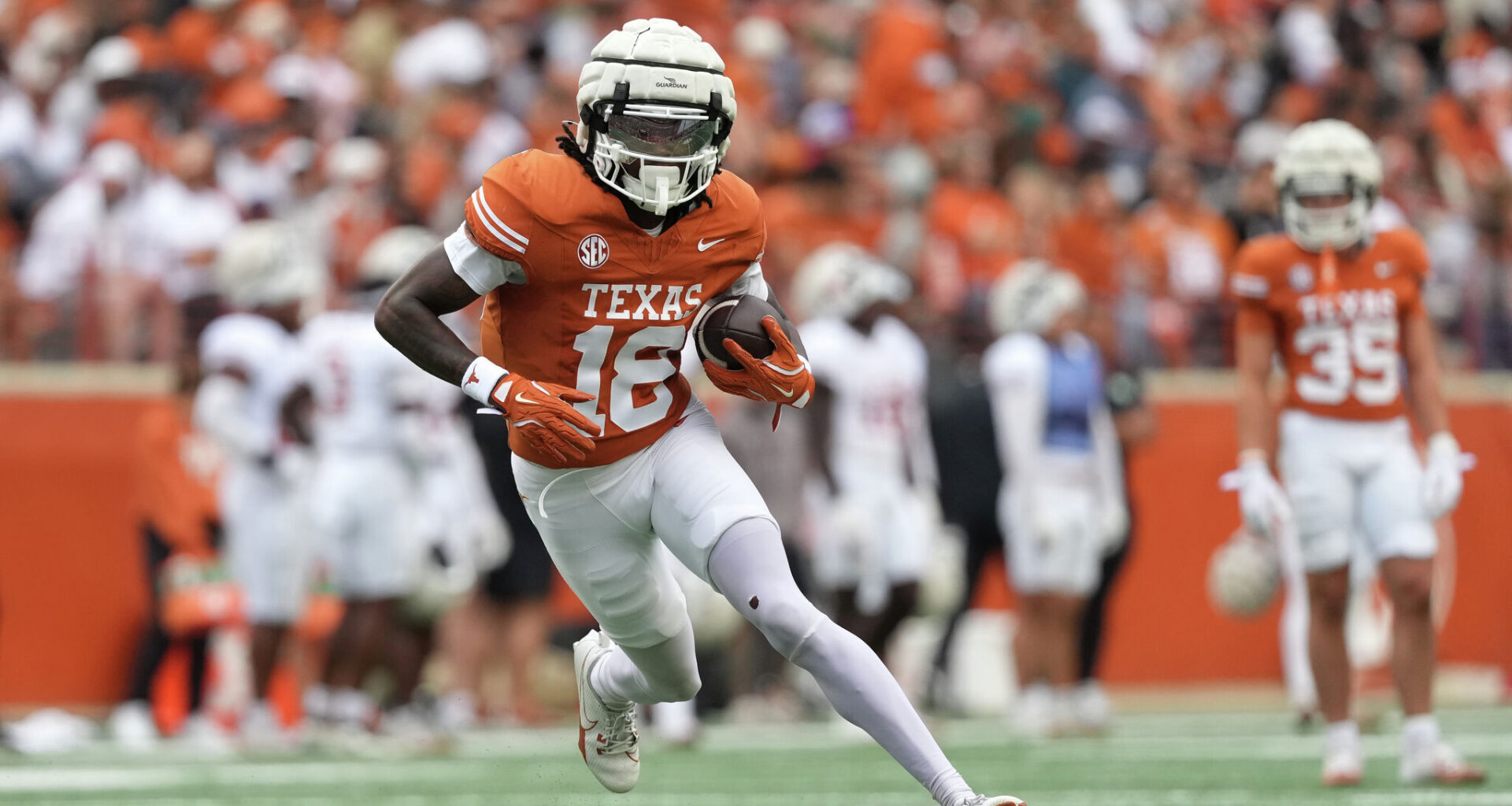
Sterling Berkhalter #18 of the Texas Longhorns runs for yardage after catching a pass during the Texas Spring Football Game at Darrell K Royal-Texas Memorial Stadium on April 18, 2026 in Austin, Texas.
Scott Wachter/Getty Images for ONIT
Sports fandom has long been a focal point of U.S. Sen. Ted Cruz’s political identity, whether he’s posting photos of himself at Houston Rockets games or holding a hearing about the difficulty of following teams in the streaming era.
Now, in his ongoing bid to overhaul how college athletes get paid, he is taking on two of Texas’ most beloved football institutions — the University of Texas and Texas A&M.
READ MORE: Texas quarterback Arch Manning made over $3.5 million in NIL deals in 2025
Article continues below this ad
The Southeastern Conference, to which both schools belong, has come out against a bipartisan bill introduced by Cruz, R-Texas, and U.S. Sen. Maria Cantwell, D-Wash., that seeks to reform an NIL system that allows top-tier schools to funnel hundreds of millions of dollars to players. After a meeting with Cruz last week, SEC Commissioner Greg Sankey and Big Ten Commissioner Tony Petitti put out a statement saying while they “share the same goal of stabilizing collegiate athletics,” they “do not support this bill in its current form.”
At its core, Cruz’s legislation seeks to overhaul a system that has aroused fierce debate among college football and basketball fans. On one side are those who say college athletes are finally getting their due from programs that generate billions of dollars a year from television deals and ticket sales. On the other are those who say the system is letting the wealthiest programs and conferences outspend their rivals, creating an unfair imbalance within college sports.
In a statement, Cruz recounted memories of attending UT and A&M games, calling them “extraordinary institutions,” but said college sports were “in crisis.”
During an online sports show last month, Cruz described a doomsday scenario in which college sports is dominated by a small group of schools and others like Baylor University, whose men’s basketball team won a national championship in 2021, are left behind.
Article continues below this ad
“In any scenario, UT and A&M survive, and they thrive,” he said. “But it would be a terrible outcome if the other schools in Texas lose their programs. Can you imagine a Texas without a TCU, a Baylor, a SMU, or a Texas Tech, or a University of Houston, or a Rice?”
At a time he is believed to be mulling another presidential run, the legislation has thrust Cruz into a thorny national issue. His advocacy could put him at odds with A&M and UT, whose donor list is comprised of some of Texas’ wealthiest businessmen, including Jeff Hildebrand, the owner of Houston oil company HilCorp, and Arch “Beaver” Aplin, founder of the convenience store chain Buc-ee’s.
But President Donald Trump has endorsed the bill. And Cruz has a powerful ally in Cody Campbell, a prominent GOP donor and Texas Tech regent who has reportedly spent more than $60 million to recruit football players to his alma mater in Lubbock.
Campbell has pilloried the current system as designed to benefit schools in the two largest athletic conferences, the SEC and Big Ten, and has come out in favor of Cruz’s overhaul. Texas Tech is in the Big 12.
“The Texas Techs of the world, you and I consider them big time athletics, but they’re not at the top of the pyramid,” said Bill Carter, a consultant who advises college athletes. “I suspect (Cody) believes by putting more regulation in place they’ll lose out less.”
Article continues below this ad
Campbell did not respond to requests for comment. Neither did donors at UT and A&M or booster clubs like Texas One.
Under Cruz’s bill, athletes would be limited in their ability to transfer, a way to curb deep-walleted programs like UT from poaching. And new rules would be put in place to make it more difficult for donors to lavish prospective athletes with cash. Also, Cruz has inserted a voluntary provision that would allow schools to pool together to negotiate television deals, which is currently disallowed under antitrust laws. The SEC and Big Ten have been opposed, warning the change would result in less revenue across the board.
Cruz’s decision to take on a divisive issue has puzzled some political insiders, who speculated he risked alienating powerful Republican donors in Texas.
But Cruz has long been willing to insert himself into controversial topics, from Trump’s fight with Jimmy Kimmel to the impact of social media technology on children and teenagers. And for all the UT and A&M boosters he may alienate, there’s plenty of disenchanted football fans he may end up winning over.
A survey of Division One athletic directors and other university officials by the Knight Commission on Intercollegiate Athletics and Elon University last year found more than 60% believed college sports were headed in the wrong direction. And social media is littered with fans bemoaning how NIL has “ruined college football,” as one user put it earlier this year.
Article continues below this ad
However, many maintain that Cruz’s warning that college sports are soon to be dominated exclusively by schools from the SEC and Big Ten is unjustified, arguing that there’s no evidence the current set-up is making it harder for other sports programs to compete.
Five years after the NIL system came into existence, Texas Tech’s football team ended last season ranked seventh in the country in the Associated Press rankings, ahead of both UT and A&M. Almost half the top 25 fell outside the SEC and Big Ten, including the low-profile North Texas University. And Texas Tech’s softball program, whose pitcher signed the first $1 million NIL deal in the sport, made it to the Women’s College World Series, where the team lost to UT.
“There are issues with NIL, but it’s not going as poorly as is often described,” said Carter, the sports consultant. “Those who want federal legislation are bemoaning every aspect. They never liked NIL, and they’re constantly on the soapbox complaining about its flaws.”