
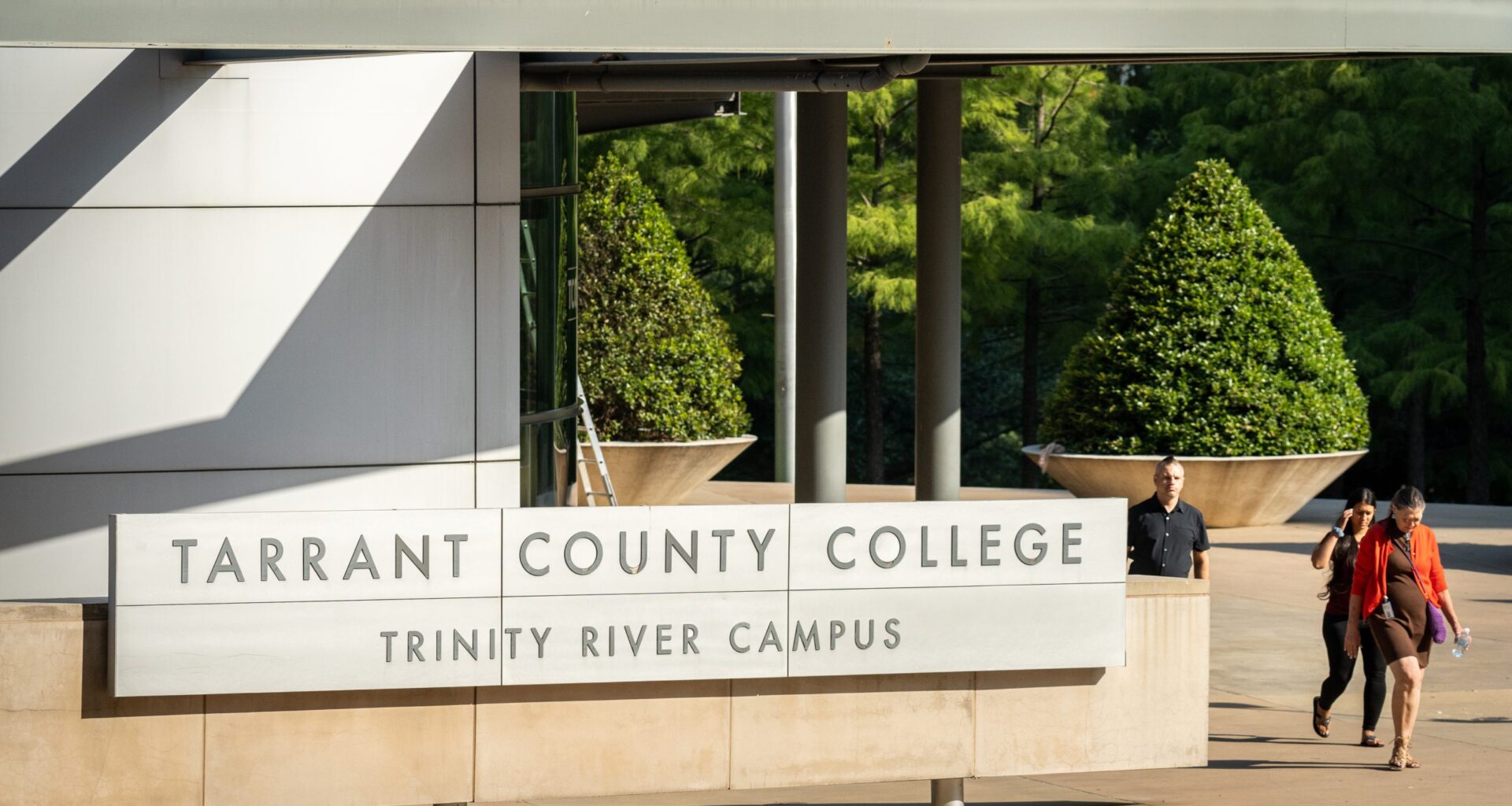
The numbers left Pamela Anglin, Tarrant County College chief financial officer, with few options for the upcoming budget year.
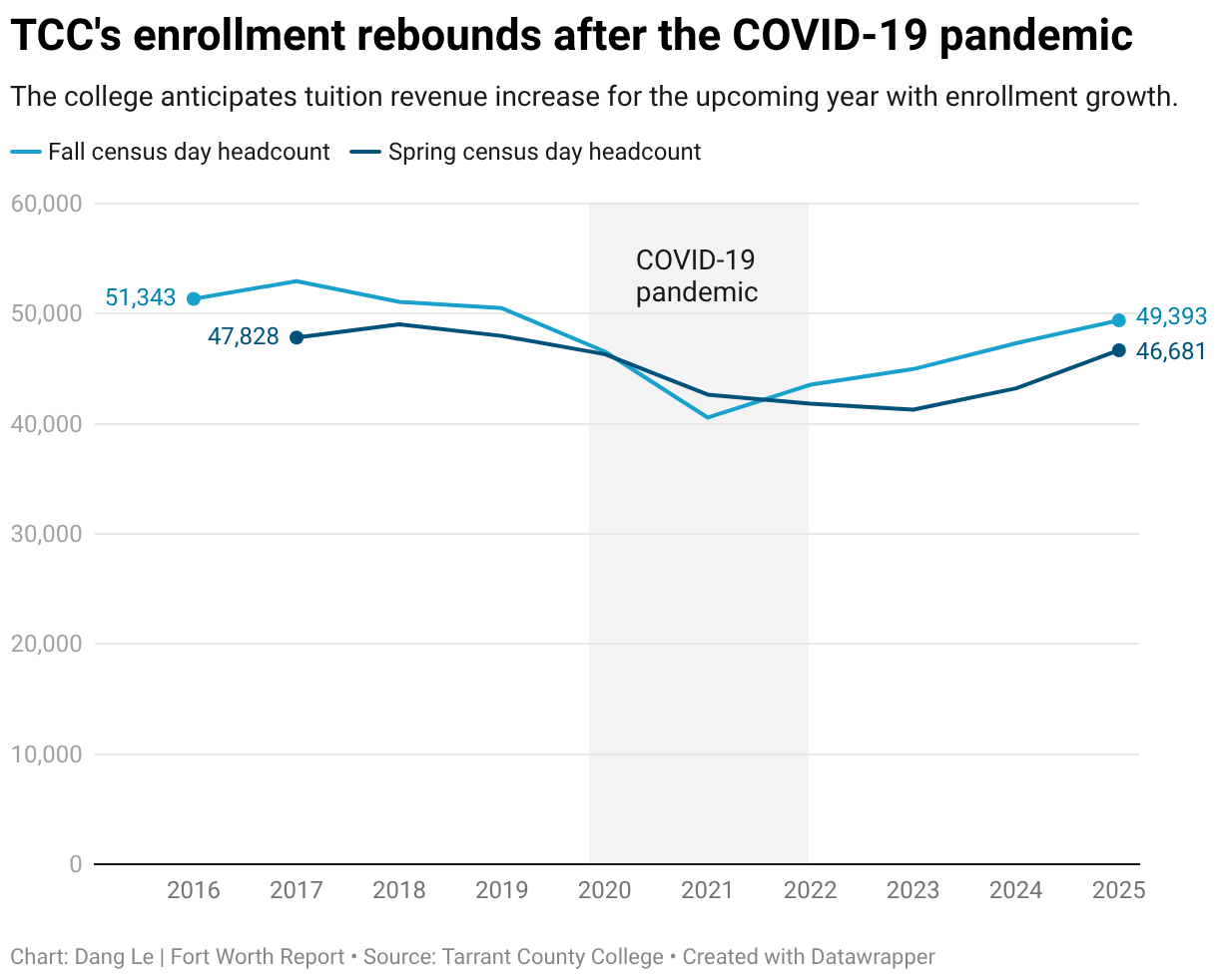
Property tax revenue is projected to decrease. State funding is expected to remain flat. Tuition revenue may increase only slightly with enrollment growth.
In February, Anglin proposed raising student fees. Trustees approved new academic fees that would have increased the cost of earning an associate of arts degree by $672 over two years, making it about 15% more expensive.
“We went from really a college that didn’t have to worry, to a college that has to be concerned,” Anglin said.
Now, a recent letter from Gov. Greg Abbott is prompting TCC to reverse course and refund almost all of the fee increases. The reversal shows the tension public colleges face in Tarrant County and across Texas: how to follow the governor’s tuition-and-fee freeze while still paying for rising costs, campus operations and student services.
Research suggests tuition freezes can make college more affordable, but the effect depends on whether the state replaces the revenue colleges lose, said Denisa Gándara, associate professor of educational leadership and policy at the University of Texas at Austin.
“If the state doesn’t replace the revenue lost through tuition freezes, institutions will likely face two options: raising revenue through less visible fees or cutting costs,” Gándara said in an email.
The case of affordability
In his May 27 letter, Abbott reminded Texas public college and university leaders that undergraduate tuition and fees should remain frozen for the 2026-27 academic year.
The governor, who is running for reelection in November, wrote that he wants to work with lawmakers next session to extend the freeze beyond 2027 to ensure Texans can access affordable higher education.
Jaime Puente, director of economic opportunity at the nonprofit Every Texan, said the freeze is aimed at college affordability but also limits how colleges respond to student needs, especially with the rising cost of living.
“The cost of childcare, the cost of transportation — all of these needs that students have to get them to campus,” Puente said.
Affordable college is important, Gándara said, but policymakers also need to consider how limiting tuition revenue affects an institution’s ability to support student success.
When colleges lose flexibility, students can lose the support that helps them stay enrolled, Puente said.
“Yes, we want to reduce costs for students, we want to maintain affordability for students,” he said. “But it’s a bigger question than just freezing tuition and fees.”
TCC reverses course
Of the fees approved in February, Anglin said TCC will keep only the $50 application fee for international students, which she described as a nonmandatory fee exempt from Abbott’s directive.
The proposed increases would have generated about $9.5 million for the college, she said.
Rolling back the fees also created a logistical challenge, Anglin said. TCC removed the general fee and refunded students who already paid for the fall semester. To reverse other fees tied to individual courses, the college will have to shut down its system for students in June while staff manually remove the charges course by course, she said.
The fee increase was meant to shift some student-specific costs back to students, Anglin said. About $4 million of the increase would have covered academic services TCC is already paying for, including nursing software with quizzes and learning materials for about 200 students.
“It’s something that other colleges have been doing for a long, long time,” she said.
TCC made more than $20 million in cuts last year so it could give employees raises, Anglin said. Most cuts came from transfers to the college’s capital improvement and technology replacement funds, which can delay facility repairs and leave technology aging longer.
The college cut employee travel budgets last year and is looking at doing so again, Anglin said.
TCC has deactivated several low-enrollment programs in recent months and is reviewing others that are costly to operate, Anglin said. The college is also looking to expand noncredit programs, which are not affected by the tuition freeze, to quickly train residents for available jobs in Tarrant County while using existing faculty and equipment.
“I’m going through right now and looking at every line item in the budget, looking at the detail that employees put in their budget requests, and looking for things that are ‘have to have’ and things that are ‘nice to have,’” she said.
 The Tarrant County College board of trustees holds a meeting on May 21, 2026, in Fort Worth. (Ash Petrie | Fort Worth Report)
How colleges live with the freeze
Abbott’s directive is not new.
Texas lawmakers froze undergraduate tuition and fees for the 2023-24 and 2024-25 school years. As that freeze was set to expire, Abbott issued the current directive in November 2024, telling colleges to keep tuition flat, citing the state’s increased investments in higher education.
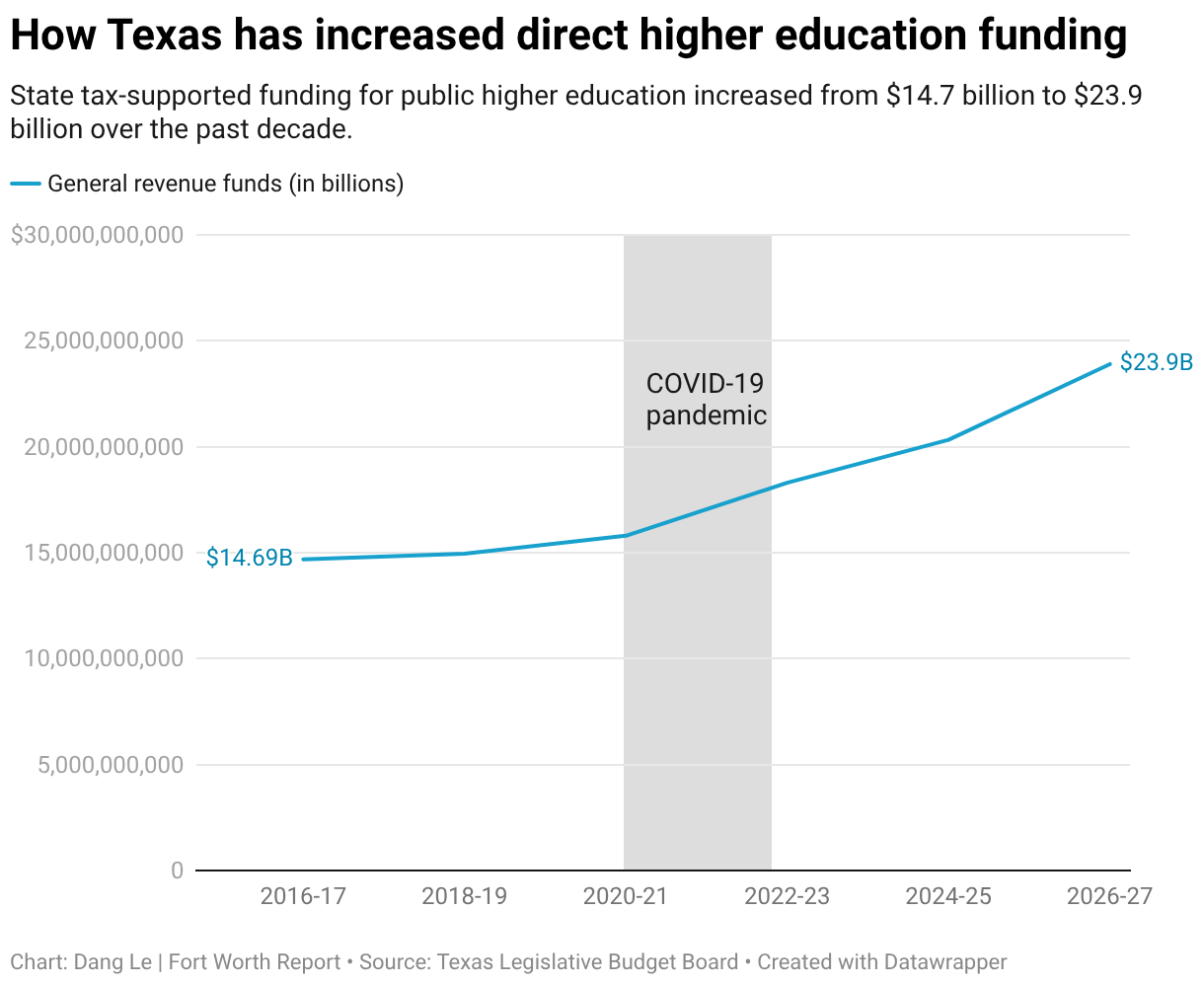
State lawmakers have increased general revenue funding for higher education over the past decade, giving state leaders a basis to argue that colleges should hold tuition and fees flat.
But that does not mean every institution is equally positioned to absorb a tuition and fee freeze, Gándara said.
“The institutions that are most affected by tuition and fee freezes are those that depend most on net tuition revenue and have limited ability to generate revenue from other sources,” she said.
Barrett Taylor, a UNT higher education professor, is an expert in higher education finance. Speaking as a private citizen, he said both arguments can be true: Texas can spend more on higher education overall, while some campuses or units still struggle to cover rising costs.
“The perspective from the institution or the campus is often quite different than the perspective from the state government, even if there are elements of truth to both perspectives,” Taylor said.
Property taxes provide the largest share of revenue at TCC, while tuition floats more of the budget at some universities.
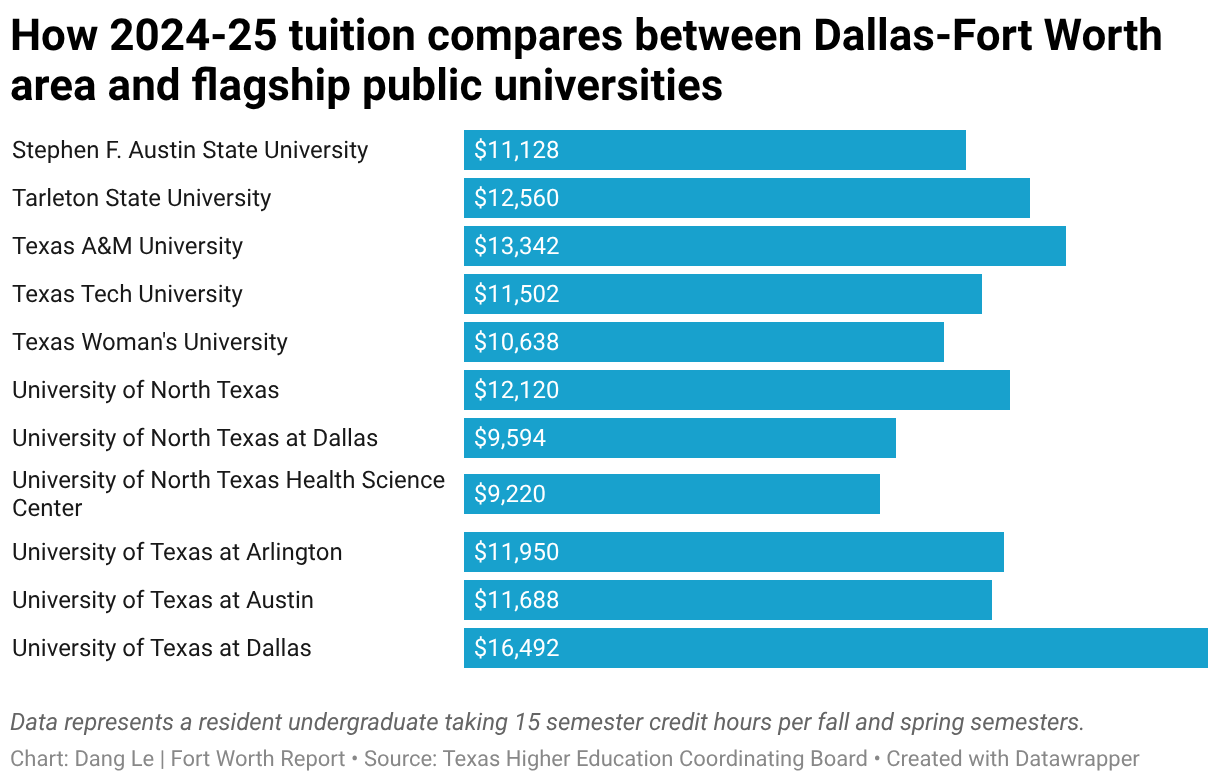
At UT-Austin, tuition and fees make up about 17% of the budget. At large regional universities such as the University of Texas at Arlington, the University of Texas at Dallas and University of North Texas, around 40% of operating budgets comes from tuition, according to data provided by each university.
UTA’s fall 2025 international student enrollment saw the largest annual decline in the past decade, dropping 20% and shrinking tuition revenue by 26% compared with the previous year. During the academic year, the university consolidated programs and offered buyouts.
Higher education is labor dependent, so colleges cannot easily cut costs without affecting people, Taylor said. Salaries, healthcare, energy and building costs all contribute to pushing budgets higher.
Colleges with large budgets and multiple revenue streams are better positioned to absorb a tuition freeze, he said. Flagship universities may have endowments or federal research funding, while teaching-focused colleges and community colleges often have fewer places to turn.
“A $5 million budget gap is much easier to absorb if your budget is a billion dollars than if your budget is $100 million,” Taylor said.
Anglin said Abbott’s 2024 letter was addressed to university system chairs and chancellors, not community colleges. But after community colleges checked with Abbott’s office following his 2026 letter, they were told the directive also applied to them, she said.
Other public institutions have taken a different approach.
In May, the University of Texas System regents approved nonacademic mandatory fee increases for several campuses, including athletics, student services, medical services and advising fees. At UTA, for example, the athletics fee would rise from $8.50 per semester credit hour to $10 per semester credit hour beginning in 2027.
The increases would not raise the average cost of attendance at any affected campus by more than 3.7%, according to system documents.
UT System spokesperson Ben Wright said in an email statement that the system remains “committed to affordability.”
He credited Abbott, state lawmakers and UT System regents with helping the system to cover tuition and fees for eligible undergraduates from families making less than $100,000 a year. UT institutions graduate more than 68,000 students each year, with half leaving debt-free, Wright said.
Community college funding
Anglin remembered when the Texas Legislature reformed community college funding in 2023.
The law tied state funding for community colleges to student outcomes, such as earning credentials, transferring or completing dual-credit hours. Texas needs more adults to reskill as industries change and more high school students to enroll in college and earn degrees, Anglin said.
“If it’s allowed to work the way it was designed to work, it’s great for community colleges,” she said. “It’s great for the state of Texas.”
 Pamela Anglin, chief financial officer of the Tarrant County College District, explains the 2025-26 draft budget to the board of trustees June 12, 2025, in downtown Fort Worth. (Shomial Ahmad | Fort Worth Report)
Community colleges get extra state money when students with greater needs earn a certificate. But in fiscal year 2027, that extra funding will shrink — from 25 cents to 20 cents on the dollar for low-income and academically underprepared students, and from 50 cents to 40 cents per dollar for adult learners 25 and older.
TCC expects to lose $2 million in state funding because of this change, although Anglin said the college hopes to make up the difference by outperforming state projections and increasing enrollment.
Every Texan supported the shift to outcomes-based funding for community colleges, Puente said. But the state should keep paying for the outcomes it promised to reward and treat community college funding as a workforce investment, he added.
“Community colleges and Texans have taken that bet,” Puente said. “It’s costing the state more money than they expected.”
Evaluating the freeze depends on what state leaders want it to accomplish, Taylor said. If the goal is to lower sticker prices, the policy has accomplished that. If the goal is to reshape how colleges operate or force harder budget choices, Taylor noted evidence of that, too.
The effects are uneven because institutions vary widely in size and revenue sources, he said.
‘It’s our people’
Anglin spent several 17-hour work days trying to make the numbers work after Abbott’s letter arrived.
She went back through the state funding changes, the projected property tax revenue and enrollment-driven tuition. She looked for cuts, line by line. As of now, she said she believes TCC could balance the budget this year.
But only this year.
Another year under the same pressure could force Anglin to look at the one line she had mostly avoided: employees.
“It’s our people,” she said, her left hand wiping reddened eyes. “It’s our people.”
Dang Le is the higher education reporter for the Fort Worth Report. Contact him at dang.le@fortworthreport.org.
The Fort Worth Report partners with Open Campus on higher education coverage.
The Report’s higher education coverage is supported in part by major higher education institutions in Tarrant County, including Tarleton State University, Tarrant County College, Texas A&M-Fort Worth, Texas Christian University, Texas Wesleyan University, the University of Texas at Arlington and UNT Health Fort Worth.
At the Fort Worth Report, news decisions are made independently of our board members and financial supporters. Read more about our editorial independence policy here.
This <a target=”_blank” href=”https://fortworthreport.org/2026/06/10/tarrant-county-college-fee-reversal-shows-tension-behind-texas-tuition-freeze/”>article</a> first appeared on <a target=”_blank” href=”https://fortworthreport.org”>Fort Worth Report</a> and is republished here under a <a target=”_blank” href=”https://creativecommons.org/licenses/by-nd/4.0/”>Creative Commons Attribution-NoDerivatives 4.0 International License</a>.<img src=”https://i0.wp.com/fortworthreport.org/wp-content/uploads/2021/04/cropped-favicon.png?resize=150%2C150&ssl=1″ style=”width:1em;height:1em;margin-left:10px;”>
<img id=”republication-tracker-tool-source” src=”https://fortworthreport.org/?republication-pixel=true&post=601607&ga4=2820184429″ style=”width:1px;height:1px;”><script> PARSELY = { autotrack: false, onload: function() { PARSELY.beacon.trackPageView({ url: “https://fortworthreport.org/2026/06/10/tarrant-county-college-fee-reversal-shows-tension-behind-texas-tuition-freeze/”, urlref: window.location.href }); } } </script> <script id=”parsely-cfg” src=”//cdn.parsely.com/keys/fortworthreport.org/p.js”></script>