
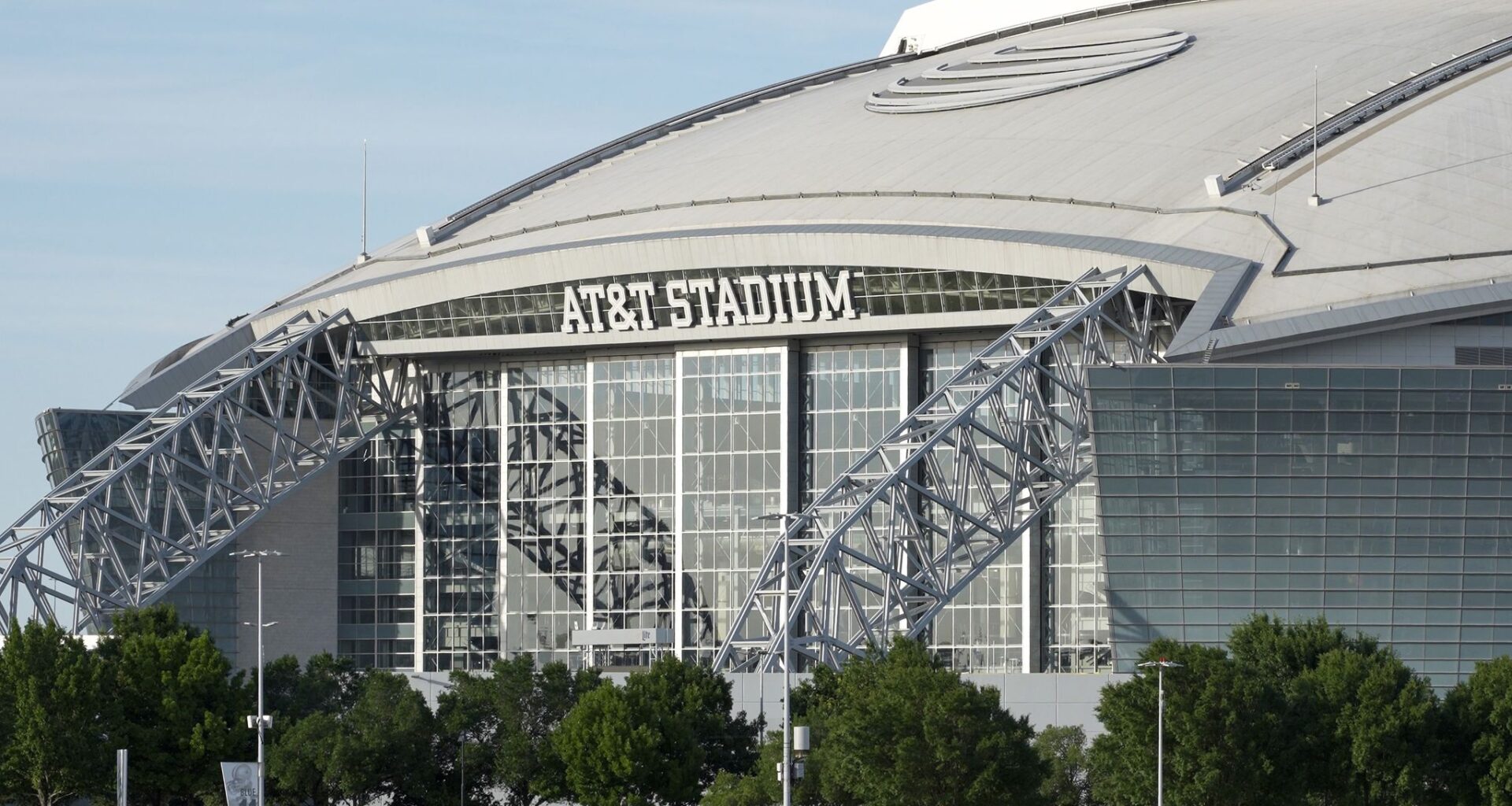
Known best as the home of both the Dallas Cowboys and Texas Rangers, Arlington has so much more to offer.

The city is third most populous in North Texas, after just Dallas and Fort Worth, and its location between those two major hubs gives it historic importance in the region. Now, the eyes of the world will be on the city when it hosts nine matches for the 2026 FIFA World Cup.
Here’s our guide to Arlington:
Fast facts
Population: 403,657
Median age: 34.5
Median income: $74,388
Unemployment rate: 5.7%
Article continues below this ad
Race / ethnicity
One race, white: 34.3%
One race, Black or African American: 24%
One race, American Indian or Alaska Native: 0.6%
One race, Asian: 8.1%
One race, Native Hawaiian: 0%
One race, some other race: 7.7%
Two or more races: 25.3%
Hispanic or Latino origin (of any race): 33.3%
White alone, not Hispanic or Latino: 30.9%
Educational attainment
For ages 18-24 (roughly 10.4% of the population)
Less than high school degree or equivalent: 13.1%
High school graduates (or equivalent): 30.3%
Some college or associate’s: 41.7%
Article continues below this ad
For ages 25+ (roughly 65.6%)
High school graduates (or equivalent): 23.4%
Bachelor’s degree: 22.5%
Graduate or professional degree: 11.1%
Housing
158,984 units; 146,132 occupied (91.9%)
77,401 Owner Occupied
68,731 Renter Occupied
Article continues below this ad
89,829 1-unit detached
5196 1-unit attached
59,691 multi-unit
3,818 Mobile Homes
450 Boat, RV, vans, etc.
Median home value: $337,800
Median rent: $1,594
Compiled by staff researcher Rachel Friend. Data from U.S. Census Bureau, American Community Survey 2024 1-Year Estimates Subject Tables, Tables S0601, S1501, S1903, S2301, DP04
Top O’Hill Terrace was once home to one of the most exclusive gambling halls in the country. Its history is detailed on a city website about historic landmarks.
Courtesy
Arlington: A brief history
The land that is now Arlington was first inhabited by various Native American tribes, according to the Texas State Historical Association. Early settlers clashed with the Native population in the Battle of Village Creek in 1841, which was followed by the 1843 Bird’s Fort Treaty between the tribes and the Republic of Texas, according to the Texas Historical Commission. This ultimately led to the removal of Native American populations and paved the way for white settlement.
Article continues below this ad
The city of Arlington, named after Robert E. Lee’s Virginia home, was founded in 1876 as a stop on the Texas and Pacific Railway track and incorporated in 1884, according to TSHA. The town quickly became a regional cotton distribution center, according to THC. By the turn of the century, more than 1,000 people lived in Arlington which by that time had several churches and schools, including Arlington College (now the University of Texas at Arlington).
During Prohibition, the city became an entertainment destination for drinking and gambling at establishments like Top O’Hill Terrace and the Arlington Downs horse racing track, according to THC.
The two historic sites shut down by the 1950s, but Arlington’s next era of entertainment was just around the corner. The Six Flags Over Texas amusement park opened in 1961. Turnpike Stadium followed in 1965 as the home ballpark of the minor league Dallas-Fort Worth Spurs.
In 1972, the Washington Senators became the Texas Rangers and moved into the ballpark, which was expanded and renamed Arlington Stadium. This marked a major step in Arlington’s relationship with professional sports in North Texas.
The city inaugurated The Ballpark in Arlington (now Choctaw Stadium) in 1993 as a new home for the Rangers.
Article continues below this ad
A little over a decade later, Arlington lured the Dallas Cowboys away from their longtime home in Irving. Cowboys Stadium, later renamed AT&T Stadium, was inaugurated near the Rangers’ ballpark in 2009. The Rangers moved to their third ballpark in Arlington in 2020, when Globe Life Field opened.
Much of the criticism of Globe Life Field’s architecture has been aimed at the hodgepodge front entry and the monotonous white roof.
Tom Fox/Staff Photographer
Notable landmarks
AT&T Stadium: Built with a retractable roof, the home of the Dallas Cowboys can hold more than 100,000 fans at its largest capacity. Since it opened, it has hosted numerous major events including a Super Bowl, an NBA All-Star Game and Taylor Swift’s The Eras Tour show. The stadium is temporarily renamed Dallas Stadium for the 2026 FIFA World Cup and will host a tournament-high nine matches, including a semifinal.
Globe Life Field: Opened in 2020, the Rangers’ current ballpark has a retractable roof and a capacity of just over 40,000 people. It also hosts concerts and other events.
Article continues below this ad
Brisket, spare ribs, tamale sausage, smoked quail, potato salad and serrano slaw are served up at Hurtado Barbecue in Arlington.
Lawrence Jenkins/Special Contributor
Things to do
Bars and restaurants
Amore Mio Trattoria
Cafe Americana
Cut & Bourbon
Fattoush Restaurant (Pantego)
Farena
Hearsay Arlington
Hurtado Barbecue
Inclusion Coffee
J. Gilligan’s Bar & Grill
Loma TXMX
Marquez Bakery & Tortilla Factory
Pan Pan Bakery & Cafe (Dalworthington Gardens)
Smoke’N Ash BBQ
Soy Cowboy
Texas Live!
Theodore’s Steak and Seafood (Dalworthington Gardens)
Related: Sarah Blaskovich’s 7 restaurant picks in Dallas-Fort Worth for World Cup travelers
Six Flags Over Texas runs tests on the new Tormenta Rampaging Run rollercoaster in Arlington. The new attraction will be the tallest, fastest, longest and first-ever giga (300+-foot-tall) dive coaster in the world, setting six world records, including the tallest coaster loop of 179 feet high. Riders will drop 285 feet at a record-breaking, beyond vertical angle of 95 degrees. It will open in 2026 as the park celebrates its 65th anniversary.
Tom Fox/The Dallas Morning News
Amusement parks
Six Flags Over Texas
Hurricane Harbor
Museums
Arlington Museum of Art
International Bowling Museum & Hall of Fame
National Medal of Honor Museum
After overnight rains, cyclists and walkers navigate the water puddles along the paths of River Legacy Parks in Arlington.
2017 File Photo/Tom Fox
Parks and trails
Bowman Springs Park
River Legacy Nature Center
River Legacy Parks
Rush Creek Trail
Sheri Capehart Nature Preserve
Vandergriff Park
Veterans Park
Village Creek Historical Area
Universities
University of Texas at Arlington
A fun fact
Arlington’s Six Flags Over Texas opened in 1961 and spawned a national chain of amusement parks and attractions. The name is a reference to the flags of the six nations that have controlled Texas over the years: Spain, France, Mexico, the Republic of Texas, the Confederate States and the United States of America.
The park is set to unveil a new record-breaking ride in 2026: the Tormenta Rampaging Run. It will be the tallest, fastest and longest dive coaster in the world at 309 feet, according to the company, and will reach speeds of 87 miles per hour across 4,199 feet of track.
Dallas neighborhood guides
Your guide to downtown Dallas: Things to do, landmarks, history and more
Your guide to Oak Lawn and Uptown Dallas: Things to do, landmarks, history and more
Your guide to Deep Ellum: things to do, landmarks, history and more
Your guide to South Dallas and Fair Park: Things to do, restaurants, history and more
Your guide to Oak Cliff: Things to do, notable neighborhoods, restaurants and more
Your guide to West Dallas: Things to do, restaurants, landmarks, history and more
Your guide to Old East Dallas and Lower Greenville: Things to do, history and more
Your guide to northeastern Dallas: Get to know Lakewood, Lake Highlands and more
Your guide to southeastern Dallas: Get to know Pleasant Grove, Kleberg and more