

Illustration by Lillian Durand
On Nov. 4, Texans will have the opportunity to vote on 17 proposed state constitutional amendments and, depending on where they live, a state Senate race.
Early voting is already underway and will continue through Friday, with Election Day set for Tuesday.
Since 1876, Texans have participated in constitutional amendment elections under Article 17 of the Texas Constitution, which allows voters to decide on proposed amendments.
Constitutional amendments are the only ballot propositions Texans get to vote on at the state level. Once an amendment is passed, to undo it, a majority of state lawmakers and Texas voters would need to pass another amendment.
Here is everything to know about the election, from where to vote to the key issues on the ballot.
What’s on the ballot?
The 17 proposed amendments to Texas’ constitution will be accompanied by a brief explanation for each change.
Most of the propositions aim to decrease or prevent taxes on a variety of demographics, including the following:
Homeowners (Propositions 11, 13)Businesses (Propositions 2, 9)Elderly and disabled homeowners (Proposition 11)Spouses of veterans (Proposition 7)People who had their home destroyed in a fire (Proposition 10)Property owners in counties with border security infrastructure (Proposition 17)People who sell animal feed (Proposition 5)People working in securities (Proposition 6)People receiving an inheritance (Proposition 8)
Republican state officials have championed tax cuts as a way to provide relief to families. Gov. Greg Abbott said in a May news release that the Texas Legislature allocated more funds for property tax relief in this legislative session than ever before.
“Texas home and business owners are on their way to keeping more of their hard-earned money,” Texas House Speaker Dustin Burrows said in the release.
Critics of the tax decreases have raised concerns about not leaving enough funding for school districts and key services like health care. Shannon Halbrook, director of Invest in Texas for left-leaning policy think tank Every Texan, said in a statement that across-the-board tax cuts “sacrifice vital revenue.”
Beyond taxes, some propositions aim to provide funding to the following:
The Texas State Technical College (Proposition 1)Dementia research (Proposition 14) The Texas Water Fund (Proposition 4)
Proposition 4 would dedicate a portion of revenue derived from state sales and use taxes to the Texas Water Fund. A report published by Texas 2036 estimates that the state needs to invest $153.8 billion to address water infrastructure challenges.
Other key proposals include Proposition 3, which would require judges to deny bail for people charged with certain felonies, and Proposition 12, which revamps the State Commission on Judicial Conduct. A full list of propositions is available on The Shorthorn’s website.
Some Tarrant County residents will also have the Texas State Senate District 9 race on their ballot. The seat is currently vacant after former Republican incumbent Kelly Hancock stepped down to become the state’s comptroller earlier this year.
The comptroller is the chief steward of the state’s finances, acting as tax collector, chief accountant, chief revenue estimator and chief treasurer for the government.
The candidates for the Senate seat include Republican Leigh Wambsganss, executive director of Patriot Mobile Action; Democrat Taylor Rehmet, a U.S. Air Force veteran and union president; and Republican John Huffman, former mayor of Southlake, Texas.
Where and when to vote
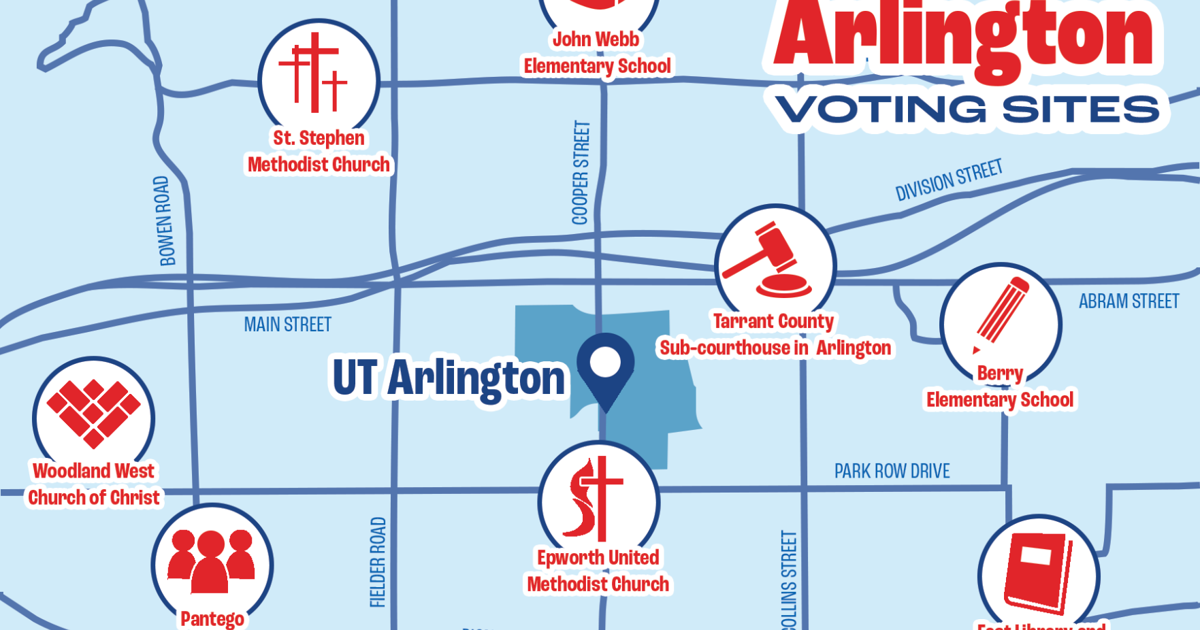
Early voting will run from 7 a.m. to 7 p.m. Wednesday through Friday. Arlington has six early voting sites:
ACTIV CenterBob Duncan CenterCity of Arlington South Service CenterElzie Odom Athletic CenterTarrant County College Southeast CampusTarrant County Sub-Courthouse
On Election Day, Tuesday, voting will run from 7 a.m. to 7 p.m. Arlington has more than 30 Election Day voting sites, including the following:
ACTIV CenterTarrant County Sub-CourthouseBob Duncan Center Southeast Branch Library East Library and Recreation Center Kenneth Davis Elementary School R. F. Patterson Elementary School Summit High School Performing Arts Center T. A. Howard Middle School Martha Reid Leadership Academy
What to bring to the polls
Residents must bring one valid form of identification to the polls, which can include the following:
Texas driver’s license issued by the Texas Department of Public SafetyTexas election identification certificate issued by DPSTexas personal identification card issued by DPSTexas handgun license issued by DPSU.S. military ID with a photoU.S. citizenship certificate with a photoU.S. passport (book or card)
If a voter does not have any of those seven forms of identification, and cannot reasonably obtain one, they can still vote using the following:
Copy or an original of any government document that shows the voter’s name and an addressValid voter registration certificateCertified birth certificateDocument confirming birth admissible in a court of law
After presenting one of the forms of supporting ID listed above, the voter must fill out a reasonable impediment declaration form.
@PMalkomes