
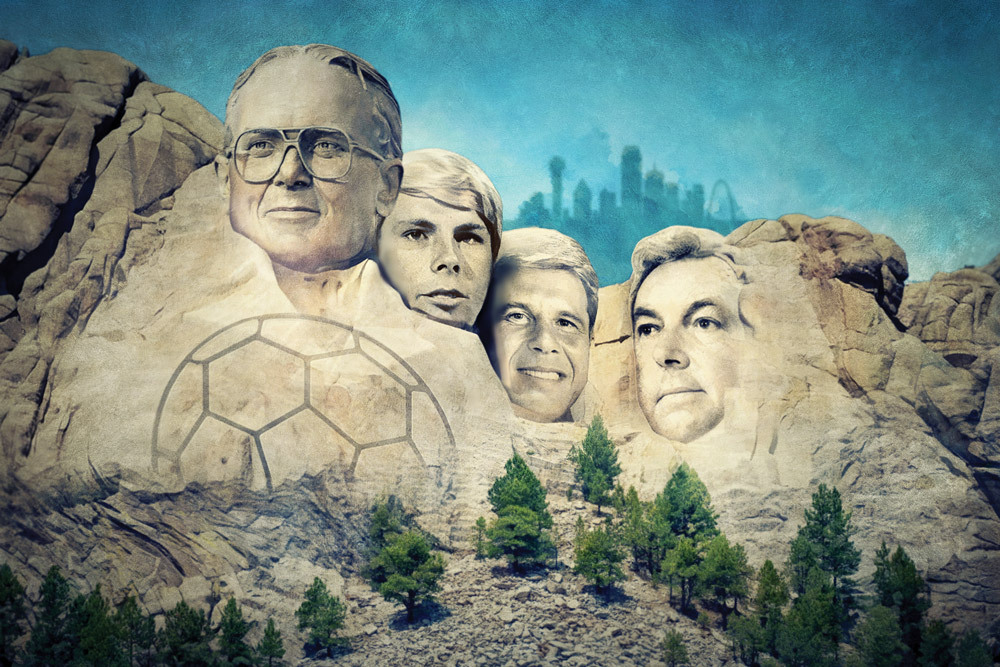
The four members of the mythical Mount Rushmore of Dallas soccer (from left to right): Lamar Hunt, Kyle Rote Jr, Tatu and Gordon Jago.
Photos/Getty Images, DMN files; Michael Hogue/Staff Artist
With the world in town for a peek at the beautiful game, it seems as good a time as any to dig out our soccer bona fides. No need to be shy. The game wasn’t born in Dallas, but if it weren’t for someone who grew up here and a few of his pals, soccer might not be much more than a Saturday morning ritual this side of the pond.

Once you get right down to it, Lamar Hunt, Kyle Rote Jr., Gordon Jago and Tatu probably did more for soccer in Texas and Dallas, in particular, than any quartet did for any sport, including the state religion.
Look at it this way: Hunt founded a professional football league as well as one of the NFL’s marquee franchises and remains a giant in the game two decades after his death. But, even if he hadn’t, we’d still have football.
Article continues below this ad
Not for nothing, on the other hand, do they call him “the Father of American Soccer.”
Hunt would head a casting call for any Mount Rushmore of soccer icons in the U.S., where its national championship cup bears his name, so he was an easy pick for our Dallas foursome, which is strictly local. Mia Hamm, the greatest female player ever? Got her first kicks in Wichita Falls. No one has scored more goals for the U.S. Men’s National Team than Clint Dempsey, but he’s from Nacogdoches.
Richardson is close enough. Carla Overbeck co-captained the 1999 USWNT and won an Olympic gold medal in ‘96. J.J. Pearce’s Jeff Agoos played in two World Cups, won five MLS Cup titles and, like Hamm, Dempsey and Overbeck, is in the National Soccer Hall of Fame.
Which is in Frisco, by the way.
Article continues below this ad
For that matter, Little Elm’s Weston McKennie is the engine for the latest USMNT baiting history.
As deserving as all of the above may be, though, they stand on the shoulders of Hunt, Jago, Rote and Tatu, each of whom played an outsized role in birthing, popularizing or sustaining soccer in North Texas. Even the nation. They came first, then and now.
The dreamer
Lamar Hunt didn’t know much about soccer growing up in Highland Park or a Pennsylvania boarding school as an heir to one of the world’s great fortunes, but he was a quick convert. After watching England beat Germany for its first and only World Cup title in 1966, he was so enraptured by the scene he figured it was time to see if it would play over here.
And when he decided to get into something, he didn’t just dip a toe.
Article continues below this ad
Within a year, Hunt and Bill McNutt of Corsicana founded the Dallas Tornado, and, before its second year, the Tornado embarked on a seven-month, worldwide tour that, as I wrote in 2014, “consumed 25,000 miles, 19 countries, five continents, 45 games and a serious bite from a family fortune.”
“We feel it not only will give our young players invaluable experience at the international soccer level,” Hunt said before the adventure kicked off, “but also will serve as a great goodwill instrument for both Dallas and the United States.”
As a warm-up for their second go, it didn’t do much. The Tornado won two games in their first NASL season. But, as a “goodwill instrument,” it was gangbusters.
Until the Tornado and Houston Stars came along in the late ‘60s, soccer in Texas was the province of immigrants who’d entered the state by way of Galveston. Texas and Baylor attempted a college league and failed. Military bases kicked it around a little. In the ’30s, the U.S. Soccer Football Federation sanctioned north-south zones in Texas as well as state tournaments. None of it lasted.
Hunt’s determination and fortune — he and McNutt reportedly lost $20 million over the Tornado’s 15-year existence — gave soccer the toehold it needed in Texas.
Article continues below this ad
Because of the Tornado, which competed in the NASL until 1981, kids in North Texas grew up watching, then playing. Pros such as Bobby Moffat and Kenny Cooper Sr. put down roots, then put on clinics that built a farm system. Hunt handled the rest.
Before his death at 74 in 2006, he would influence the creation of the MLS; own MLS teams in three cities; build the nation’s first soccer-only stadium in Columbus, Ohio; and, in 1994, help bring the World Cup to the U.S. For his tireless missionary efforts, he received countless accolades, including the U.S. Soccer Association’s Lifetime Achievement Award.
Brad Sham, who earned his chops broadcasting Tornado games before moving on to the Rangers and Cowboys, made a succinct case for his old boss.
“There’s no professional soccer presence in Dallas,” he said, “without Lamar Hunt. His vision results in everything that’s happened, from two World Cups to all of the pros to the National Soccer Hall of Fame in Frisco.”
The shooting star
When Kyle Rote Jr., broke a leg in an Oklahoma State football practice the summer before his freshman year in 1968, he told one of college football’s all-time greats that he was thinking about changing sports.
Article continues below this ad
“Don’t feel like you have to follow in my footsteps,” Kyle Rote Sr., replied. “You make your own footsteps.
“Just because you carry my name, you don’t have to do the same thing I did.”
Given his old man’s blessing, Rote transferred to the University of the South, having never seen its Sewanee, Tenn., campus. He went because his best friend back in Highland Park played soccer there, and he figured he’d have fun. He did more than that.
Before retiring from the sport in 1980, he’d lead the NASL in scoring his rookie year with the Tornado and become America’s first native-born soccer star at a time when the sport was trying to elbow its way into pro sports’ big four.
Rote’s celebrity, as well as the family name, earned him an invitation to compete on ABC-TV’s Superstars. Think America’s Got Talent, only with pro athletes. He won three of the first four years over a field of competitors far more famous. By the time he retired his crown, he was a household name.
Article continues below this ad
“All of a sudden he had a name as a Superstar,” his old Tornado teammate Kenny Cooper told The Guardian in 2015. “It helped catapult the game to a different level. It helped the league.
“It helped everybody.”
Club officials would send him ahead of the team to drum up interest on road trips. None of his teammates objected. Rote, who went on to a long career as a sports agent, told The Guardian he was lucky that way.
“They were kind enough to let an American kid score goals,” he said. “If the team had not accepted me at a certain level and rejoiced in any success that I had in the team’s success, had they not seen it that way, it could have been a bad situation.”
Rote made a good call switching sports. American soccer was better for it.
The connector
The lanky kid from London’s East End with the sideways grin and clever game would enjoy several lives in the game he loved. First as a center back for Charlton Athletic, then coach of teams at home and in the U.S., including a short stint in charge of the USMNT, before returning to England for the job of Gordon Jago’s dreams: the Queens Park Rangers.
He presided over the club’s promotion to the First Division, ultimately calling his 1970-74 tenure the most enjoyable of a seven-decade career.
But it was far from the most significant.
“The most disappointing day of my life,” he once said, “was when I had to resign from the QPR.
“But every ending led to a new beginning, and I found my greatest purpose in growing the game.”
Jago eventually returned to the U.S., where he coached two indoor teams, the Tampa Bay Rowdies and Dallas Sidekicks, to league titles. Once the Tornado blew out, he kept a soccer flame lit in North Texas, building an indoor fan base at Reunion Arena.
But even those accomplishments pale next to his work with the Dallas Cup, one of the world’s finest youth soccer tournaments. When he took over as executive director in 2002, he later said, it was $100,000 in debt and had lost most of the European clubs that once frequented it.
First thing he did as executive director was make a few calls to old friends back home. In short order he had commitments from Newcastle’s U18s and Manchester United’s U12s.
“So everybody wants to be in the U12 group because they want to play Manchester United,” he once said.
“So, all of a sudden, it took off.”
David Beckham, Wayne Rooney and Landon Donovan were among the stars who passed through. Jago didn’t just attract stars. He brought together nations.
In 2005, he employed his considerable political connections to engineer a U-12 game between Israel and Palestine, a diplomatic feat that drew international attention. For his efforts there and his lifelong contributions to soccer, Queen Elizabeth made him a member of the Order of the British Empire in 2006.
“It wasn’t just a competition,” FC Dallas president Dan Hunt said of Jago’s impact on the Dallas Cup after his death last year at 92. “It was an experience shaped by his passion for the game and his commitment to developing young talent from around the world.
“Gordon helped put Dallas on the global soccer map, and his legacy will continue to inspire all of us at FC Dallas and beyond.”
The showman
In Antonio Carlos Pecorari’s first game with the Tampa Bay Rowdies in 1981, the 19-year-old scored a goal even though he’d never practiced with the team, and he still got in trouble at halftime.
He didn’t throw his jersey into the crowd.
“If you score,” he was told, “make sure you take it off.”
And, with that instruction, a signature celebration was born.
Tatu is famous for many things, starting with his nickname — “armadillo” in Portuguese — as well as the fact that he’s second all-time in indoor goals and owns six MVP awards to go with four league titles in his 21 seasons with the Dallas Sidekicks. He also carried the Olympic torch when it came through town on its way to Salt Lake City in 2002. And he’s coached local high school and youth soccer teams for years.
Oh, and he was the only man in indoor soccer — or anywhere, probably — to win Coach of the Year and Player of the Year in the same year.
All of which is impressive, and the stuff of his Indoor Soccer Hall of Fame induction. But what any kid who grew up in Dallas in the ’80s or ’90s remembers most about him is his No. 9 sailing into the seats, the most famous celebration in Dallas sports.
The gimmick was inspired by a player from Tatu’s home country of Brazil who had several celebrations besides the shirt toss. Difference was, he wore another jersey underneath. Tatu was reluctant to strip at first because any such celebration meant a yellow card.
And what if they wouldn’t let him re-dress?
Tatu eventually got over his reservations, which was a good thing. When he joined his old coach, Gordon Jago, and the Sidekicks in 1984, most of the local media didn’t know a nutmeg from a nutcracker.
But they knew a good gimmick when they saw one.
One problem early: The Sidekicks’ first owner, Don Carter, a devout Baptist, didn’t care for anything that might be considered, well, sexual on the pitch. Fortunately, he got over it.
As Tatu told the FORTitude FW podcast in 2021, the club usually kept a half-dozen jerseys on the bench, though there was at least one occasion when the equipment manager told him he was out. Tatu eventually learned not to throw his jersey into crowds on the road, because sometimes they threw it back.
Over his long career, he estimates he gave 600 fans the shirt off his back. He’d have done more, too.
“If it would bring more fans to the games,” he once said, “I’d have thrown my shorts into the stands after every goal.”
Over Don Carter’s dead body, he would have.