
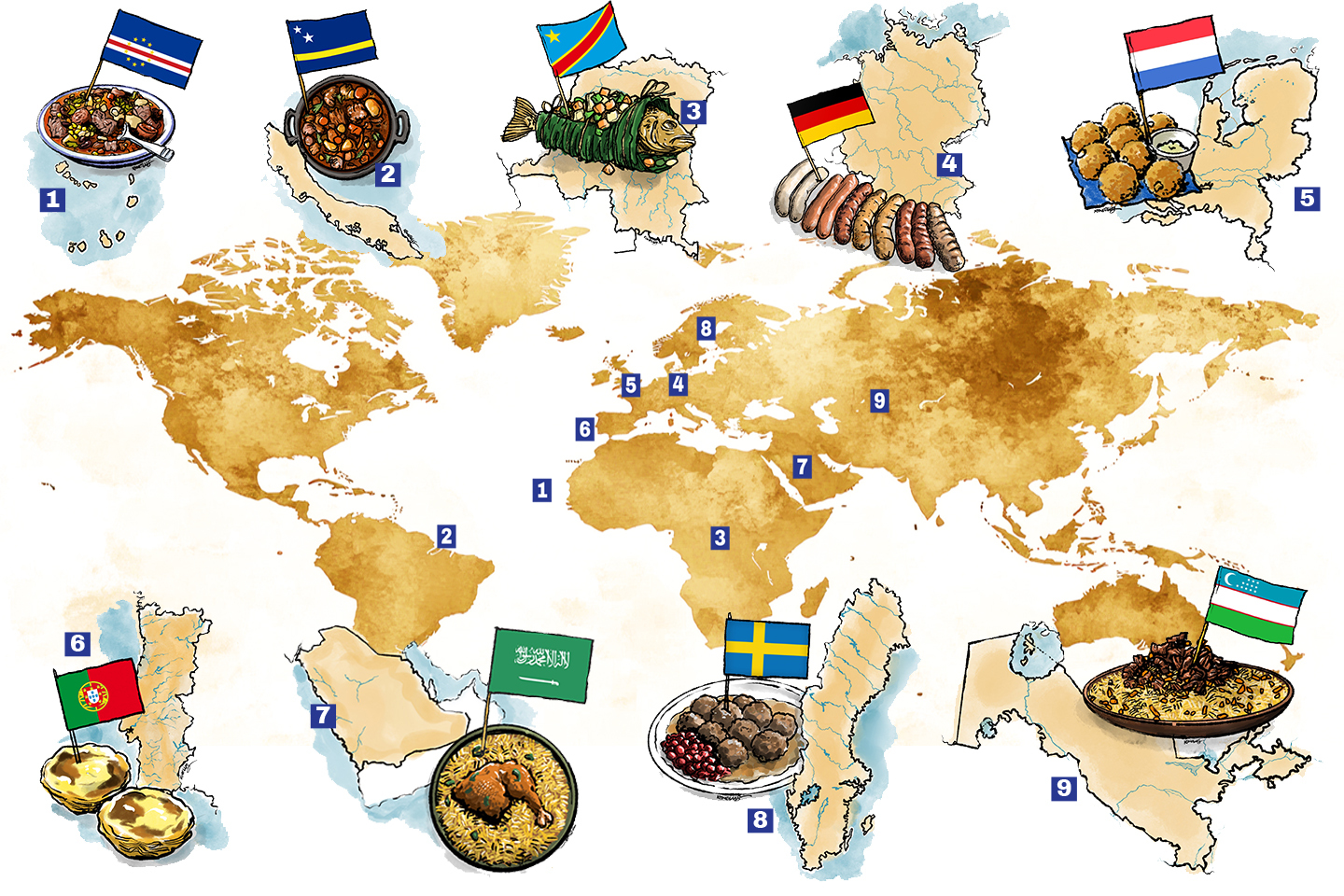
Here is an inexhaustive list of foods I’ve eaten since moving to Houston last year: fajitas, carrot tacos, scallion waffles, pho, sour cabbage fish soup, chicken and waffles, oxtail tamales, chile verde-smothered chilaquiles, grilled goat chops.
Taken together, they support a claim I’ve heard again and again: Houston has it all. But if that’s the boast on which you want to stake the city’s reputation — and many people do — it deserves proof.
An assortment of Houston’s diverse foods: German pretzels, Congolese kwanga.
An assortment of Houston’s diverse foods: German pretzels, Congolese kwanga.
How exactly would you demonstrate Houston’s food scene is as diverse as advertised? You could count how many continents’ cuisines appear in a single strip mall. Or tally fusion dishes like butter chicken kolaches, barbecue Thai curry, Middle Eastern fried chicken. Or try something a little more creative.
Article continues below this ad
King’s Bierhaus in Dickinson is shown on Sunday, May 31, 2026.
Brett Coomer/Houston Chronicle
The giant beer pretzel with cheddar bacon beer sausage and Düsseldorf mustard is shown at King’s Bierhaus in Dickinson, Sunday, May 31, 2026.
Brett Coomer/Houston Chronicle
The Taste of Germany is shown at King’s Bierhaus in Dickinson, Sunday, May 31, 2026.
Brett Coomer/Houston Chronicle
The Taste of Germany is shown at King’s Bierhaus in Dickinson, Sunday, May 31, 2026.
Brett Coomer/Houston Chronicle
Kortney Dailey carries beers to customers at King’s Bierhaus in Dickinson, Sunday, May 31, 2026.
Brett Coomer/Houston Chronicle
Katie Winkler carries beers to customers at King’s Bierhaus in Dickinson, Sunday, May 31, 2026.
Brett Coomer/Houston Chronicle
Customers have lunch at King’s Bierhaus in Dickinson, Sunday, May 31, 2026.
Brett Coomer/Houston Chronicle
Kortney Dailey carries beers to customers at King’s Bierhaus in Dickinson, Sunday, May 31, 2026.
Brett Coomer/Houston Chronicle
Chicken stew is shown at La Congolaise in Houston Friday, May 29, 2026.
Melissa Phillip/Houston Chronicle
Bottles of Congolese drinks are shown at La Congolaise in Houston Friday, May 29, 2026.
Melissa Phillip/Houston Chronicle
A variety of dishes are shown at La Congolaise in Houston Friday, May 29, 2026.
Melissa Phillip/Houston Chronicle
Grocery items are shown at La Congolaise in Houston Friday, May 29, 2026.
Melissa Phillip/Houston Chronicle
A dish of mackerel is shown at La Congolaise in Houston Friday, May 29, 2026.
Melissa Phillip/Houston Chronicle
Brochettes are shown at La Congolaise in Houston Friday, May 29, 2026.
Melissa Phillip/Houston Chronicle
A plate of tilapia fish is shown at La Congolaise in Houston Friday, May 29, 2026.
Melissa Phillip/Houston Chronicle
Jars of pili pili, a Congolese hot pepper sauce, made by owner Bonheur Malonga are shown at La Congolaise in Houston Friday, May 29, 2026.
Melissa Phillip/Houston Chronicle
Maboké, a catfish stew, is shown at La Congolaise in Houston Friday, May 29, 2026.
Melissa Phillip/Houston Chronicle
A bowl of okra stew is shown at La Congolaise in Houston Friday, May 29, 2026.
Melissa Phillip/Houston Chronicle
Kwanga is shown at La Congolaise in Houston Friday, May 29, 2026.
Melissa Phillip/Houston Chronicle
Grocery items are shown at La Congolaise in Houston Friday, May 29, 2026.
Melissa Phillip/Houston Chronicle
Kwanga is shown at La Congolaise in Houston Friday, May 29, 2026.
Melissa Phillip/Houston Chronicle
Packages of frozen Safou plum, left, and Cassava leaves, right, are shown at La Congolaise in Houston Friday, May 29, 2026.
Melissa Phillip/Houston Chronicle
La Congolaise is shown in Houston Friday, May 29, 2026.
Melissa Phillip/Houston Chronicle
WORLD CUP FOOD: FIFA Fan Festival in Houston announces food vendors: pizza, japchae, onigiri, ice pops
This summer, Houston will host teams from nine countries during the 2026 World Cup: Portugal, Germany, Uzbekistan, Democratic Republic of the Congo, Saudi Arabia, Sweden, Cabo Verde, Curacao and the Netherlands. So I landed on a related challenge: Before the tournament began June 11, I would show that Houston had foods from each of them.
Admittedly, better yet would be to find restaurants representing the world’s 200-odd countries. Alas, my expense account was limited, as was my appetite. And the World Cup teams coming to Houston make for a fairly representative mix: large and small, known for their cuisine and known for anything but. (Other, as-of-yet undecided teams will come for later rounds of the tournament.)
Article continues below this ad
So in May, I set out on my quest. I’d eat at restaurants. I’d visit people’s homes. I’d cook the food myself if I had to. I’d take detailed notes, so you could live this somewhat deranged journey vicariously through me.
All to answer the question: Is Houston’s food scene as diverse as we say it is?
Portugal
Ken Ellis / Houston Chronicle
Starting to research, I quickly realized I had no clue where to find food from Curacao or Cabo Verde. Was Dutch cuisine even a thing?
Article continues below this ad
These questions, I decided, would be good challenges for future me. Present me would drive six minutes to the Portuguese restaurant nearest my apartment.
At Oporto Fooding House & Wine on West Gray, diners primarily nosh on seafood: scallops, octopus, snapper and bacalhau, a kind of shredded salt cod that appears all over Portugal.
“It’s hard to replicate Portuguese food because it is so simple, and the fish is so fresh,” Rick Di Virgilio, the chef and owner, told me.
WHERE TO EAT: Houston’s Top 100 Restaurants
He makes a good stab at replicating it anyway. At Oporto, winey mussels arrive in a bath of tomato. An octopus tentacle merges with potato in a dish that delights in a monotonously soft mouthfeel. Sugared custard jiggles inside the pastels de nata, or egg tarts. I perched at the counter with a friend, slurped up the pastry crumbs and got ready to make the journey back home.
Article continues below this ad
Germany
Ken Ellis / Houston Chronicle
King’s BierHaus announced its presence with a nine-piece band, a wooden sign reading “Willkommen!,” a waitress in a dirndl and a mural that included both James Harden and a man in a spacesuit.
This, I could see, was a restaurant committed to German kitsch, Texan kitsch and a fun but somewhat absurd time. One of the region’s few German spots, King’s BierHaus opened in Dickinson in 2019. (Its other location in the Heights closed a few years ago.)
King’s Bierhaus in Dickinson is one of the Houston region’s only German restaurants.
King’s Bierhaus in Dickinson is one of the Houston region’s only German restaurants.
When I arrived, I sat down on the back patio with two friends. Up by the band on stage, an older man waved his handkerchief and got down to “Disco Inferno.” Farther back, a waitress clambered atop a wooden table and ululated in honor of a young birthday boy, who clutched a balloon sword in apparent shock.
Article continues below this ad
As we laughed, I pondered what to order. Pizza schnitzel? Rattlesnake sausage? The options stretched on. Considering the mission, I thought we should stick to German beers and the Taste of Germany special. I asked our waitress how many the special would feed.
She looked faintly alarmed and informed us a family of six had just eaten it — and nothing else.
But, I rationalized, that family may have only had two adults. Who knew if all their children could even eat solid food! My friends and I were hungry. We ordered the platter, with a pretzel on the side.
Katie Winkler pours a beer from the taps at King’s Bierhaus in Dickinson, Sunday, May 31, 2026.
Brett Coomer/Houston Chronicle
Ten minutes later, the waitress sat down two trays, laden with chicken and pork schnitzel, two kinds of sausage, sauerkraut mellowed out by pork bits, potato salad, cucumber salad, a chicken thigh and pretzel bites. The full pretzel arrived shortly thereafter.
My friends and I assessed the food. We can finish this, we declared.
Halfway through the platter, we dumped sauerkraut and schnitzel into styrofoam to-go containers.
Uzbekistan
Ken Ellis / Houston Chronicle
Beck Mamat is a former trampoline athlete and current trampoline coach. He has worked in Canada, Qatar and New Zealand. He now trains a Houston trampoliner on the national U.S. women’s team. They practice at the Jewish Community Center on Braeswood.
Why is this relevant? Am I hoping you will lose interest, skip over this section and thus avert your eyes from my failure to locate Uzbekistani food?
No. Mamat, you see, is from Uzbekistan. And he has lived a life beyond trampolines. He is also the founder of Houston restaurant Foreign Grill, which he and his wife Irina Mamataliyev launched at the Conservatory food hall before moving to Post Market downtown.
“We merged a couple cultures from post-Soviet Union countries,” Mamat said of his menu.
Among them: his home country. That manifests largely in two dishes at Foreign Grill. One is somsa, a pastry that encases minced beef in laminated dough.
The other is billed as pilaf, though it’s called plov in Uzbekistan. It comes with either lamb or chicken, seared to keep in the juice. Then the meat is fried with onion and carrots, seasoned and cooked with rice for three to five hours. The rib-sticking end result is a dome of yellowed rice, topped with thin slices of lamb, fragrant with fennel and cumin.
It’s possible, Mamat suggested, that I found the only commercially available Uzbekistani dishes in Houston. He used to know of a few other restaurants but said they’ve since closed.
“In Houston,” he told me, “nobody has this.”
Democratic Republic of Congo
Ken Ellis / Houston Chronicle
Deborah Malonga sounded more thrilled to talk with me than almost anyone I have ever called to request an interview.
Ordinarily, when I say I’d like to speak with someone, they tell me, Sure, I’m free later this week. When I’m lucky, people say, I’d love to! When I’m not, people inform me in dour tones that they don’t talk to the media. And once, when I was really unlucky, a source asked me, Did you say you write for a political magazine? What do you guys think about Ted Cruz?
Malonga, on the other hand, gushed over the phone: Come visit! Tomorrow? Yes!
Bonheur Malonga, center, with her daughters Christia McIntyre, left, and Deborah Malonga, right, are shown at at La Congolaise in Houston Friday, May 29, 2026.
Melissa Phillip/Houston Chronicle
So the next day, I drove over to La Congolaise African International Food Market on Gessner, the tiny market and restaurant that Malonga operates with her more reserved mom, Bonheur Malonga. Frozen palm cream and sweet potato leaves packed the freezer; big, butter-yellow bags of semolina and bottles of a vanilla-scented drink called Vitalo lined the shelves.
Sitting at one of just a few tables, the Malongas explained how they got started. Bonheur, who is from the Republic of Congo, launched what she thinks was Houston’s first Congolese restaurant in 2012. The Republic of Congo is a separate country from the Democratic Republic of Congo, and the latter is the one participating in the World Cup here. But the Malongas still expect to see Congolese visitors for the World Cup.
At La Congolaise, they serve classic Congolese food: maboke, fish wrapped in banana leaves; poulet jus, a chicken stew made with hardy, flavorful hen; and of course pale little coins of kwanga, mochi’s less-stretchy cousin and the starch most commonly eaten with Congolese meals.
Clockwise from top left: Jars of pili pili hot sauce, chicken stew, the market at La Congolaise and kwanga.
From top: Jars of pili pili hot sauce, chicken stew, kwanga and the market at La Congolaise.
While I sat down to chew on a leg of chicken and marvel at the almost mashed potato-like consistency of stewed cassava leaves, I watched Deborah flit over to another customer. She shot a video for TikTok, explaining for her viewers that this would be Hannah’s first time trying Congolese food. Then she talked with Hannah about travelling to Japan. Then she extracted Hannah’s number and a promise to return.
Trying Congolese food in Houston, as it turns out, is not that hard. To only try it once, though — well, that might be a challenge.
Saudi Arabia
Ken Ellis / Houston Chronicle
With Houston’s wealth of Middle Eastern food, and its connections to the energy industry, I’d assumed Saudi Arabia would be easy to cross off the list. But I couldn’t find any restaurants online. Puzzled, I fired off an email to the local Saudi consulate.
“Unfortunately, there are no Saudi restaurants serving traditional Saudi food,” the consulate emailed back.
“However,” they continued, “we suggest Yemeni restaurants, as their cuisine is very similar.”
The consulate steered me toward two options: Kabsah on Hillcroft or Hadramout Restaurant on Gessner. A cafe owner I know seconded Kabsah, so a friend and I drove out one Sunday.
We found a strip-mall restaurant with long tables inside, clearly meant for a whole community to sit down and devour a feast together. The communal spirit extended to food, too. In the back, I poured free spiced adeni tea into two cups and ladled out bowlfuls of complimentary yellow lamb broth.
We ordered both kabsa and mandi, dishes popular in Yemen and Saudi Arabia, and gaped when they arrived on silver plates the size of my forearm. Lamb sat atop saffron-yellow rice plumped with raisins. Salty clumps of tuna mixed into the kabsa, reddened and cardamom-sweet. My friend and I left with at least four meals worth of food boxed to go.
Kabsah might not be Saudi, exactly. But it has the consulate’s stamp of approval and, for whatever it’s worth, mine too.
Sweden
Ken Ellis / Houston Chronicle
Asking a consul worked once. Why not again? I emailed Houston’s brand-new Swedish consulate to ask about Swedish restaurants.
Yes, consul general Anna Hammarlund Blixt told me: Ikea. I began to daydream about shopping for yarn storage bins and miniature lazy Susans. Then I read her next line.
“I was thinking that maybe I could invite you for lunch at my residence and you could sample some Swedish food (prepared by myself) and drinks?” her email continued.
OTHER FOOD NEWS: Three sisters blend coffee with Bangladeshi flavors at Moharani Coffee House
So a week later, I pulled up outside Hammarlund Blixt’s tall-ceilinged house to greet her and Linn Larsson, the Swedish vice consul. They graciously ushered me and a colleague to a table where each seat was set with three plates, gold-rimmed and decorated with little blue crowns.
Hammarlund Blixt ferried out a procession of small plates: boiled potatoes, sliced cheese, pickled herring two ways, a pocked hard bread and a little squiggle of pink paste. Grainy kid’s toothpaste? No, this was the Swedish version of caviar, Larsson told me: fish roe paste.
A few potatoes and sips of licorice-tinged schnapps later, Hammarlund Blixt returned to the kitchen to prepare the main course. Larsson primed us with a very promising description: In Sweden, people eat lots of “beige and brown” foods with “so much butter.”
What could it be? Meatballs, lingonberry jam, “brown sauce” — and, to my surprise, an apology from Hammarlund Blixt. She’s not much of a cook, she said. And the consulate, which opened here last fall, has no chef on staff. The result?
“When we emailed, I also said that, well, there are no Swedish restaurants here. There is Ikea,” she said. “I have to profess that I got the meatballs from Ikea.”
Cabo Verde
Ken Ellis / Houston Chronicle
Sarah Ramos Jackson landed in my inbox a few days after I began posting in Cape Verdean Facebook groups, asking if anyone from the archipelago country off the West African coast could help me find its food in Houston.
Jackson lives in Fifth Ward now, having moved here from the Netherlands, but her dad was born and raised in Cabo Verde. When she visits, she said she buys that day’s catch, fresh from the boat. She especially loves moray eels, which flash through the water like dragons, and fry up into a delicious snack.
But Houston doesn’t host many other people from the islands. In about 13 years here, Jackson said she’s only met two Cape Verdeans. And Jackson doesn’t much like to cook.
Oh, no. I tried a new tack: “Do you have any family recipes you would be willing to share with me, so I can try making it for my article?”
Jackson did. She directed me to a recipe for cachupa, the corned beef-salt pork-hominy-bean-yuca stew considered Cabo Verde’s national dish. Her step brother, a chef, signed off on the instructions. And I set to work browning meat and stewing beans.
Three hours and one smoke alarm incident later, I spooned myself a bowlful of fatty pork, slightly astringent collard greens, sour corned beef and salty sauce thickened into a gravy consistency. Fire orange oil floated atop like specks of amber.
“I am so proud of you!” Jackson emailed me when I sent her a picture. “Every family has their own version of cachupa, so this can be (the) start of your family’s recipe!”
Curacao
Ken Ellis / Houston Chronicle
Mari Balentina, who once won a Houston beauty pageant as the representative for Curacao, had bad news for me.
“There’s Jamaican restaurants, and there’s Haitian, and there’s little elements that are also like Puerto Rican and Cuban, because they do like the fried plantains,” she said when I asked about Curacaoan restaurants in Houston. “But (there’s) not an authentic restaurant.”
She told me I should talk to her cousin, Suheidi Benito Michel, who runs the traditional restaurant Chez Susenne in Curacao, if I wanted to know more about the Caribbean island’s food. So I called Michel, and we talked about her best-sellers: okra soup, beef stew, red snapper, sweet red beans. When I asked, she sent the beef stew recipe my way.
It looked relatively simple, at least compared to the cachupa. Combine meat, onion, cumin, curry powder, tomato paste, bell peppers, Worcestershire sauce, soy sauce, butter and garlic. Sure, the recipe didn’t specify all the measurements, or when to add each ingredient, but I could improvise.
I threw the ingredients together and let them simmer until the sauce turned into a thick, golden-brown coat that gave the beef a glossy glow. I tasted it: savory, salty, umami. I sent Michel a photo.
“Wow I’m surprised,” she texted back.
“Haha surprised about what?” I asked.
“That it looks very good,” she said. “Looks like I cooked it.”
Netherlands
Ken Ellis / Houston Chronicle
To start, I reached out to Houston’s Holland Club. Member Leo Valk told me, “Sadly there are no Dutch restaurants around.” I asked friends and family. They weren’t sure what Dutch cuisine might be. Did I want to get a pancake? Or some cheese?
No, I did not. So I went back to Valk, who directed me to Diana Mulder. I called her, and she told me she knew a woman in Fulshear who makes bitterballen — deep-fried, nutmeg-spiced Dutch beef croquettes — at home. I called this person, Constance Filius. She told me she was going on vacation. But she’d be back at the beginning of June.
Once she returned, I arranged to meet Filius’ husband to pick up a dozen frozen bitterballen. He delivered them bagged up and topped with a pink card stamped with cowboy boots. It told me to fry the bitterballen straight from the freezer, let them rest a minute before eating and definitely “don’t use an air fryer.”
A completely reasonable prohibition — an air fryer, after all, could hardly replicate the delight of submerging frozen croquettes in oil a couple of inches deep. Bubbles fizzled around them. The breadcrumbs darkened into a crisp shell. When I bit in, liquid gravy and shredded beef spurted out. I ate three and turned the stove back on to fry more.
Victory! Or at least, close enough.
OK, fine: I did not find restaurants in Houston that represented all nine countries coming to participate in the World Cup. But I did sample foods from all of them.
And I managed that much because our city is home to people from all over the world who were eager to help me, to talk about their cuisines, to cook for me and tell me how to make their food for myself. People who love their countries, who love this city, who love the culinary diversity that Houston puts on display — even if, perhaps, our food scene doesn’t literally have it all.