
Michael Adkison/Houston Public Media
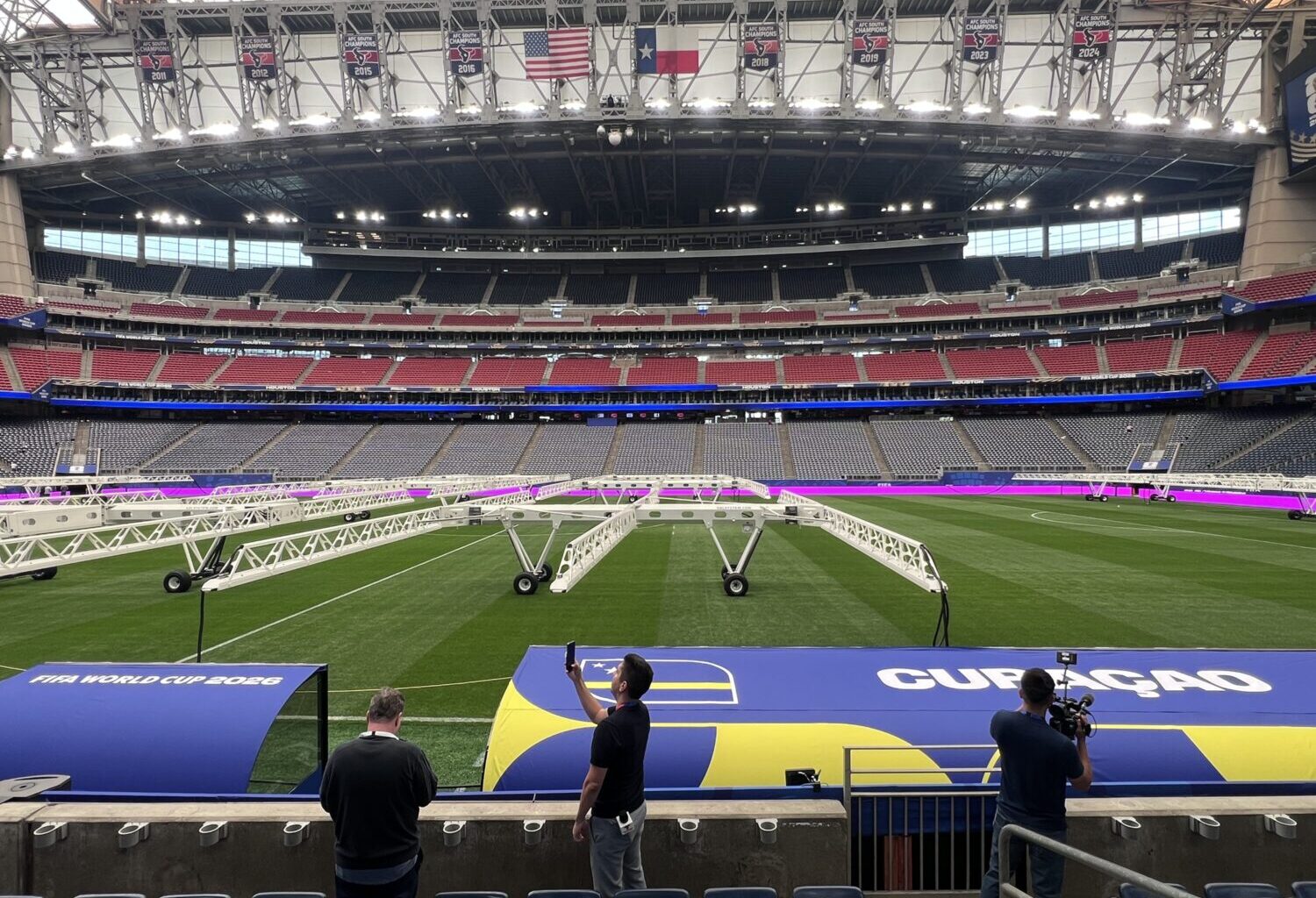
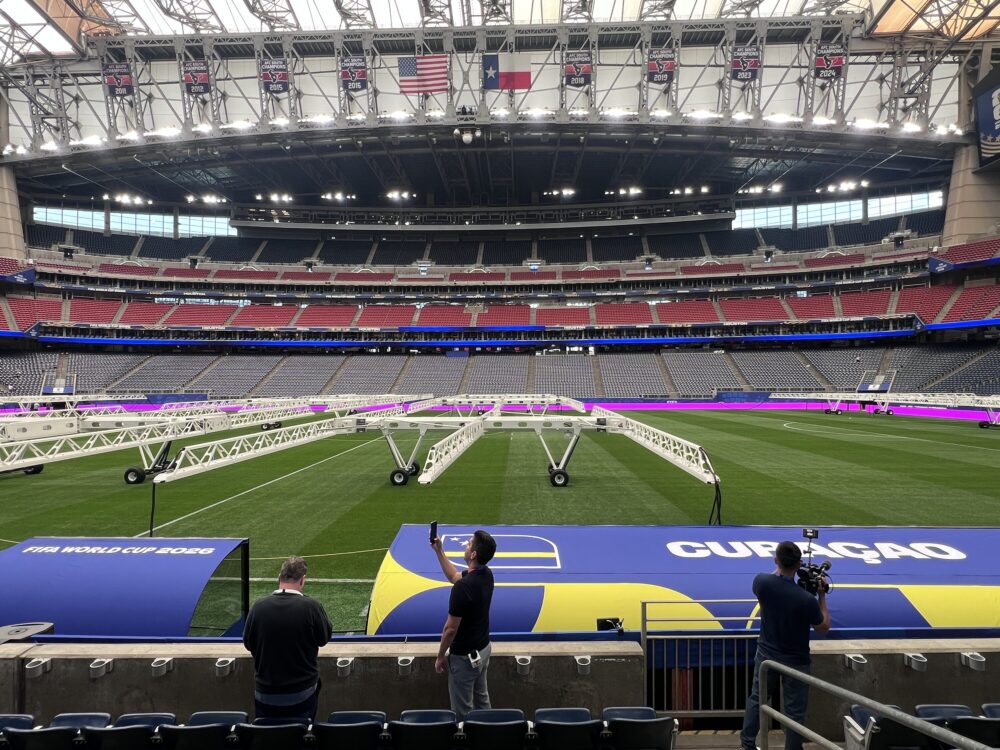
The grass pitch at NRG Stadium, called Houston Stadium for the 2026 FIFA World Cup, on June 10, 2026.
Are you excited about the FIFA World Cup but unsure about how to follow the action?
FIFA’s rules and regulations for the international soccer tournament, which is kicking off Thursday, make up a 96-page document. Houston Public Media turned to the University of Houston women’s soccer team for a breakdown of the rules of soccer — sometimes referred to as “the beautiful game.”
“When I’m playing soccer, I don’t really think about anything else,” Blake Hodgson, a left back for the Cougars, said in an interview.
Sign up for the Hello, Houston! daily newsletter to get local reports like this delivered directly to your inbox.
RELATED: The ultimate guide to the 2026 FIFA World Cup in Houston
And this year’s World Cup, which is being hosted in Houston and several other cities in the U.S., Canada and Mexico, institutes some new rules and regulations, including the introduction of mandatory cooling breaks during each match. The logic behind that new rule comes as this World Cup is expected to be one of the hottest on record.
“People coming over from Europe — talking from experience, coming from England — you are very rarely reaching 80 degrees,” UH coach Ben Williams said. “So, when you play in the stadiums which add an extra 10 degrees, you’re probably looking in around the 100s. It’s all for safety.”
The basic rules of soccer
It should come as no surprise that soccer is a foot-based sport. It’s called football in many parts of the world.
Teams’ objective in each match is to score more goals than the other team, by kicking a soccer ball into the netted goal defended by the opposing team. The 10 players in the field can also use their heads to advance the ball but are not allowed to use their arms or hands. Only goalkeepers are allowed to use their hands inside the penalty area, which is marked by large rectangles outlined in white lines on each end of the pitch (the soccer term for the field of play) .
“The general basics of the game is to score in the opponent’s goal, stay within the lines, and try not to be offside,” Hodgson said.
More on offsides later.
A FIFA World Cup field’s dimensions are 115 yards by 74 yards. Like in basketball, if a ball goes out of bounds on the sidelines, the team that did not touch it last gets to throw it in. This is the only time when the players — aside from the goalkeepers — are allowed to touch the ball with their hands.
When it comes to the ball going beyond the goal lines at each end of the pitch, how the game proceeds depends on who kicked the ball out of bounds. If it was the offensive team, the defense gets a “goal kick,” in which a goalie kicks the ball into play. If it was the defensive team that knocked it out of bounds, the offense gets to do a “corner kick,” a high-stakes kick from the corner of the pitch that can put the offensive team in a good position to score.
Each soccer team will have 11 players on the pitch, with up to 15 substitutes. For the players on the field, the game is one of stamina.
“Endurance is very important,” Hodgson said. “I personally run at least 6 to 8 miles a game.”
How long is each match?
A soccer match is made up of two 45-minute halves, totaling 90 minutes. But, in every match there are stoppages, like when a player is injured or teams celebrate after scoring a goal. The clock continues running during those stoppages, and referees will tack on a few extra minutes to each half to make up for them. That additional time is called “stoppage time.”
“I would say you’re looking at probably at a minimum 5 minutes [of stoppage time] per half in every game, and that is just probably at a minimum,” Williams said.
During the group stage of the World Cup, which begins on Thursday and will last until June 28, matches can end in a tie. After that, the knockout rounds begin, and each match must have a victor and loser.
If there is not a victor by the end of 90 minutes (plus the stoppage time as determined by the officials), the teams will enter “extra time,” which will last two 15-minute periods. Think of it as overtime in basketball and football.
Extra time in soccer is not sudden death, meaning the two 15-minute periods will be played in their entirety, regardless of how many goals are scored.
If there isn’t a victor by the end of extra time, the match enters a high-stakes penalty kick shootout, often simply called penalties. During penalties, the game comes down to two players at any given moment: a kicker and a goalie. The kicker is aiming for a goal; but the pressure is really on the goalie to catch the ball or knock it away from the goal. Whichever team scores the most out of five penalty kicks wins; otherwise, the two teams go to sudden death, alternating penalty kicks until they are no longer tied after a given round.
RELATED: FIFA turned NRG Stadium into ‘Houston Stadium.’ Here’s an exclusive inside look
In the 2022 World Cup, the final match between Argentina and France went to penalties, only the third time in World Cup history that happened. Argentina defeated France 4-2 on penalty kicks, after the match ended 3-3.
How do offsides and fouls work?
It’s almost a clockwork Google search for non-soccer fans every World Cup: How does offsides work in soccer?
“There’s the back line [of the defense], which is the final four players before the goalkeeper, and you want to try and stay in front of them when you’re on the opposite team’s half,” Hodgson said. “And if you go behind them on the opposite team’s half, you have to make sure that you go behind them after the ball is played.”
Added Williams: “It has to be a minimum of two people between you and the goal when the ball is kicked. That includes the goalkeeper.”
In other words, an offensive player cannot run past all the other team’s defensive players until the ball is advanced in that direction by another player. Offensive players are allowed to run past the defense while possessing the ball.
The idea is to not give an offensive player an unfair advantage. When offsides is called, the other team is given an indirect free kick, in which the kicking player must pass to a teammate before a goal is allowed to be scored.
Players can also foul against one another for unsportsmanlike behavior. Things like tripping, pushing and holding result in free kicks for the other team. Those fouls, and arguing with a referee, also can result in a yellow or red card. A yellow card is a warning; a red card is an immediate ejection from the game. Two yellow cards are the equivalent of a red card.
And that brings soccer to one of its most controversial stereotypes. Sometimes, players are injured during the game. Sometimes, they’re flopping.
“When you’re running at that pace, it also only takes a little nudge to knock you off balance to actually make you fall over,” Williams said. “So, yes, there is a little bit of time players embellish and then try to draw fouls.”
He also noted that sometimes fouls result in better opportunities to score a goal, making the presentation of an injury perhaps more enticing. If an offensive player is fouled inside the defensive team’s penalty area — the rectangular box marked by white lines — and that foul is punishable by a direct free kick, a penalty kick is awarded.
How is the World Cup structured?
Beginning Thursday, the World Cup begins the group stage. Back in December, each of the teams was assigned to a group of four, and each member of the group faces off against one another.
After the group stage ends, each team is scored based on their performance. Teams earn three points for a win, one point for a draw, and zero points for a loss. The top two in each group, plus the eight best third-place teams, advance to the knockout rounds.
Then, the knockout rounds work like a traditional single-elimination bracket, until only two teams are left for the final match on July 19.
New rules for the 2026 World Cup
This year’s World Cup also instituted new rules and regulations. For one, there are more teams than ever playing in this tournament, with 48 countries represented. Prior to this year, 32 teams played.
Also importantly, the matches now institute a required cooling break. Every match will include a mandatory 3-minute hydration break at the halfway point of each period.
RELATED: The FIFA World Cup will be a hot one in Houston. Here’s how organizations are adjusting
The rule is in place, regardless of where the match takes place, the temperature of the stadium, or whether or not the stadium has a roof, like Houston’s NRG Stadium — which is being called “Houston Stadium” by FIFA because of its sponsorship policies.
One other new rule could keep matches moving quickly, Williams said.
“If the goalkeeper gets the ball now in their hands they have 8 seconds to release the ball,” Williams said. “And if they don’t release it in 8 seconds, it will now be a corner [kick] for the opposition team to increase the speed of play of the game.”
The games begin Thursday afternoon in Mexico City, where Mexico faces South Africa. The first of seven matches to be played in Houston is scheduled for Sunday, June 14.
Disclosure: Houston Public Media is licensed to the University of Houston System. The university does not play a role in Houston Public Media’s editorial decisions. Read our statement of ethics and standards here.