
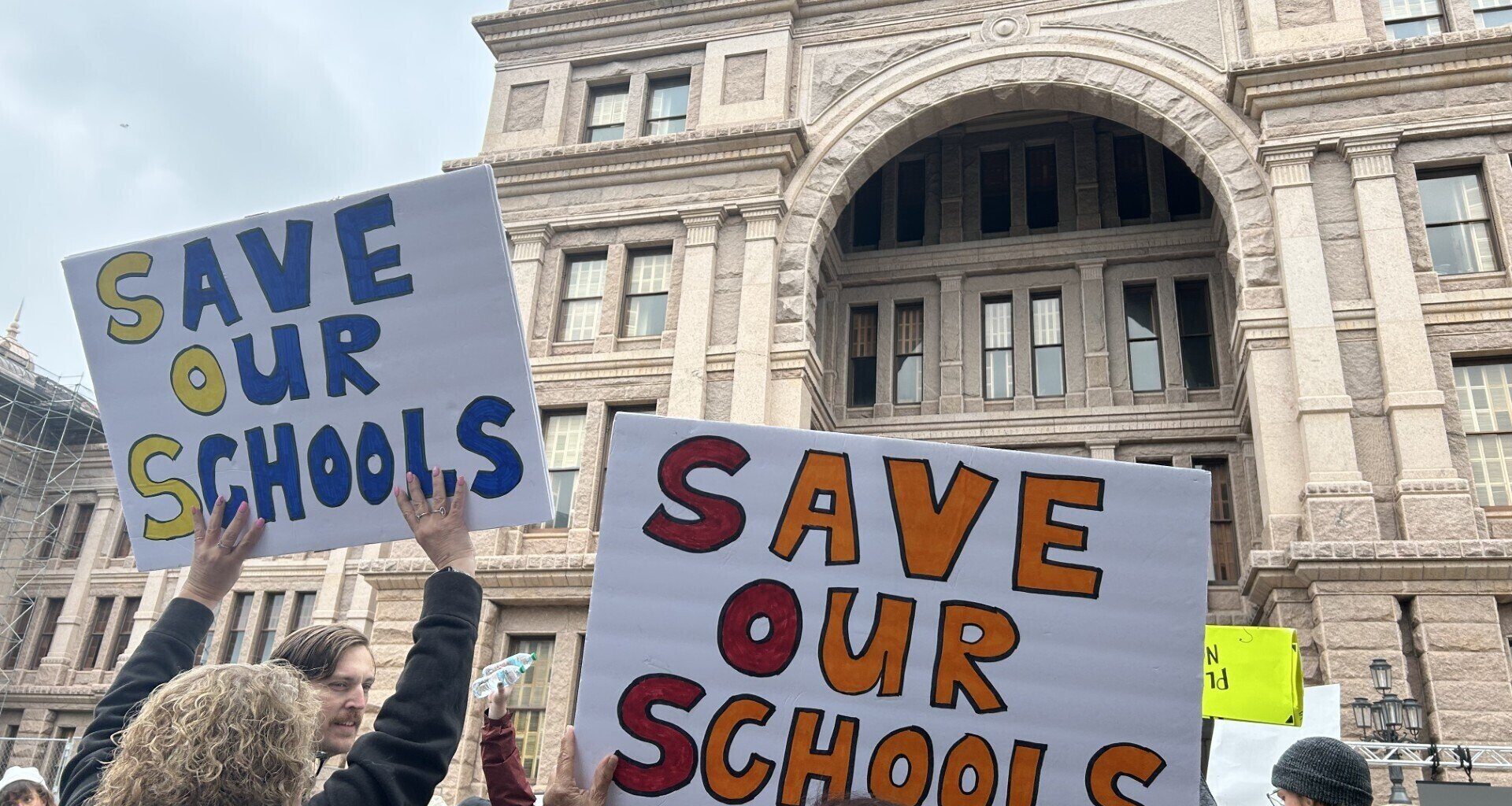
Teachers and parents rally in April 2025 outside the Texas Capitol in support of more public school funding and against private school vouchers. Texas did not arrive in the bottom 10 nationally in per-pupil education funding by accident or poverty — it arrived there by choice, Jorge Meave writes.
Keri Heath/American-Statesman
I spent more than 30 years in East Austin classrooms. I watched what happens when the campus down the street closes — the longer bus ride, the bigger class, the teacher stretched too thin to notice the kid in the back row who’s drowning quietly. So when state lawmakers gathered June 1 at the Capitol to hear school leaders describe a system in crisis, I didn’t hear a budget hearing. I heard the sound of a promise breaking.

Here is the number Texas leaders want you to remember: Last year, the Legislature sent roughly $8.5 billion in new money to public schools through House Bill 2.
Article continues below this ad
Here is the number they’d rather you forget: After six years of largely stagnant funding, the basic per-student allotment — the core of how schools pay for teachers, lights and books — increased by just $55.
So it should surprise no one that the $8.5 billion did not stop the bleeding. Austin ISD faces a $181 million shortfall. In Crystal City, in the South Texas I come from, a district recently told families it had less than $500 in the bank.
Less than $500. For a school district.
How did the wealthiest state in the most powerful nation on Earth arrive here? Not by accident. By design.
Article continues below this ad
First, for six years Texas schools went without a meaningful increase in per-student funding because Gov. Greg Abbott refused to approve a package unless it included a school voucher program. Public schools became the leverage.
Second, a drain is coming. The voucher program launches next school year, and officials warn it will pull still more money from public education budgets. Texas funds schools by attendance: When a student leaves, the dollars leave, too. And here’s the part that ends the “school choice” fairy tale: Of the nearly 96,000 students recently invited into the voucher program, 57% already attended private or homeschool. We are not rescuing poor children from failing schools. We are writing checks to families who already left and billing the children who stayed.
Third, fear is emptying some desks. School leaders told lawmakers that declining enrollment — driven in part by families’ fear of immigration enforcement — is feeding the crisis. When an immigrant mother is afraid to send her citizen child to school because ICE might be waiting, that empty desk becomes a budget cut. In a system funded by attendance, fear becomes fiscal policy.
SIGN UP FOR THE AUSTIN ANGLE and get Statesman commentaries in your inbox
Article continues below this ad
And when the state labels those schools as failing, the science does not support the verdict. A peer-reviewed study of 398 Texas elementary schools found that schools rated “Unacceptable” by the Texas Education Agency showed the highest academic growth of any accountability category. The system risks closing schools where children are growing the fastest.
I am the grandson of South Texas farmworkers. The system was never built to serve families like mine. I became a teacher because I believed public education was the one institution in American life that still said: every child, no exceptions, come in. That belief is being dismantled in plain sight, dressed up in the language of “choice” and “parental rights.”
Texas did not arrive in the bottom 10 nationally in per-pupil education funding by accident or poverty. It arrived there by choice — decades of decisions that prioritized property tax relief, corporate incentives and now private school subsidies over investment in the classroom. The children sitting in those classrooms today did not make those choices. They are simply living with them.
On June 18, the Austin school board will decide on budget cuts to address its $181 million shortfall. Those choices did not have to be this hard. They are this hard because the state handed the bill to local boards, local teachers and local kids — so Austin takes the blame for decisions made under the dome.
Article continues below this ad
If you live here, show up. Watch how your board votes. Ask your state representatives why “the best state in the nation for business” cannot keep a Crystal City school district above $500. And the next time someone blames teachers or “woke” curriculum for the state of our schools, remember: The math was done by people who knew exactly what it would cost.
But the state crisis is only half the story. Washington is loading a second gun. The “One Big Beautiful Bill” — signed into law last July — creates the first federally funded national private-school tax credit, kicking in January 2027, in the middle of the school year Austin ISD is struggling to survive. It also cuts Medicaid funding for the therapists, counselors and nurses who serve Austin ISD’s 16% special education population, with 80% of district leaders nationally predicting staff layoffs as a result.
The full reckoning of what that bill means for Texas public schools is still coming.
Public schools educate 5.5 million Texas children. They are not a line item. They are the promise. And right now, in our name and on our watch, that promise is being closed campus by campus.
Article continues below this ad
I taught long enough to know what we lose when a school goes dark. I’m telling you now, before the lights go out, while there is still time to keep them on.
Jorge Meave is a retired bilingual educator and administrator with 30 years of experience in the Austin, Round Rock and Del Valle school districts. He is the founder of Word Works, a literacy platform for English language learners. James Troutman, an educational consultant whose doctoral research documented state takeovers of public school districts, contributed to this piece.