
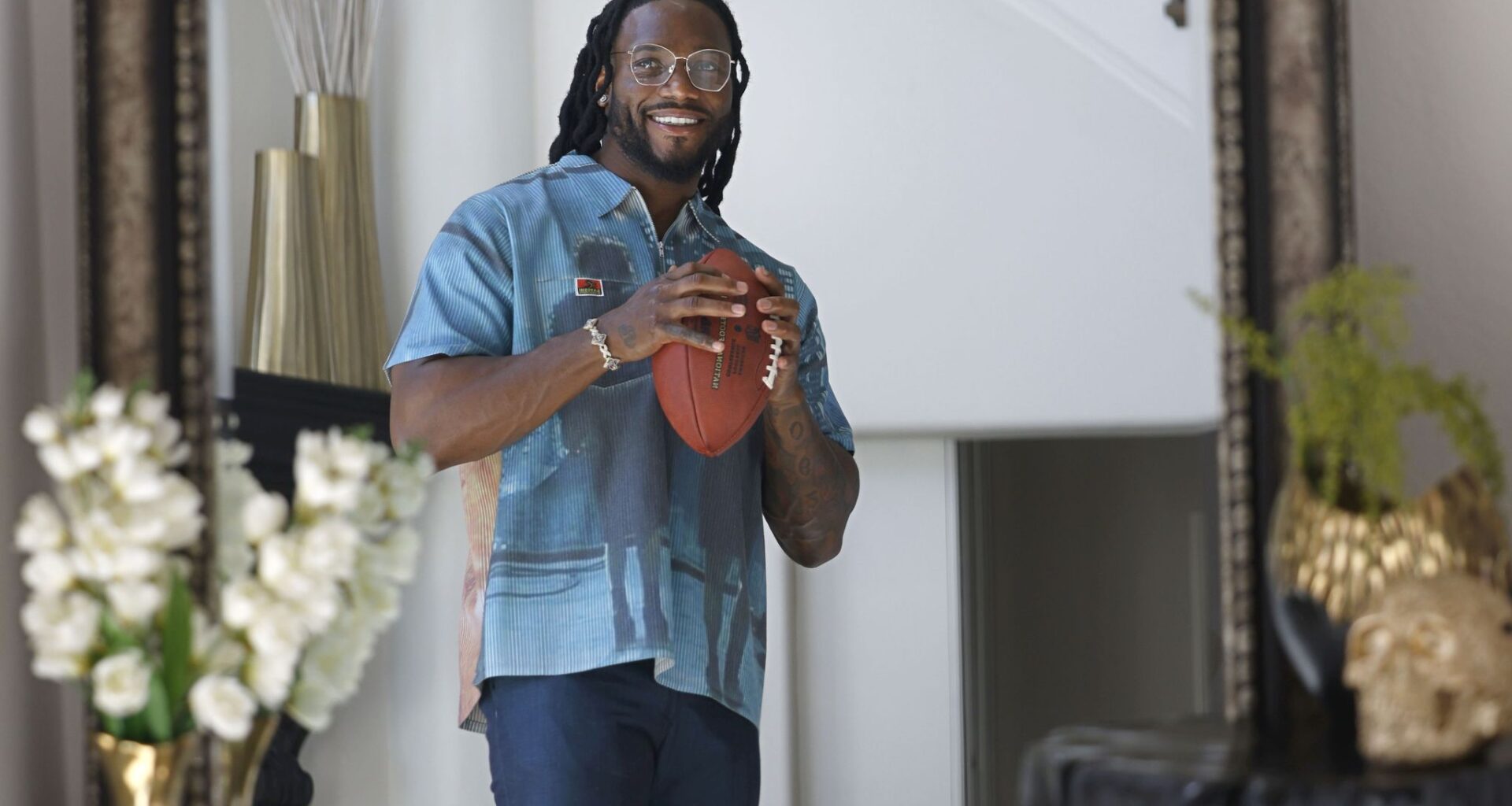
FRISCO — He opened the front door himself — the 30-year-old who has taken a sledgehammer to the trope about NFL players going broke.

There’s Jaylon Smith, shuffling about as “So Amazing” by Beyoncé and Stevie Wonder resonates through his 5,000-square-foot home. His 9-year-old dog, Achilles, meanders. Follow the former Dallas Cowboys linebacker into his office, past the golden skull and giant mirror, for a glimpse into the mind of a man who stands to make more money off the field than the tens of millions he has made over the last decade on the field.
Jaylon Smith slaps hands with then-Cowboys coach Jason Garrett before facing the Green Bay Packers at AT&T Stadium. Smith stands to make more money off the field than the tens of millions he has made over the last decade on the field.
2019 File Photo/Tom Fox
“I’ve played 10 years in the National Football League. I beat a lot of odds,” Jaylon Smith says. “But I have a real purpose beyond athletics.”
Chitose Suzuki/The Dallas Morning News
Cowboys players (from front left): Dak Prescott, Jaylon Smith (54) and Darius Jackson server an early Thanksgiving Day meal at the Salvation Army’s Mabee Social Service Center in Fort Worth in 2016.
File Photo/Staff
Jaylon Smith (right) speaks during a panel discussion at the Rise Athlete Enterprise Symposium, a sports business networking event in Frisco. Heath Butler, Mercury Fund partner (left), and Marty McDonald, founder of Elle Olivia and Boss Women Media, were also on hand.
DMN
A whiteboard with his hand-written message: “Have you been choosing your favor, or have you been choosing your demise?” Shelves with a globe, a Louis Armstrong record, boxed bottles of Hennessy. Dozens of books — Weapons of Mass Instruction, The Science of Scaling, The Motivation Manifesto — about which Smith can rattle off quick commentary.
Article continues below this ad
“This one, Rocket Fuel,” he says, “really, really, really good. A business operating book. So, one of my very first investments was in an entrepreneurial operating system.”
Talk business with Smith and topics ping-pong from the venture he’s most proud of, his life insurance company with his oldest brother, to the 65 acres he owns in Sherman. Watch him beam when he details the academic curriculum he’s creating about entrepreneurship, business ownership and leadership that he’s piloting in high schools in northwestern Indiana, where he grew up and owns a home.
He walks to a living room chair facing the swimming pool in his backyard. He sits. He leans back. He smiles. A decade ago, when the Cowboys selected him 34th overall in the second round of the NFL Draft, he started letting his money make money. Unsigned for next season, he eyes the horizon.
“I’ve played 10 years in the National Football League,” Smith says. “I beat a lot of odds. But I have a real purpose beyond athletics.”
Article continues below this ad
The devastating injury Smith suffered a decade ago in his final game at the University of Notre Dame derailed a potential Hall of Fame career. But it also set him on a trajectory — before he had even played a down for the Cowboys — to create generational wealth for his family and serve as a blueprint for professional athletes looking for an entrepreneurial playbook.
Jaylon Smith smiles during a Rise Athlete Enterprise Symposium in Frisco. Rise Family Office, founded by Michael Ledo, helps pro athletes become business savvy.
2025 File Photo/Staff
During a 90-minute visit with The Dallas Morning News at his home, Smith called the injury the “greatest thing” to ever happen to him. Whenever the football-playing chapter of his life ends, he says, will mark the beginning of another, one with unlimited potential.
He says he has made $44 million gross — $33 million net — to date during his playing career, which began with the Cowboys from 2016 to 2021 and most recently included signing with the Las Vegas Raiders in spring 2025 before being released in August. In 2021, according to his business plan at the time, he had a net worth of $12.5 million.
He says he’s on track to have a net worth of $100 million by 40. He’s ultimately planning to have a net worth of $250 million.
Article continues below this ad
“Liquid, liquid, liquid,” he says.
“Magic Johnson made $30 [million] to $40 million [just from on-court earnings] in his career,” Smith says, noting Johnson made exponentially more in his post-playing career. “The trajectory of the b-hag — the big hairy audacious goal — is that.”
Smith wants to be a beacon as an athlete entrepreneur. He began his career with the end in mind. Because of the injury, he was forced to. He maximized the opportunity, putting himself in “uncomfortable situations, learning about business, about terminology, being okay with being incompetent but putting in the work to learn,” he says.
“Now, four operating companies that are cash flowing, 21 investments, and I’ve got a lot to give.”
There may be current NFL players with more capital — Patrick Mahomes, Travis Kelce, among others. Smith hasn’t merely been an active investor but rather an active entrepreneur during his career. His story flies in the face of statistics revealing that 78% of NFL players go broke. His story highlights how the paradigm is shifting compared with the previous generation, known as the “bling, bling” or MTV Cribs era, when many athletes were awash in excess and financial troubles.
Article continues below this ad
Sports agent Leigh Steinberg has represented some of the most prominent NFL players in history, including Troy Aikman, Steve Young and Mahomes, and was the real-life inspiration for the movie Jerry Maguire. He said many athletes of the 1990s had little to no understanding of wealth management — but a shift is well underway.
“That’s why you had so many horror stories from that era,” Steinberg told The News in a lengthy interview. “We had enough problems just keeping them from bankruptcy, divorce. There is a quantum leap to a contemporary athlete who is eminently more savvy and sophisticated. Contemporary athletes have been totally aware of the problems of past athletes.”
Working closely with Smith has been his mentor since the age of 14, Michael Ledo, founder and CEO of Frisco-based Rise Family Office. Ledo is the nephew of the acclaimed late sports agent Eugene Parker, who represented Deion Sanders. Ledo said his company serves a purpose to “crack a code that we don’t believe has been cracked.
Jaylon Smith has worked closely with his mentor, Michael Ledo, the founder and CEO of Frisco-based Rise Family Office. Together they crafted what they called the “athlete enterprise plan.” It was a 10-year plan they reverse-engineered based on what they wanted his net worth to be by 2026.
Elias Valverde II/Staff Photographer
“Jaylon is a great blueprint. He is the blueprint.”
Article continues below this ad
In a 10th-floor office high above Frisco, Ledo looked for a way to detail Smith’s business strategy over the past 10 years. He grabbed a notebook.
‘End goal was our North Star’
Sitting in his living room, Smith remembers one thing about Jan. 1, 2016: Dinner plans were set. He was to join Larry Fitzgerald and Parker after Notre Dame’s Fiesta Bowl against Ohio State.
Then everything changed in what served as a seminal moment as well as an ignition point. He tore his ACL and LCL and suffered nerve damage, causing his top-five overall draft status to drop and jeopardizing his entire career. He couldn’t bring himself to think what others did: That he may never play again.
Article continues below this ad
“I couldn’t afford to think that way, transparently, my biggest fear or initial negative thought was more so about the timing,” Smith says. “It just sucked, the timing in which it happened, but in hindsight, it’s the greatest thing that’s ever happened to me.”
This was five years before the NIL era, which now enables star college athletes to earn seven figures while in school.
“If I was a part of NIL, I probably would have been up anywhere from $3 [million] to $5 million while I was in college, based on the university, the stature,” Smith says. “I didn’t want to take illegal money [against NCAA rules at the time] and get disqualified or expelled from school. So it was just more about, man, this is going to be a huge loss to my family — $17 million like right off the bat.”
So while Smith rehabbed, there was something else he was already engrossed in: regular business strategy sessions with Ledo.
They still have the videos of some sessions. They crafted what they called the “athlete enterprise plan.” It was a 10-year plan they reverse-engineered based on what they wanted his net worth to be by 2026.
“Nothing was done by accident,” Ledo said. “We started with the end goal — that was our North Star.”
Ledo said Smith played his career at 70% of his best. There was always a sense of urgency. They didn’t know if he’d ever play again, at what level or for how long.
“Hey, we’ve got to make sure, with the little money we got from his insurance policy and the contract with the Cowboys, we didn’t know how long the nerve was going to last,” Ledo said. “So when you talk to the doctors, he’s like, ‘Hey, the nerve could go out, we don’t know how long he’s going to be able to play.’ ”
Halfway through the plan, at the five-year mark in 2021, they devised another. At that point, according to the plan Ledo showed The News, Smith had a net worth of $12.5 million with sights set on $50 million.
Ledo recalled that Smith would “get a lot of heat” from Cowboys fans because they would see some of his off-field business ventures and feel he should just focus on football.
“But if that dude would have focused just on football, whenever he begins the transition, he wouldn’t be where he is now,” Ledo said. “This element of when guys have to transition to the game of life after the game of football — they are totally unprepared.”
‘He was my idol at 17’
Smith spends about 60% of his time in Frisco and 40% in Indiana, where he has a daughter about to turn 2.
In his Frisco living room, he talks for four minutes uninterrupted about his emotions. He said the opportunity to play for America’s team is “something that will always be in my heart.”
His mind rewinds to his first of five seasons with the Cowboys.
The 2016 season was a redshirt year for Smith, who learned under linebacker Sean Lee and spent a lot of time with Tony Romo as the two rehabbed from injuries together. He also said he “got uncomfortable” in learning about business and himself and hearing doctors saying he may never play the game again.
That year gave him the opportunity to learn new business terminology, get into boardrooms and become a sponge. Becoming an athlete entrepreneur was something Smith had targeted since he was 11.
After he won his fourth state football championship in high school, he opted against playing basketball his senior year. Instead, he got a job at Burger King.
“I wasn’t going to be able to work in college. I wanted to get an opportunity making my own money, but then practicing ‘service over sales,’ so in working at fast food I was able to sit with multiple families, serve multiple families,” he says. “You may have a Burmese family of 12 that I’m feeding dinner.
“You may have a pregnant woman that’s coming through the drive-through, that’s cussing me out, because I messed up her milkshake. All these different experiences shaped me into, like, OK, this is what customer service looks like, this is what great sales look like, this is what costs look like, cost of goods and different portions, all of these different things.”
One day, he went home and typed “most successful athletes who had great success in business” into a computer. The name Junior Bridgeman popped up. Bridgeman played in the NBA from 1975 to 1987, invested in a fast-food empire of 450 restaurants and died last year with a net worth of $1.4 billion. He spent his off-seasons learning under experts, developing new skills, proving he was more than an athlete.
“He was my idol at 17,” Smith says. “I’m like, ‘That’s who I want to be like.’ So me embarking on the journey of all the different endeavors I have is a great testament to the Junior Bridgemans, the Shaquille O’Neals, the LeBron Jameses, the Magic Johnsons, those guys that have displayed you can do extreme things outside of using your body as labor.”
To that point, Ledo recalled recently asking a veteran player how much more football he knows now than when he was a rookie.
“A lot,” the player answered.
How much more does he know about money than when he was a rookie?
“That’s the issue,” Ledo said. “They come in and they leave, in many cases, almost like infants in other respects.”
They don’t have an identity beyond the field, Ledo said, adding, “They’re like, ‘Yo, what am I going to do?’ It’s a real question. They’ve been on autopilot.”
“People are starting to want to know more,” Ledo said. “They want to be more empowered, instead of just totally blind, trusting somebody with their money. ‘Hey, do this.’ But I think the culture of sports for the pro athlete is so destructive that it’s hard to be part of that culture and not operate in it.”
‘An excuse for mediocrity’
Smith says fellow NFL players often ask him about his business blueprint.
He says he wants peers to not treat the NFL like an extended vacation. Prepare yourself for life after the game, and not just financially, but mentally and spiritually.
“When it stops, when that [cash] spigot cuts off, they don’t even have a slightest idea,” Ledo said. “What most of them are doing is they’re saying, ‘Hey, when I’m done, I don’t ever want to have to work again.’ But you’re 30 years old. While they think they’ve made it to their pinnacle, we’re preparing and developing them for the next stage before it even gets there, where the other guys are just reacting.
“In many cases, it is too late.”
Steinberg said the first time athletes walk into his office to hire him, he asks, “What other talents, skills, interests do you have in the world?”
“The goal is to empower a player to be in charge of his own life,” Steinberg said. “He needs to learn about the tax system, he needs to learn about budgeting, he needs to learn how to buy a house, he needs to learn how to invest, he needs to learn how to take his brand and transfer that into not only an endorsement but one that involves equity.
“What we used to look at is if you could just spend your endorsement money and retain capital.”
Former NFL player and front-office executive Rodd Newhouse, a wealth manager with 44 Management, has dozens of former and current NFL players as clients. He doesn’t want to attribute pro athlete-financial issues to mismanagement or bad decisions. He wants to call if life — the transition to a post-playing career is hard.
He recalled when he once had $16.17 in his bank account, with a wife and two kids, with a law degree, with a real estate broker’s license, having worked 10 years in the NFL as a player and executive.
“Just because you have this money doesn’t really mean you’re going to have money for the rest of your life,” he said. “Professional sports is a high-paid, part-time job.”
He’s fired a player who had $3 million, was down to $832,000 and told him, ‘I don’t want you to go broke on my watch.”
Jaylon Smith says he wants peers to not treat the NFL like an extended vacation: Prepare yourself for life after the game, and not just financially, but mentally and spiritually.
Elias Valverde II/Staff Photographer
Technology has changed. Human nature has not. Athletes are inundated by fly-by-night charlatans pitching deals, looking for capital, promising big returns.
Newhouse, the son of former Super Bowl-winning Cowboys fullback Robert Newhouse, said there are famous former Dallas Cowboys who invested in bottled water in the 1970s and 1980s and “went broke.”
What’s the craziest pitch he’s seen to NFL players?
“I’ve seen the vodka deal,” he said. “I’ve seen the ‘Give me $2 million to unlock $10 million because we’re going to build a casino.’ I’ve seen ‘Invest in the Spike Lee movie that Spike Lee is not even a part of.’ I’ve seen the construction project that doesn’t exist.”
Ledo said athletes can be inundated by people looking for them to fund their ideas, because they have a lot of capital but “aren’t very sophisticated and don’t understand money. They are an easy target to raise capital.
“If you and I got in a plane right now and went to China, and we step off the plane and are not fluent in that language, then we’re probably not going to have a lot of success in that country on how to protect ourselves,” Ledo said. “That’s an athlete in business and finance. You don’t know the language.”
Even when the athlete wants to learn the language, Smith says, the culture of professional sports often discourages it.
“What’s encouraged is for us as athletes to wait, wait until you’re done [playing],” Smith says. “You don’t have time to focus on that right now. You don’t have time to learn that. And it’s really just an excuse for mediocrity.”
‘He’s going to light the room like a fire’
A can’t-miss prospect, Smith says he knew he was going to make the NFL since he was 7.
In the business world, there was a learning curve. He said he was “illiterate” from a business sense, not understanding rudimentary ROI [return on investment] concepts or P and L [profit and loss] documents.
Some of the most important things he’s learned: The best companies fix problems — what is the problem to fix? And it’s essential to have the right people — you need to hire slow and fire fast.
He has his hand strategically in many buckets:
There’s the Minority Entrepreneurship Institute, where he helps minority founders get support, funding, and mentorship they need to grow.
He opened his first Jinya Ramen Bar franchise on Notre Dame’s campus in July 2025, with several additional Indiana locations slated to open in the coming years. He founded The Cycle Management Group in partnership with Globe Life insurance.
He invested $100,000 in Oura Health during the company’s Series C round in 2021 and cashed out in February 2026, netting a 10x return.
He cofounded CEV Collection, a sunglass line available in more than 500 Sam’s Club and Eye Mart Express stores nationwide.
And there’s the 65 acres he owns in Sherman and the 150 acres he invested in in North Dallas.
He’s shown a laser-like focus on details.
At a recent Super Bowl in Miami, Ledo recalled one of his assistants telling him Smith was out until 5 a.m. — and he had a meeting with a top business leader, a Notre Dame alum, at 8 a.m.
Regardless, Smith walked into the restaurant promptly at 8 a.m. in a full suit, focused and game-day ready.
“He is dynamic in meetings,” Ledo said. “You put Jaylon in the room with a whole bunch of people, he’s going to light the room like a fire. That’s his gift.”
Jaylon Smith shows Brianna Dix what she looks line in his line of Clear Eye View glasses at Frisco Lincoln Experience Center in The Star in Frisco. Smith’s sunglass line is available in more than 500 Sam’s Club and Eye Mart Express stores nationwide
Nathan Hunsinger/Staff Photographer
Ledo said Smith does not walk into rooms insecure. He doesn’t walk into a room and say, “ ‘Oh, I don’t want to sound stupid.’ No, he wants information. He feels like he belongs.”
Smith always says the No. 1 thing Ledo taught him is “how to think, how to process.”
Smith is visual. If they are going through financial charts, they’re on a whiteboard. Smith wants to see the plan, have it explained, have the strategy detailed.
“He loves accountability,” Ledo said. “Some people are allergic to that s—.”
Smith says that’s the “only way to reduce your ego. I truly care about learning. Some people want the result but don’t want to learn the information. Yeah, you can make $100 million, but if you don’t gain another skill or transfer the knowledge, it’s not going to matter.
“I didn’t grow up learning about business or how to read a P and L, or even understanding what an ROI really means, and never thought about different tax corporations to help reduce what you’re paying through the IRS and all these different tax strategies.”
The reason 78% of NFL players go broke “isn’t because they can’t do math,” Ledo said. They need to learn.
Ledo said Smith isn’t afraid to go into a meeting and know the least, because he’s going to walk out knowing a lot. He’s had 10 years of at-bats, 10 years of reps in finance.
“That experience, the good and the bad, at just 30 years old, has prepared him for this journey of entrepreneurship,” Ledo said.
‘Net worth over $100 million’
Back in the 10th-floor office high above Frisco, Ledo grabbed a pen and notebook and scribbled down several pages of Smith’s business plan.
“He will cash flow $3 million next year,” Ledo said. “That’s from his businesses off the field, not his investments.”
Ledo flipped a page and continued.
“We invested in 150 acres of land,” he said. “About to close here in the next 60 days, so he’s going to get a big return on that.
“He’s going to get a 3x. Then he invested into a company called Wizehire, and he’s about to get an investment back on that in the next six months. Then he has a company he invested into called EOS Worldwide that we think is going to sell here in the next 12 months and that’s going to be 10x. He’ll make over a million on that.”
Ledo drew a circle. That’s a handful of operating entities. That represents $3 million. As those entities grow, he said, that bucket will be between $5 million and $10 million in annual cash flow.
To the right of the circle, Ledo drew a box.
“This is what we call his financial freedom,” Ledo said. “His equities are sitting over here in the millions.”
Ledo said, hypothetically, if Smith’s living expenses are $800,000 per year, he’s netting $2.2 million per year. That then goes back into businesses.
“And it’s just, boom, boom, boom, boom,” Ledo said. “Jaylon is invested in 21 private investments. They are going to appreciate in value, valuations are going to go up. He’s going to have exits. So when he has those exits, it’s going to be like, ding, ding, ding, ding — here’s another million.”
Ledo said he will have one exit that will pay him more than his entire NFL career earnings so far.
“Net worth over $100 million,” Ledo said. “He’ll be worth that kind of money in the next 10 years.”
‘We’re so much more than athletes’
“Achilles, what’s up, man?” Smith says.
Nine-year-old Achilles, a pit bull, border collie and German shepherd mix, lumbers through the living room like a nose tackle.
“I rescued him when he was,” Smith says as his cellphone rings, interrupting him.
Former Dallas Cowboy Jaylon Smith, with his dog Achilles, says he has made $44 million gross — $33 million net — to date during his playing career. In 2021, according to his business plan at the time, he had a net worth of $12.5 million. He says he’s on track to have a net worth of $100 million by 40.
Chitose Suzuki/The Dallas Morning News
“Talk to me,” he says into the phone. It’s a business call. It lasts 34 seconds.
Smith likes efficient, a word he uses often. To him, time is gold.
Ledo fields questions from NFL players all the time: They want to know how to get access to unique deal flow, private investments. They want to know how to avoid predatory deals. Most of all, they have another question:
“How do I become the next Jaylon Smith?”
Smith weighs another question — his legacy whenever he is finished playing football.
Smith says he wants his legacy rooted in understanding you can be elite in everything you do. He has accepted that “I’m the one in my family to bridge the gap as it pertains to misinformation, lost information, new information.
“We’re so much more than athletes, we just have to allocate the amount of time that we allocated being great at the sport, you have to direct that to another channel, and with knowledge comes wisdom, with wisdom comes wealth, and more, more, more, and more opportunities — impact most of all. The athlete entrepreneur.”
He says less than 1% of pro athletes get the “fairy-tale ending.” But his playing career, once entirely in jeopardy, will have a pretty good ending whenever that chapter closes.
The man some call The Blueprint turns back and smiles.
“I’m just getting started.”