
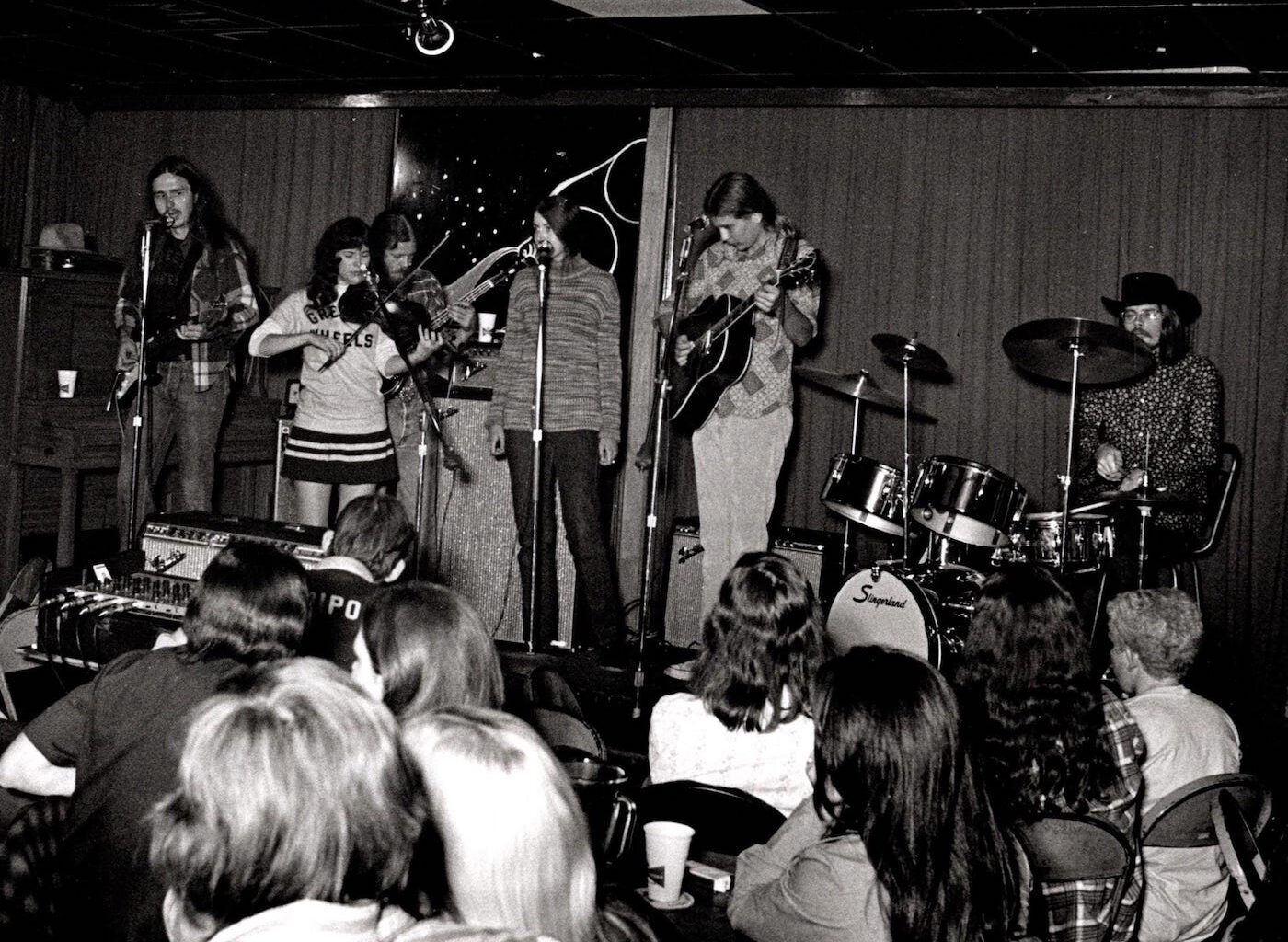
August 12, 1972, marks one of the most pivotal moments in Austin music history. That night, Willie Nelson climbed onto the stage at the fabled Armadillo World Headquarters for the very first time—but the band that made it all possible was the evening’s opener, Greezy Wheels. One of the capital city’s most beloved bands in the 1970s, the group had developed a reputation for packing the house, which helped the club introduce local crowds to new artists.
“We had a deal with [Armadillo co-founder] Eddie Wilson that we could have our own shows and make the door,” said Cleve Hattersley, Greezy Wheels’s founder and visionary. “And when they wanted to develop new acts we would come and open for 100 bucks. We would draw the same audience, but they got to see this new thing.”
The “new thing” included headliners like Bruce Springsteen, Asleep at the Wheel, Ry Cooder, along with the aforementioned Nelson. “Willie discovered our audience, which joined his fanbase. Springsteen found the same thing. Austin was sort of programed to be that way,” said Hattersley.
Greezy Wheels also had the honor of being in the inaugural class of artists to record an episode during the first season of Austin City Limits, which aired back in 1976. That roster of performers included Nelson, Bob Wills, Townes Van Zandt, Doug Sahm, and Jerry Jeff Walker, to name a few. In short, this crew of forward-thinking music makers has a resume of accolades that stacks up impressively against pretty much any other artist from the live music capital.
This week, Greezy Wheels, returns to its hometown with a handful of performances to support its final studio album, We Come We Go (Armadillo Records). Formed as a trio in 1970, the group quickly earned immense local popularity within the then-burgeoning “progressive country” music scene, eventually performing at the legendary Armadillo World Headquarters more often than any other band—123 times according to local music historians Michael Corcoran and Jason Mellard.
Townsend Miller, perhaps Austin’s finest music writer of the 1970s, praised the band’s evolving musicianship, noting that whenever they “stray the farthest on certain numbers” into more progressive territory, those songs “may prove to be the most exciting.” As the Armadillo’s “house band,” Greezy Wheels fostered—or mirrored—Austin’s counter culture, where rednecks and hippies came together under one roof to drink beer, smoke dope, devour shrimp enchiladas, and dance.
Songwriter, guitarist, and vocalist Hattersley met bassist Michael Pugh and guitarist Pat Pankratz in 1970 and instantly clicked, playing skiffle, gospel, traditional country, and rock-and-roll. They kept adding players, including drummer Tony Laier and fiddler and vocalist “Sweet” Mary Egan (now Hattersley).
“Two weeks after Mary was in the band [Armadillo World Headquarters co-founder] Eddie Wilson says come and play with the Flying Burrito Brothers,” Hattersley said, recalling the band’s June 1971 debut at the iconic music hall and beer garden. “First time on that stage we got a standing ovation and an encore. We thought we were going in the right direction.”
Following Nelson’s inaugural 4th of July picnic in Dripping Springs (1973), the New York Times described the rapidly growing progressive country category as—essentially—“Willie Nelson’s friends,” including Waylon Jennings, Billy Joe Shaver, John Prine, and “an outstanding young local band called Greezy Wheels, whose style is a tasteful blend of the Grateful Dead, the Allman Brothers, and something all their own”.
“It was basically whatever happens happens,” said Pat Pankratz of the band’s occasional turns toward the psychedelic music of the cosmic cowboy period. “There were a lot of times when we were psychedelicized ourselves. That made it easier. You could drone in the key of A for hours.”
After hundreds of live performances, three albums, and several different band lineups, Greezy Wheels went on indefinite hiatus in 1978. Cleve and Mary Hattersley (currently of Las Cruces, NM) reformed the band with original and new members in the early 2000s and began recording again. We Come We Go marks the group’s ninth studio album, which Cleve Hattersley described as not only a farewell release but a “self-portrait” from all the band’s individual contributors.
“Every song is its own universe. And our fans always understood that about us,” Hattersley said. “Our music was always sort of indefinable and, I guess, it remains so to this day. “The way we formed was sort of an identifier to the way the whole music community was forming,” he said of the band’s lasting impression on Austin’s music scene. “We were just as astounded by everything as everybody was.”
If We Come We Go is truly the Greezy Wheels’s swan song, it is a fitting collection of eclectic world tracks from a band that once cast a mighty large shadow across the live music capital of the world. “We’re proud of it,” said Hattersley. “I think it says what we wanted to say.”
You can catch the legendary Austin act at several performances over the next week:
June 13 at Continental Club: Original guitarist Pankratz joins Greezy Wheels, with a special appearance by Jim Franklin, whose poster art defined the Armadillo’s idiosyncratic and influential existence and who often acted as emcee for the shows.
June 16 at Waterloo Records: The legendary record store hosts an instore record signing with Cleve an Mary Hattersley.
June 18 at Evangeline Cafe: The landmark Cajun and Creole restaurant hosts Cleve and Mary Hattersley.
June 20 at CBoys: The full band takes the stage with an appearance by Texas blues-rocker Chris Duarte.