
Dominic Anthony Walsh / Houston Public Media
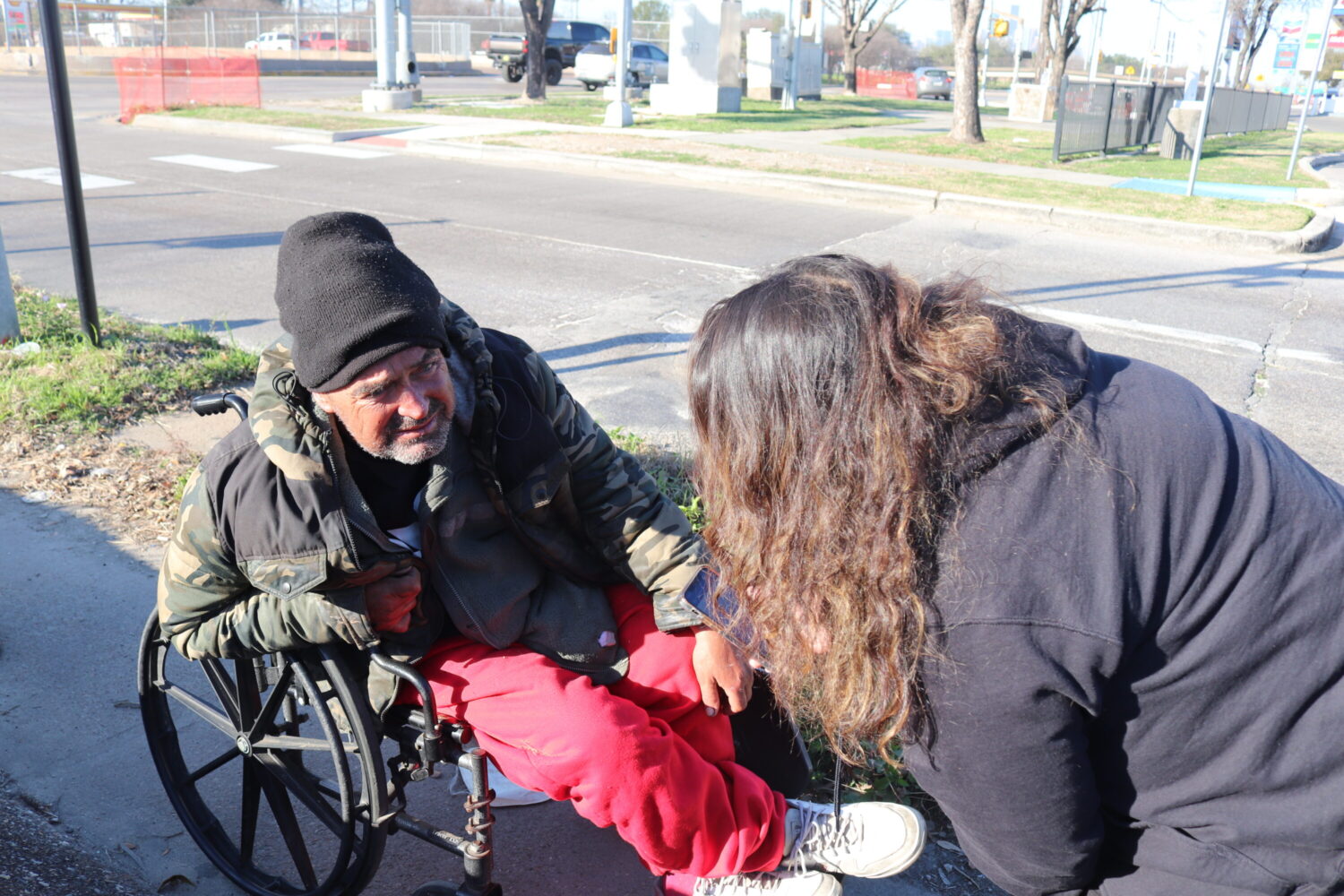
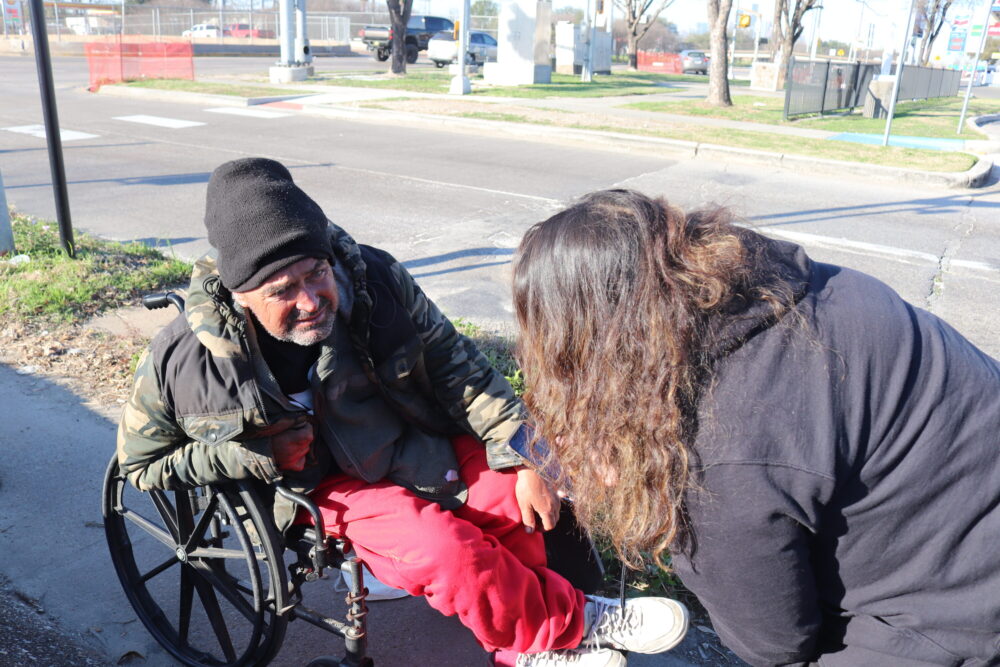
Timothy Wright responds to a survey conducted by Jackie Urbina, an outreach associate with the Coalition for the Homeless, on Feb. 24, 2026.
As the population of people who slept in Houston-area streets or shelters held steady for the sixth year in a row, Mayor John Whitmire’s administration moved to recalibrate its initiative to help them — shifting from “ending street homelessness” to “reducing” it, according to city housing director Mike Nichols.
In a report released on Friday, the Coalition for the Homeless of Houston and Harris County said it counted 3,321 people on streets or in shelters during its annual point-in-time count in February. During the count in 2025, conducted across Harris, Fort Bend and Montgomery counties, the organization counted 3,325 people.
“Steady does not mean solved,” said Renee Cavazos, the coalition’s vice president of the homeless response system. “The system is working, but it is still under pressure.”
Sign up for the Hello, Houston! daily newsletter to get local reports like this delivered directly to your inbox.
The vast majority lived in Harris County, where the unsheltered population living on the streets ticked down from 1,210 in 2025 to 1,189 in February.
The flat line came as the national number of homeless people hit a record high over the past two years.
Despite success, the first year of Whitmire’s initiative didn’t ease concentration in the central urban core
In late 2024, Whitmire unveiled his initiative to “end street homelessness” in Houston. Throughout 2025, the city and its partners focused their efforts in the city’s central urban core, where more than 200 people were moved into housing through the effort.
Still, according to Cavazos, the population remained concentrated in the downtown and Midtown areas during the count in February.
“There’s a lot of outreach and basic need supports that happen in our downtown region every day, and so you will always see a concentration of folks coming downtown for help,” she said.
RELATED: Mayor Whitmire wants to ‘end homelessness’ in Houston this year. The effort faces challenges
In addition to dispersing the concentration of homeless people downtown — through a combination of housing and service referrals as well as ramped-up enforcement of sidewalk obstruction rules — the administration initially hoped to “end street homelessness” by the end of 2026. It defined the ambitious target as ensuring everyone moves from the street into housing within 90 days of them becoming homeless.
Over its first year, Whitmire’s effort struggled to find funding, raising less than half of its $70 million annual goal. But it also celebrated the $16 million purchase of a 222-bed residential resource center for homeless people in East Downtown, expected to move 750 people off the streets each year.

Dominic Anthony Walsh / Houston Public Media
Each room at 419 Emancipation Avenue contains three beds and a set of lockers.
The facility came with $13 million in annual operating costs. The city tapped the Harris Center for Mental Health to run the center, and it’s required to report monthly metrics including shelter utilization and housing outcomes. After opening earlier this month, Nichols said it’s already near capacity as of this week, sheltering and providing services to about 200 people.
RELATED: A 222-bed homeless services hub is set to open in Houston in the coming weeks
Nichols said the administration’s overall goal has shifted to cutting the 1,200-person population living on the streets in half within two years.
“I’m OK with ‘ending street homelessness’ because that’s aspirational — that is our goal,” Nichols said. “The reality is we should judge ourselves on reducing street homelessness because the inflow is so big, that even staying flat, we should be proud of ourselves compared to other cities.”
As Trump administration critiques ‘housing-first’ approach, local officials and service providers seek ‘balance’
In the Houston area, the homeless population has held steady for the past six years after sharply decreasing from more than 8,000 in 2011 — despite the national total hitting a record high over the past two years. Officials point to the region’s “housing-first” model as the foundation of the success, in which service providers prioritize moving people from the streets into permanent housing.
Despite the documented success across the county, members of President Donald Trump’s administration have been critical of the approach.
In May, the U.S. Department of Housing and Urban Development (HUD) released its annual report on homelessness for 2025 — in which it reported 745,652 on the streets or in shelters, the second-highest total on record.
“The data is clear that the status quo of ‘housing first’ has failed to meaningfully reduce homelessness, resulting in crisis levels of people living on the streets,” HUD Secretary Scott Turner stated in a news release. “HUD is restoring its programs to advance recovery and self-sufficiency and to ensure that taxpayer-funded benefits serve American families.”
Turner’s statement is a “purely political comment,” Nichols argued.
“I’m a proponent of people working. I think it’s good, if you’re not disabled or elderly,” he said. “We need funding for people experiencing homelessness. We need funding for people who are vulnerable. We need mental health funding. All that’s accurate. So to say we need one or the other, that’s inaccurate. We need to continue to be able to house people.”
According to the local coalition, about 37,000 people have been moved into a variety of permanent housing programs in the Houston area over the past 15 years.
Much of that work is supported by more than $70 million in funding from HUD each year. Under Trump and Turner, the department has signaled its intention to impose time limits and work requirements on people in permanent supportive housing.
Local officials and service providers are now leaning into a more wide-ranging approach, including steps to address homelessness before it begins or more targeted interventions when it starts — like emergency rental assistance, transportation to family or restoration of work credentials like a commercial driver’s license.
According to a survey of homeless people conducted during the count in February, job loss, eviction and housing costs were the foremost drivers of homelessness — with about 32% of respondents stating those factors were the primary reason they lost housing, followed by about 22% who pointed to family or relationship conflict.
“I think it’s all about a balance,” Cavazos said. “It’s really about meeting people where they are and making sure that there is a pathway available for that individual so that they could reach stability, whatever that means for them.”