
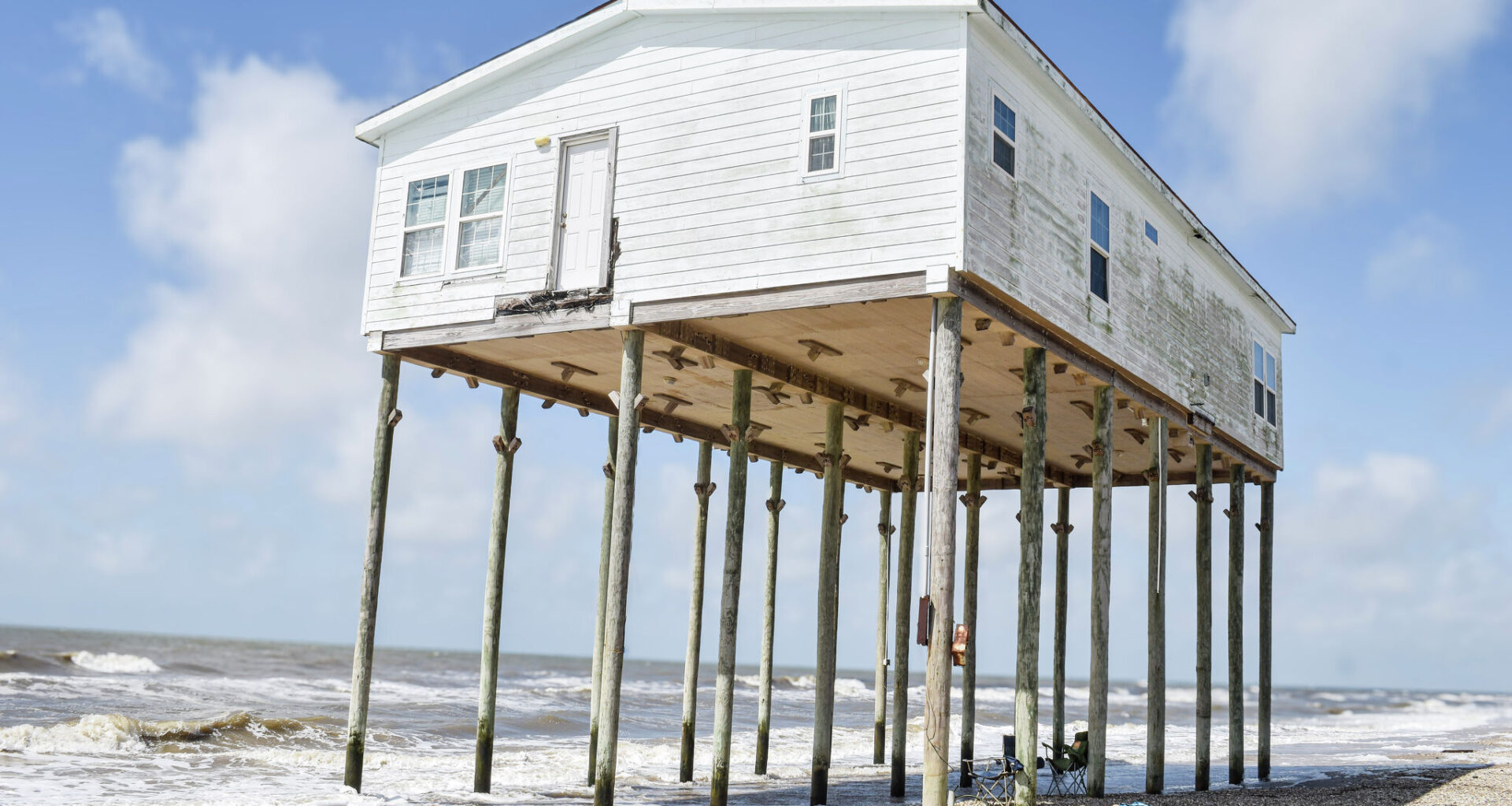
As high tide rolled in, a family walked the shell-covered shoreline and rested their lawn chairs against the towering wooden pilings. A short distance away, a woman lay quietly sunbathing.

Above them stood the so-called “Lonely House.”
The weathered white beach house rises on dozens of tall stilts near the intersection of Highway 87 and Highway 124 on Bolivar Peninsula near High Island. Once surrounded by beach, the structure now appears to hover over the surf as waves lap beneath it. No neighboring houses remain in sight.
Article continues below this ad
Online, the salt-stained home has become known simply as the “Lonely House.” The narrow strip of beach beneath it attracts beachcombers searching for shells, sea beans, sea glass and other treasures carried ashore by the tides.
Visitors search for shells, sea glass and other treasures beneath the so-called “Lonely House” on Bolivar Peninsula.
Ariana Garcia
For Troy and Deborah Commander of Marshall, visiting the house has become an anniversary tradition.
“We come down here every year, so it’s a place of refuge,” Troy Commander said as he searched the shoreline for sea glass with his wife on their 51st wedding anniversary.
Article continues below this ad
The couple first learned about the house through Facebook and now make an annual pilgrimage. Last year they found a massive seashell, which they took home, varnished and displayed on their mantel.
“We don’t like crowds, so we come down here,” Deborah said.
To them, the house has become a landmark.
“People enjoy coming out,” she said. “We’ve been out here, and there’s been several people that stay under it. The other day we came out, and it was kind of raining. There were people hiding under there.”
Article continues below this ad
Waves roll beneath the so-called “Lonely House” on Bolivar Peninsula, where coastal erosion has left the beach house standing alone in the surf.
Ariana Garcia
Nearby, Kelly Taylor slowly combed the shoreline for sea beans and sea glass. She first learned about the house years ago from a former boyfriend and continues returning because of its solitude.
When she looks at the structure, she thinks about “what could have been.”
“It’s a mix of feelings,” she said.
Article continues below this ad
Many visitors know the house’s story from a Facebook post written by its owner, Gail Odom-West.
The woman behind the Lonely House
Odom-West said she has been surprised by the attention the house has received.
“I’ve gotten so many emails and pictures,” she said.
Article continues below this ad
One woman told her about bringing her sister, who used a walker and spent hours collecting treasures beneath the house before later passing away.
“It tells a lot of stories for different people,” Odom-West said. “I’ve kept all the pictures that were posted or sent to me because it’s a memory.”
Drivers traveling along Highway 87 can spot the so-called “Lonely House” standing on stilts near the shoreline on Bolivar Peninsula.
Ariana Garcia
The story of the house stretches back more than 50 years. Odom-West and her now-husband Ted first dated as teenagers and had their first date at a nearby fishing pier that was later destroyed by storms.
Article continues below this ad
Remnants of older waterfront structures stand near the Lonely House on Bolivar Peninsula after years of storms and coastal erosion reshaped the shoreline.
Ariana Garcia
The two eventually went their separate ways before reconnecting in 2015 and marrying. Three years later, Ted purchased the beach property as a birthday gift.
“We had like two acres there,” she said. “It was beautiful.”
An interior photo of the Lonely House shows the beach home’s kitchen and dining area before its owners were forced to remove their belongings and leave.
Gail Odom-West
Though the couple lives on a farm in East Texas, the beach house became their escape.
Article continues below this ad
“We’d watch the sunsets and the sunrise,” Odom-West said. “We had just gotten a chocolate heeler, and she loved the waves.”
A photo provided by owner Gail Odom-West shows the Lonely House before years of erosion narrowed the shoreline. The home’s staircase is visible, along with Odom West’s heeler playing on the beach.
Gail Odom-West
The couple spent holidays there, welcomed friends for fishing trips and began renovating the home.
“We had just started painting the inside, getting it all going,” she said. “We were going to put up barriers and stuff like that, but it just wasn’t meant to be.”
Article continues below this ad
A heeler owned by Gail Odom-West is seen inside the Lonely House during the years when the beach home was still accessible.
Gail Odom-West
The turning point came after the closure of nearby Rollover Pass, a man-made channel cut through Bolivar Peninsula in 1955 to improve fishing and water circulation between the Gulf of Mexico and East Bay. State officials closed and filled the pass between 2019 and 2020, arguing it was accelerating erosion and requiring expensive maintenance.
Around the same time, a series of storms battered the coastline.
An earlier photo shows a restroom inside the Lonely House before the home became inaccessible.
Gail Odom-West
“When they did the rollover, it basically made the ocean start coming up,” Odom-West said. “I had to take up my electricity, water and the septic tank because the sea had basically taken it over.”
Article continues below this ad
The Texas General Land Office disputes that connection.
In a statement to Chron, a GLO spokesperson said the Texas Legislature authorized the closure of Rollover Pass to reduce shoreline erosion, prevent the continued loss of beachfront property and eliminate costly dredging operations. The agency said studies conducted before and after the closure found no evidence of continued erosion at the project site or nearby.
The staircase leading to the so-called “Lonely House” has been lost to storms and erosion, leaving the beach house inaccessible.
Ariana Garcia
According to the GLO, numerous environmental reviews and monitoring efforts were completed before and after the project.
Article continues below this ad
By 2020, the couple realized they were losing the battle against the Gulf.
Storms eventually claimed the staircase, while erosion steadily narrowed the beach.
An earlier photo shows a section of the staircase that once provided access to the Lonely House. The staircase has since disappeared.
Gail Odom-West
“We went ahead and took everything out,” she said. “I’m glad we didn’t furnish it.”
Article continues below this ad
Today, she said, little remains inside beyond a stove and a knife block.
The couple eventually lost road access as nearby highway work and protective barriers were installed.
Gail Odom-West photographs debris and barriers near the spot where the driveway to the Lonely House once provided access to the property.
Gail Odom-West
“They blocked our entrance to our home and didn’t even notify us that was happening,” Odom-West said.
Article continues below this ad
She still pays property taxes on the house. Although someone once offered to help relocate it, Odom-West said she was told it would cost more than $10,000 to remove one of the barriers blocking access to the property.
Questions regarding roadway work and access to the property were referred to the Texas Department of Transportation. TxDOT said it was researching the matter and had not provided additional information by publication time.
A place people keep returning to
A new fishing pier is currently under construction nearby and is expected to open next month. Meanwhile, visitors continue making pilgrimages to the Lonely House.
Article continues below this ad
Odom-West said she loves seeing photos of people posing with seashells, sea beans and other discoveries beneath the structure.
“When somebody finds something special, they’ll put it right there with the Lonely House in the background,” she said. “‘I got this at the Lonely House.'”
Gail Odom-West and her husband visit the Lonely House on Bolivar Peninsula.
Gail Odom-West
She believes the house will eventually succumb to the Gulf, and when it does, she hopes to place a cross there in its memory.
Article continues below this ad
For now, she still returns whenever she can.
“It hurts sometimes,” Odom-West said. “But then again, I love the way that other people are finding the peace that we had there and can enjoy it.”
Storms and coastal erosion eventually claimed the staircase leading to the so-called “Lonely House” on Bolivar Peninsula.
Ariana Garcia
Many have encouraged her to write a book about the house. If she ever does, Odom-West said it won’t just be about her.
Article continues below this ad
“I’ll put it all in there with pictures and things like that,” she said. “All the people who visited her.”