
CAT SPRING — “One cat. One spring.”
That’s how residents of this tiny Texas settlement distinguish their town along the scenic back roads between Houston and Austin from other historic spots.
Founded in the 1830s, this unincorporated community in Austin County might be home to 50 residents, spread thinly around the intersection of the Union Pacific railroad tracks and FM 949.
Article continues below this ad
Or there might be 200. It depends on who is counting.
It’s a small enough place that everybody really knows everybody else, and many of them are related. Some have lived here for going on a century.
“I’ve always lived in the same place I’m living now,” says Herb “Herbie” Kollatschny, 89, journalist, author and a reliable local historian.
Article continues below this ad
It’s one of the rare places at the heart of the increasingly connected “Texas Triangle” — Dallas, Fort Worth, Austin, San Antonio and Houston — that has held on so tightly to its timeless identity.
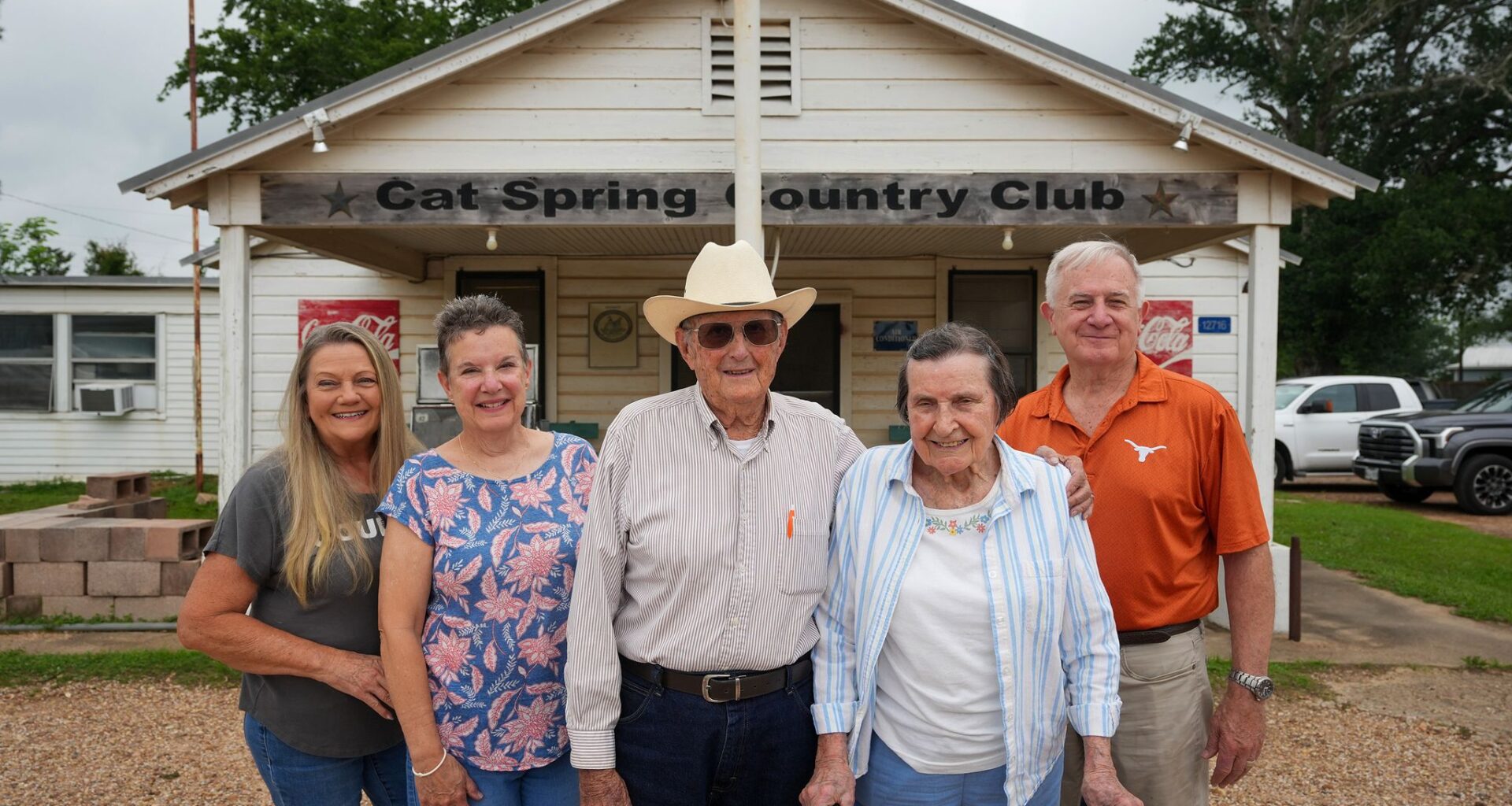
Marilyn Nelson, from left, Terri Brasher, Herbie and Elrose Kollatschny, and Ronnie Volkening pose for a portrait outside Cross Road Tavern in Cat Spring on Wednesday, May 6, 2026.
Jay Janner/Austin American-Statesman
The rural community began when Robert Justus Kleberg, namesake of Kleberg County in South Texas, led German immigrants who fled political oppression to settle this region, more than 10 years before there was a New Braunfels or Fredericksburg.
Article continues below this ad
Kleberg married into the wealthy von Roeder clan after he earned his law degree in Germany, then later the Klebergs married into the King family of King Ranch fame. The story goes that one of the von Roeders killed a bobcat at Wildcat Spring near the San Bernard River.
They called the place “Katzenquelle.”
Cross Road Tavern sits at the intersection of FM 1094 and FM 949 in Cat Spring on Wednesday, May 6, 2026.
Jay Janner/Austin American-Statesman
As residents remind visitors, in the old story, there was only one cat, and only one spring, no matter how often newcomers mangle the town’s name. (The most common mistake: Cat Springs.)
Article continues below this ad
About the location of that spring, which reportedly still flows: The most precise answer so far: “It’s over by the cemetery.”
A keeper of the Cat Spring flame
While the tentacles of Houston creep ever closer to this town — and weekenders sometimes outnumber residents — folks here are still devoted to the heritage of this place.
They hang out at the Cross Road Tavern, a supremely informal joint, also known jokingly as the Cat Spring Country Club; or maybe Wagon Haus, a former garage that now serves as a coffee house, dress shop and music venue; or Mustang Alley Antiques, the former general store around the corner from Stardust Emporium, another antiques seller.
Article continues below this ad
Few local historians, however, marshal the experiential advantages of all-around nice guy, Herbie.
Herbie Kollatschny, left, and his wife Elrose eat lunch at Cross Road Tavern in Cat Spring on Wednesday, May 6, 2026.
Jay Janner/Austin American-Statesman
A descendant of those early German settlers, Kollatschny was born March 13, 1937, a little more than 100 years after Cat Spring was founded.
His father was farmer Elliott Kollatschny, who was born in 1897 and died in 1959.
Article continues below this ad
“Daddy farmed peanuts, corn, cattle,” says Herbie, tight-lipped yet underhandedly funny in conversation. “I decided that’s not what I wanted to do.”
Elliott Kollatschny’s family migrated from German-speaking Silesia and he’s buried in Cat Spring Lutheran Cemetery.
Note: Although Czechs settled this slice of Texas as well — and many of the region’s famous “painted churches” are Catholic — the dominant social group in Cat Spring is German and Lutheran.
Herbie’s mother was Emma Amsler Kollatschny (1908-1990), whose family arrived from German-speaking Switzerland around the same time as the earliest German settlers in Texas. Some of her relatives first stopped in the bigger town of Industry, about 20 minutes up the road from Cat Spring, now reached by passing through the tidy burg of New Ulm, founded in 1841.
Article continues below this ad
Historic photos of the Cat Spring railroad depot and the Cat Spring City Band & Orchestra.
Jay Janner/Austin American-Statesman
Herbie attended the two-room Cat Spring Elementary School, which closed around 1950, through sixth grade, then he headed off to Sealy High School, about a 20-minute drive in the other direction from New Ulm.
“I played sports but never was that good at it,” says Herbie, who has been covering Austin County high school sports, first for the Tri-County News in Sealy, and then for the Bellville Times for more than 40 years. “I still write for the Times.”
“During the sports season, I did sports,” he says about his reporting career. “Off-season I wrote features that were turned into books. People said ‘You need to put them in books,’ and I had experience laying out books.”
Article continues below this ad
That’s because Herbie started laboring in the newspaper’s back shop, which did a good deal of commercial printing as well, in 1956 when he was 19.
That’s right: Herbie has been an “ink-stained fool” for 70 years.
Among the big changes in his business is digital photography. Herbie: “I used to process the black and white pictures in a darkroom at home, then took them to work on Monday.”
‘A Texas version of Ingrid Bergman.’
Herbie and his wife, Elrose, 87, went to the same small country school, but they did not click romantically for many years.
Article continues below this ad
Elrose’s older brother Olin hunted with Herb.
“He lived down there,” Elrose explains about the relatively short distance that separated the future couple in childhood. “I lived over here. We knew each other from itty-bitty days. We played baseball at recess, the boys and girls together.
“He was kind of pudgy,” she adds with a sweetly wicked smile. “He didn’t lose weight until he played football.”
By consensus, young Elrose was “show-stoppingly beautiful.” One resident remembered her mother as “a Texas version of Ingrid Bergman.”
Article continues below this ad
Time and a lifetime of hard work have softened some of that youthful glamour.
Cat Spring residents Herbie Kollatschny and his wife Elrose walk into Cross Road Tavern for lunch in Cat Spring on Wednesday, May 6, 2026.
Jay Janner/Austin American-Statesman
For a few years, Elrose worked in Houston at Southwestern Bell and for an envelope company. Later, she served as the rural delivery carrier in the greater Cat Spring area. Unlike many towns its size, Cat Spring has retained its U.S. Post Office.
“Herbie was crowned king at the agricultural society’s 100th anniversary,” Elrose says. “My cousin was queen and she picked Herbie as king.”
Article continues below this ad
That regal liaison didn’t last.
“I wasn’t looking for marriage problems,” Herbie jokes. “Then I started looking for a wife.”
During an impromptu lunch of thickly layered ham and cheese sandwiches at Cross Road this spring, Herbie’s friends joshed him for not being more demonstrative about Elrose and their long romance.
“There’s that joke,” he says. “Did you hear of the Lutheran man who so loved his wife, he almost told her?”
Article continues below this ad
‘A perfect Huckleberry Finn place for a kid.’
The best history flows from a mix of personal memory, oral tradition, the written and printed record, along with rigorous yet empathetic questions and a sense of broader historical context.
All these come together in Cat Spring.
A journalist must also obtain access and a certain degree of encouragement. For this story, those last elements were provided, from a distance, by friends such as Eugene Sepulveda, whose family farm is just down the road, and his husband, Steven Tomlinson, pastor of St. John’s Episcopal Church in nearby Columbus.
Article continues below this ad
The deeper reporting would not have happened, however, without Ronnie Volkening, an Austinite who grew up in Lake Jackson, but spent summers in and around his grandparents’ roomy bungalow right on the railroad tracks in Cat Spring.
The U.S. Post Office sits near the railroad tracks in Cat Spring on Wednesday, May 6, 2026.
Jay Janner/Austin American-Statesman
“It was a perfect Huckleberry Finn place for a kid,” Volkening says. “I’d sit on the porch and count the railroad cars going by. Then dig up some worms under the faucet, grab a cane pole and head to a stock pond to fish, before ‘helping’ my grandfather Strauss at the general store next door.”
Volkening introduced me to about a dozen Cat Spring residents during multiple visits.
Article continues below this ad
German artists reborn as farmers
Gradually, more than just an idea or image, something more like a feeling emerged from the town’s personal histories.
Take the language, for instance.
“People mostly spoke German,” Herbie says. “The preacher preached in German. Folks were fluent in English, but one uncle spoke German only.”
Article continues below this ad
Herbie Kollatschny, left, Marilyn Nelson and Ronnie Volkening hang a historic German-language sign inside the Cat Spring Agricultural Society Hall in Cat Spring on Wednesday, May 6, 2026. An English version of the sign reads, “The Wearing of the Hat & the Spurs, The Smoking & the Chewing Is in this Hall Forbidden.” The 12-sided dance hall was built in 1902 and has served as a gathering place for the community for more than a century.
Jay Janner/Austin American-Statesman
That state of affairs persisted well into the 20th century, even after the German language was excoriated in Texas during two world wars.
Most Germans in Cat Spring professed the Lutheran faith, and their first church rose close to Cross Road. Yet the presence of another Protestant group, German Baptist Brethren — also known as the Schwarzenau Brethren or Dunkers — also pops up in conversation. The Brethren split from other Christian churches during an 18th-century religious revival in the old country.
Cat Spring straddled the Old San Felipe Trace between San Felipe de Austin and San Antonio. The nearby San Bernard River, which flows independently of the Brazos and Colorado watersheds for about 120 miles from near New Ulm down to the Gulf of Mexico, outlined the boundary between Austin and Colorado counties at the heart of empresario Stephen F. Austin’s colony.
Article continues below this ad
No sources, written or oral, have so far pinpointed when the San Bernardo River, named by Spanish explorers for a medieval French abbot, was Anglicized to San Bernard. The nearby town of Bernardo retains the Spanish ending.
Yellow fever raged during the early days and founder Kleberg was advised not to choose this location. Early arrivals died.
“The Germans were not farmers,” Herbie says. “Many were musicians, writers and artists who came here after the 1848 Revolution in Europe. Stephen F. Austin’s Old 300 settlers had already taken the good land in the area. Since they were not as well adapted to farming, they eventually created the agricultural society. They grew cotton and we had a couple of cotton gins.”
The Cat Spring Agricultural Society Hall is seen in Cat Spring on Wednesday, May 6, 2026. The 12-sided dance hall was built in 1902 and has served as a gathering place for the community for more than a century.
Jay Janner/Austin American-Statesman
They founded the state’s oldest agricultural society in 1856, precisely because they had been urbanites and intellectuals in the Old World, not farmers.
Article continues below this ad
In Texas, they needed to learn to live off the surrounding oak savanna that shifted between floods and droughts.
Among the settlers, the “Latineers” studied Latin and attempted to farm from book knowledge, some of which was derived from the Roman era. In other words, they likely learned Texas farming from writers like Tacitus, Columella, Cato the Elder and Marcus Terentius Varro.
Another settler, Ernest Gustave Maetze, a university graduate, was once a member of the German parliament and debated Otto von Bismarck, the “Iron Chancellor.”
As often was the case in these communities, social cohesion contributed to survival.
Article continues below this ad
“There were very few slaves, and most of the Germans and Czechs opposed slavery,” Herbie says. “They resisted Confederate conscription.”
According to family tales, younger men in the area sometimes dressed up as girls to escape conscription. Friction between the German Americans and the Confederates — and later the Ku Klux Klan — turned into shouts, scuffles and shootings in nearby Bellville and Sealy.
A donkey and a goat stand inside a fenced pasture in Cat Spring on Wednesday, May 6, 2026.
Jay Janner/Austin American-Statesman
“For close to 100 years, there was the Cat Spring Butcher Club,” wrote George Carmack in a San Antonio Express-News article published Aug. 26, 1978. “It had 20 members. Each Friday, one of the members, in turn, provided a fat steer for butchering. The meat was butchered into 30 cuts and a record was kept of just what cut each member received. This was so when the 30-week cycle had ended, each member would have received the equivalent of his own fat steer in meat.”
Article continues below this ad
The tradition did not end until the 1960s, long after the introduction of deep freezers.
Strands of history, personal and otherwise
True to stereotype, the German Americans in Cat Spring kept excellent records, then republished them in book form.
In 1956 alone, decades of agricultural society minutes were collected in a 462-page book, “Century of Agricultural Progress: 1856-1956.” The same year, “The Cat Spring Story” was published.
Article continues below this ad
Marilyn Nelson looks through the Cat Spring Agricultural Society treasurer’s book from the 1938 June Fest in Cat Spring on Wednesday, May 6, 2026. The handwritten records list the festival’s income, expenses and profits.
Jay Janner/Austin American-Statesman
The reader can trace the evolution from a corn and cotton culture to cattle ranching once the rich bottomland played out. At one point, Cat Spring made a healthy business of cattle hides, echoed in today’s processed-hide décor for sale in local shops.
In the early 20th century, Cat Spring workers were invited to join the National German-American Alliance, an umbrella group with 2 million members. The Texas town declined.
At the same time, old stereotypes are hard to shed. After several men in our company simultaneously tried to pay the modest bill for sandwiches and Cokes at Cross Road, one of the Cat Spring women muttered: “So Southern German!”
Article continues below this ad
German faith survived. While the original Lutheran church was among the first significant structures built in Cat Spring, today’s church is comparatively bland and modern, except for the preserved original altarpiece.
The previous Sunday’s attendance and a statue of Jesus on a wooden altar is seen inside St. John Lutheran Church in Cat Spring on Wednesday, May 6, 2026.
Jay Janner / American-Statesman
Joachim Hintz’s 12-sided Cat Spring Agricultural Society Hall, constructed some 70 years after the town’s first settlers arrived, is a handsome wooden building that looks like the kind of social and dance halls that German and Czech settlers raised all over the rolling countryside between the Brazos and Colorado rivers.
Built in 1902 and 1903, the hall is tucked behind the Cross Road on the far eastern edge of the village’s scattered sprawl.
Article continues below this ad
“It was once in the middle of the town,” Herbie says. “But when the MKT railroad came, almost the whole town moved to the tracks and the depot one mile to the south.”
The Cat Spring hall was hardly Hintz’s only such accomplishment.
“He was the head foreman who built all the round halls in Austin County,” Herbie says. “Local volunteers hauled the long poles from the railroad. It was designed so that you had space to dance.”
The Cat Spring Agricultural Society Hall is seen in Cat Spring on Wednesday, May 6, 2026. The 12-sided dance hall was built in 1902 and has served as a gathering place for the community for more than a century.
Jay Janner/Austin American-Statesman
The country school is gone, as is another meeting place, the large wooden Turner Hall, which hosted performances and other events until the 1950s.
Article continues below this ad
“There were not enough people to keep it up,” says Marilyn Nelson, whose house stands on the Turner Hall site. “People staged plays there in the summertime.”
Like other Cat Spring residents, Nelson adds stories of the family links in town.
When asked about connections to the Kollatschny family, Nelson says: “We’re cousins down the road away.”
Nelson has rescued some historical birdhouses built masterfully in the shapes of the town’s landmarks: church, social hall, general store, post office and diner.
Article continues below this ad
Nelson manages the Agricultural Society Hall, long the centerpiece of Cat Spring social life, although some say the volunteer fire department building has stolen some of the attention.
“We always had the Christmas dance and New Year’s party at the hall,” Nelson says. “There was a Santa for the kids. We were always disappointed when he handed out fruits, nuts and hard candy.”
Small town rivals
Bonnie Hegemeyer, left, owner of Cross Road Tavern, visits with Karen Landrum in Cat Spring on Wednesday, May 6, 2026.
Jay Janner/Austin American-Statesman
As often is the case in small-town Texas, bitter rivalries and friendly alliances grow around activities like high school sports.
Article continues below this ad
Cat Spring is too small to attract the contempt of the citizens of Columbus, Sealy or Bellville.
Yet similarly sized Millheim — perhaps 150 residents — serves as a small-scale rival just a 10-minute drive to the northeast. It is home to the historic Millheim Harmonie Verein Hall, also built by Hintz and similar to the Cat Spring Agricultural Society Hall.
Closer to Columbus is Bernardo. Despite being the same size as Cat Spring, it once hosted a semi-pro baseball team, the Bernardo Hurricanes, sponsored by Hurricane Fences.
Fielding high school sports teams, Bellville and Sealy, however, remain hot competition.
Article continues below this ad
“Given the rivalry, I’m amazed how many Bellville boys married Sealy girls, and vice versa,” Herbie says. “But there’s really only hatred during football season.”
A rusted car sits among tall weeds in Cat Spring on Wednesday, May 6, 2026.
Jay Janner/Austin American-Statesman
‘Times have changed.’
Terri Strauss Brasher, who now lives in Columbus but gets back to Cat Spring as often as she can, is aware that the town’s future belongs, in part, to newcomers. “More and more are coming this way,” she says.
Article continues below this ad
Until recently, some visitors stayed at Ronnie Volkening’s grandfather’s house, which had been turned into a bed and breakfast, but that enterprise faded. Now they are more likely to check into the resort-like BlissWood Bed and Breakfast Ranch. Kids might explore the Cat Spring Retreat, a nearby summer camp.
“Times have changed,” Marilyn Nelson says. “There’s been a change of lifestyle, too. The weekenders go back home on Sunday.”
That change of habit instigated what some jokingly call the “blasphemy,” when the town’s annual June Fest was changed from noon on a Sunday to a Saturday afternoon.
Marilyn Nelson posts a flyer for the 170th annual June Fest at Cross Road Tavern in Cat Spring on Wednesday, May 6, 2026. The longtime community festival is hosted each year by the Cat Spring Agricultural Society.
Jay Janner/Austin American-Statesman
Old-timers welcome new businesses, nevertheless, especially if they fill a niche.
Article continues below this ad
Wagon Haus, for instance, is a new enterprise operated by two young women, Sophie Mudge and Carli Jeffrey, who graduated from Texas A&M University. Built into an old mechanic’s shop located right on the railroad, it’s a sophisticated coffee shop, an outlet for products from the region, and a boutique for country-inspired apparel.
Jeffrey’s husband is touring country singer, Carson Jeffrey, who sometimes plays the attached outdoor venue. The singer-songwriter is also a full-time cowboy who grew up in Cat Spring.
Sophie Mudge, owner of Tucker & Co., stands inside her boutique in the historic Wagon Haus in Cat Spring on Wednesday, May 6, 2026.
Jay Janner/Austin American-Statesman
“Everybody was once related to everybody else,” Brasher says. “Herbie is my uncle because he married my mom’s sister, Elrose. He’s also my cousin because we are related on my dad’s side.”
Article continues below this ad
“That’s not the case anymore,” Herbie says. “I went to the Firemen’s Party and didn’t hardly know anybody.”
No matter what, German food, culture and language still leave an imprint on Cat Spring.
It is important to remember that the Texas German dialect is distinct from modern German as spoken in Europe. Like so many descendants of immigrants, the German Texans unknowingly preserved many of the antique forms of the mother tongue.
Article continues below this ad
“The German culture is pretty much all gone,” Herbie says. “A German news crew came here and they wanted me to do an interview in German. I got so lost, I couldn’t finish. I gave up.”