
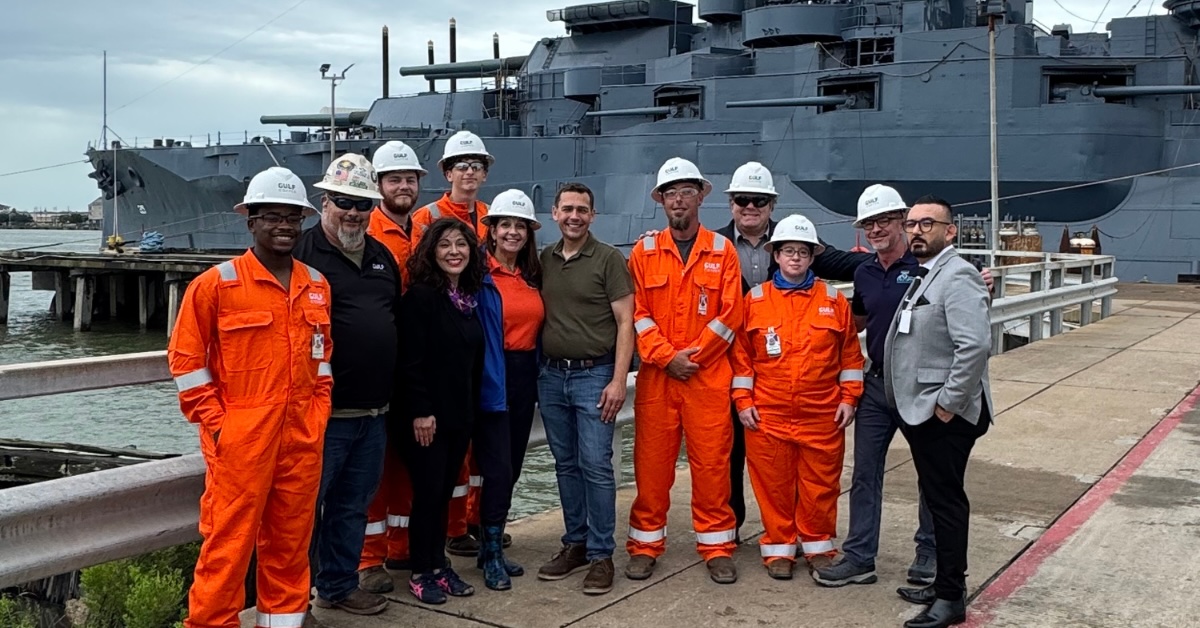
The shovels are still dirty from last week’s major Gulf Coast groundbreaking. Davie Defense is spending $1 billion to convert its newly acquired Gulf Copper facility from dry-dock repair yard to manufacturer of icebreaker ships for the U.S. Coast Guard, but Galveston’s colleges and secondary schools are already ahead of the curve for the island’s looming economic transformation.

Galveston Regional Chamber of Commerce President and CEO Gina Spagnola tried unsuccessfully to find a word other than ‘game-changer’ to describe the impact of Davie’s arrival on the area’s long-term prospects.
“It’s hard to really even put into words, but I think it’s significant,” Spagnola told Chron last week, adding that Davie’s arrival heralds “such a better future [for] opportunities” on the island.
Article continues below this ad
“I was just speaking to a group of educators this morning and I said, ‘I believe that it is the greatest economic impact on Galveston and our region since the rebuilding [after] the great storm [of 1900],” she said.
Galveston students learn about maritime survival skills and many other possible career paths at Texas A&M-Galveston’s annual Maritime Careers Camp every summer.
Galveston Regional Chamber of Commerce
The British-Canadian shipbuilder’s investment in Texas is expected to add up to 2,400 jobs, some of which will be at Davie’s Port Arthur facilities. Some estimates have as many as 1,500 coming to Galveston, and the Port of Galveston has begun laying the groundwork to ensure that these jobs—welders, shipfitters, engineers and logistics experts, among other trades—go to graduates of local schools as often as possible.
Colleges becoming part of maritime pipeline
Last month, the port announced the establishment of a $40,000 initial endowment for Galveston College students, to be managed by the Galveston College Foundation. The money, seeded by sponsorship proceeds from the port’s 200th-anniversary gala last fall, will support students pursuing degrees in maritime-related fields such as global logistics and supply-chain management, as well as technical certifications in welding and shipfitting, the port said.
Article continues below this ad
In November, a few weeks after the gala, the port also announced it would establish a similar endowment of more than $300,000 for Texas A&M-Galveston students pursuing degrees in maritime and marine-related fields. Specifically, according to the port, money will fund four annual scholarships of $3,000 each for students in the Maritime Business Administration, Marine Transportation and Marine Engineering Technology programs.
Campers learn hands-on skills in a variety of maritime-related trades from members of the U.S. Coast Guard and the camp’s other partners.
Galveston Regional Chamber of Commerce
The program will begin in the fall 2026 semester and give preference to students from Galveston County, the port said.
Article continues below this ad
“As one of the Gulf Coast’s leading deepwater ports, the Port of Galveston and its port partners depend on a strong pipeline of skilled professionals to sustain and grow our maritime economy,” Port Director and CEO of Galveston Wharves Rodger Rees told Chron in a statement Tuesday.
The port’s recent partnerships with both schools demonstrate “our strong commitment to help students gain the education and training they need to work in this critical industry,” Rees added.
Alumni of A&M’s Maritime Academy can earn salaries of up to $130,000 immediately after graduating from the four-year program, but officials have also increased their efforts to interest students in maritime careers even earlier. In 2024, Galveston ISD partnered with the chamber and Galveston College to create a program that allows high-school students to earn college credit in logistics and maritime distribution.
Hitchcock ISD also introduced a maritime program when its new career and technical education building opened that year, the Galveston County Daily News reported.
Article continues below this ad
The Moody Foundation and other sponsors help defray the cost, so maritime campers attend free of charge.
Galveston Regional Chamber of Commerce
For years, the chamber has helped facilitate visits to local schools by representatives of port-connected industries, including International Longshoremen’s Association members, captains from the Galveston-Texas City Pilots, and Rees himself.
“There are summer jobs, there are internships, there are lots of things,” Spagnola said. “And the thing is, we’ve begun to really reach out to the parents and make sure. I’m involved in it, but the schools know that we have to really educate the parents, too, about these maritime opportunities.”
Career camp for younger students
A handful of lucky students have a chance to start even younger. Next month, around 30 incoming eighth through tenth graders will head to A&M’s annual Maritime Career Camp, a weeklong program that allows them to explore cruise ships, tour the Galveston Ship Channel by boat, wield welding equipment, test scuba gear, steer a virtual-reality vessel into New York Harbor, and visit the island’s Coast Guard station, among other activities.
Article continues below this ad
The camp grew out of the chamber’s Maritime Careers Pathways Committee; the Moody Foundation and other sponsors offset the cost so that campers (and their families) pay nothing. When it started a decade or so ago, “no one knew anything about the big ships coming in,” Spagnola recalled. “No one knew about the industry that was happening on their very island. A lot of [campers] couldn’t even swim.”
In 2024, Galveston ISD partnered with Galveston College to allow high-school students to earn college credit for courses in logistics and maritime distribution.
Galveston Regional Chamber of Commerce
Now, with Davie’s arrival and the port’s assistance, things look quite different.
Not only has Galveston College received that $40,000 endowment to support the maritime industry, the island’s newest employer has partnered with the school to create a 22-month apprenticeship program that covers students’ tuition and guarantees them a full-time job at Gulf Copper upon graduation. Already, the program has inspired Lamar State College in Port Arthur to expand its own shipbuilding curriculum.
Article continues below this ad
“I think it’s gonna be great; I think it’s gonna be a game-changer,” Spagnola said. “Again, [I] wish there [was] a better word, but we’re so excited.”