
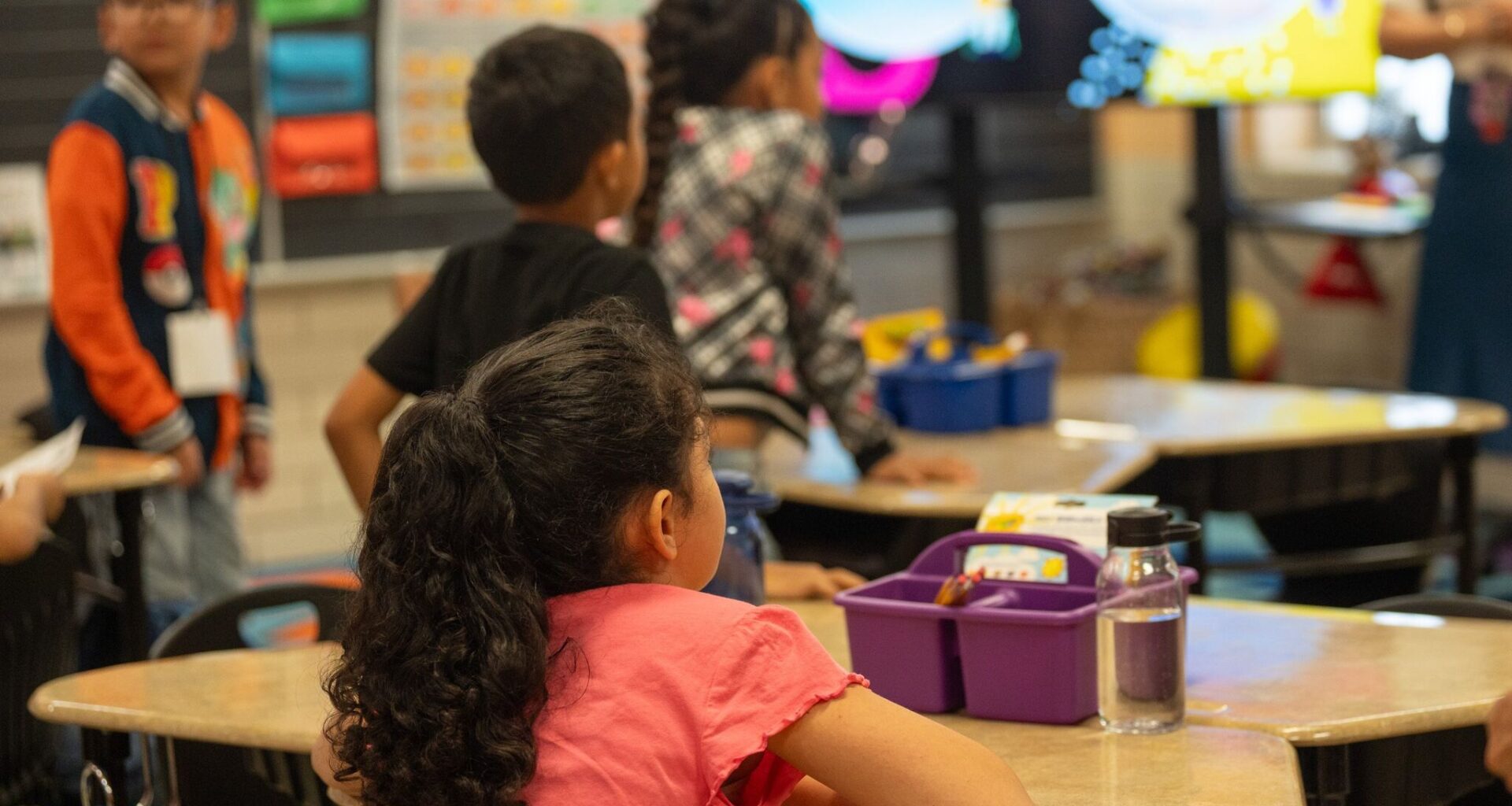
Children attend class at Andrews Elementary in 2024, the year Austin school district taxpayers approved a substantial property tax hike to invest in teacher raises, librarians, and other critical staff and resources. But with state funding lagging far behind the need, the district faces more painful budget cuts.
Mikala Compton/American-Statesma
In 2024, as the Austin school district faced a $119 million deficit, voters approved a substantial property tax hike to invest in teacher raises, mental health counselors, librarians, nurses and other critical staff and resources for Austin schools — priorities this Editorial Board also supported.

Two years later, many families are justifiably incensed that some of what they have been paying extra for is now on the chopping block. Up against a $181 million shortfall for next year, the Austin school district is looking to cut staff, pare back bus routes and split librarians between smaller schools in order to make ends meet.
Article continues below this ad
And the picture grew even more grim this past week, as Superintendent Matias Segura announced the deficit for the current year had ballooned from $19 million to $95 million. The district will have to dig into reserves and take out a loan this fall to make payroll.
The situation is dire. Children’s education and employees’ livelihoods are on the line. Trustees are expected to vote Thursday on another round of painful budget cuts, making impossible tradeoffs.
The district bears responsibility for failing to more accurately project declining enrollment and sell properties to generate cash. But the blame for the fundamentally broken school finance system rests with state lawmakers who have underfunded Texas schools for years. Those lawmakers are not only failing the nearly 5.5 million children in Texas public schools, they’re neglecting the Legislature’s constitutionally mandated duty to “make suitable provision for the support and maintenance of an efficient system of public free schools.” Lawmakers need to provide meaningful, long-term funding for public education next session.
Legislators last year gave themselves a hearty pat on the back after passing an $8.5 billion increase in school funding. State Rep. Brad Buckley, the Salado Republican who authored the bill and chairs the House Public Education Committee, said the funding would provide “the largest teacher pay raise in history, targeted funding for our special education students, investments in early childhood learning and additional funding for our schools to address the rising fixed costs of operation.”
Article continues below this ad
District officials rightly noted it failed to make up for a per-student allotment that hadn’t been raised since 2019 while the state added underfunded and unfunded mandates such as a cop on every campus and seatbelts on school buses — all while inflation soared and revenue sank from declining enrollment.
RELATED: Texas didn’t stumble into this school crisis. It built it.
The math is undeniable: The state’s $6,160 basic student allotment from 2019 would need to be $8,059 today just to keep pace with inflation, according to the U.S. Bureau of Labor Statistics inflation calculator. Instead, the basic allotment bumped up to just $6,215 this past year. That translates into a $1,844 per-student funding gap just to keep up with rising costs. Multiply that by the 68,188 students the Austin district expects next school year, and that’s more than $125 million the district needs and isn’t getting.
Austin ISD is hardly alone in feeling this pain.
Article continues below this ad
El Paso ISD is on the verge of declaring the school district equivalent of bankruptcy and carrying out mass layoffs due to its $52.8 million deficit. Officials in Crystal City, in South Texas, say the district there has less than $500 in the bank. And although Houston ISD appears to have dug itself out of the $528 million hole from the 2024-25 school year, the district’s finance officer recently said they’re using duct tape “to keep our HVAC systems together.”
Minda Anderson, an Austin teacher-librarian, listens April 28 to a presentation about the school district’s budget. While Austin school trustees will vote on deep cuts to address a $181 million deficit, state lawmakers must change the math by investing in public education next session, the Editorial Board writes.
Sara Diggins/Austin American-Statesman
Here in Austin, the district is set to cut 560 positions, reduce contributions to health benefits, decrease many teachers’ planning time and offer diminished transportation options, among other unpopular cost-cutting efforts. Worse, without a fundamental reinvestment in public education next legislative session, districts will face more difficult cuts in the years ahead.
Yet in a startling disconnect, Gov. Greg Abbott champions the state’s world-class economy while many of the school districts educating tomorrow’s workforce struggle to operate on dwindling dollars.
Article continues below this ad
“With the Best Business Climate in America and unmatched pro-growth policies, Texas is the premier destination for job creators from across the country and world,” Abbott said in a mid-April press release, boasting that the Texas economy has grown $1.3 trillion under his watch. “We will keep attracting world-class investment, create jobs, and expand opportunity for Texans for generations to come.”
But those businesses need an educated workforce. Those future workers are in today’s underfunded public schools. Abbott and lawmakers must recognize that pro-business policies include investing in the education of that workforce. Doing so would bring unmatched dividends: More skilled workers with greater earning and spending power, more businesses growing in Texas and adding to the tax base. Expanding opportunity for future Texans requires a real up-front investment in public education now.
SIGN UP FOR THE AUSTIN ANGLE and get Statesman commentaries in your inbox
As with any investment, Texas will get what it pays for. The state ranks among the bottom 10 U.S. states in terms of per-student funding. It pays teachers nearly $11,000 below the national average, placing it 33rd in the country. Such sub-par funding will not yield world-class results.
Article continues below this ad
Texans deserve a public education system focused on educating students, not managing perpetual budget crises.
While lawmakers must increase direct funding for schools, they should also consider structural solutions that provide long-term stability. The nonpartisan education advocacy group Raise Your Hand Texas has proposed a Legacy Education Fund, a public education endowment meant to supplement existing school funding. Similar to the Texas Water Fund approved by voters, an education endowment would ensure a source of long-term funding by earning interest on a locked-in principal. Such a fund would work only if it’s treated as additional revenue for public education, not switching out one pot of money for another.
Lawmakers should put such a proposal on the ballot, in addition to providing other funding increases next legislative session.
Article continues below this ad
Public schools educate more than 90% of Texas students. Even with homeschooling on the rise and the school voucher program drawing a fraction of students away from public schools (57% of those awarded vouchers had previously attended private school or homeschool), the students in public schools aren’t going anywhere. Their schooling today is Texas’ tomorrow.
The budget woes at Austin ISD and districts across the state are rooted in funding failures at the Capitol. Nothing will change the math driving the budget cuts that Austin trustees and other school boards must make in the coming weeks and months. But state lawmakers can — and must — change the math for the years ahead by investing in public schools next session.