
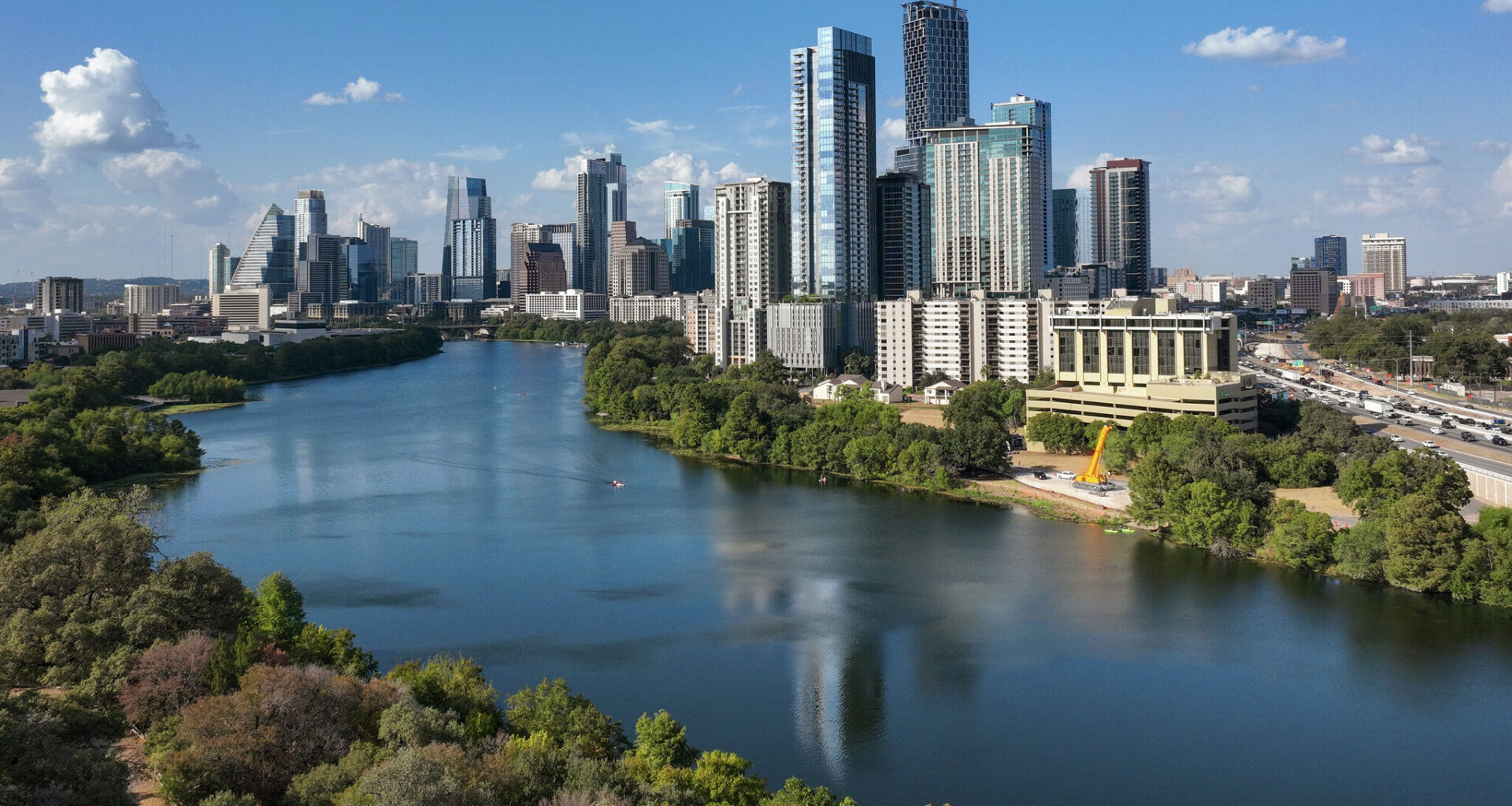
Long before Rainey Street became known for luxury towers and nightlife, it was a small residential neighborhood sitting at the edge of Downtown Austin.
Former Austin City Manager Toby Futrell says the change over the past two decades is striking. Cranes crowded the skyline, high-rises multiplied, and the neighborhood that once felt open became engulfed in downtown’s growth.
More: How has Austin changed over time? Photos show city’s development
Article continues below this ad
A view of the skyline of downtown Austin, Wednesday, Dec. 10, 2025.
Mikala Compton/Austin American-Statesman
Futrell, who served the city for 31 years and led it as city manager from 2002 to 2008, describes pre-boom Rainey Street as a “unicorn” — one of the last surviving Mexican American neighborhoods west of Interstate 35 as downtown development intensified around it.
“It was a close, tight-knit community of color,” Futrell said. “And all around it grew downtown.”
For those who grew up there, the loss is not abstract. It arrives in flashes: a backyard gone, a porch replaced by a parking garage, a rent receipt from 1991 for $250 that now reads like fiction.
Article continues below this ad
The houses before the high-rises
Elevated view, looking southeast (from the William P Hobby Jr State Office Building), of downtown Austin, Texas, January 8, 2001. At right is the intersection of West 2nd Street (running left to right) with Lavaca Street. Visible in the background is the Lower Colorado River.
John Anderson/Getty Images
Teresa Velasquez lived in the neighborhood from 1987 to 1996. She has receipts folded between old family photographs and papers she has kept for decades.
“Received from Teresa Velasquez,” one says, “$250 rent payment for 91A Rainey Street.”
Article continues below this ad
She still laughs when she reads it aloud. The same patch of land where her duplex once stood is now occupied by apartments that rent for more than $1,800 a month.
“It was very pleasant,” Velasquez said of Rainey Street in the years before the bars arrived, before the towers. “It was a place for families.”
The Velasquezes’ lives revolved around the family’s taxi business just off Interstate 35. People moved in and out of one another’s houses without announcement, the way families do when they are familiar with the neighborhood.
Left: Rainey Street was once home to a close-knit Mexican American community. In 2024, the East Austin Ghost processional marched from East Austin to Rainey Street carrying screen printed lanterns with artwork reflecting on the displaced people, businesses and resources. The procession is seen here heading toward I-35 while walking on Nash Hernandez Senior Road, June 20, 2024. Right: Rainey Street bungalows became dwarfed by towers.
Left: Sara Diggins, Right: American-Statesman file
Top: Rainey Street was once home to a close-knit Mexican American community. In 2024, the East Austin Ghost processional marched from East Austin to Rainey Street carrying screen printed lanterns with artwork reflecting on the displaced people, businesses and resources. The procession is seen here heading toward I-35 while walking on Nash Hernandez Senior Road, June 20, 2024. Bottom: Rainey Street bungalows became dwarfed by towers.
Left: Sara Diggins, Right: American-Statesman file
Rainey moved at a slower pace then. Children played football in the street. Neighbors knew one another through school and church. The names Velasquez remembers from those blocks — Solis, Sanchez, Mendez, Guerra — map onto an older Mexican American Austin that survives now mostly in memory.
Article continues below this ad
“It was quiet,” she said. “Pretty. The houses were nice to see.”
Some of those houses were already old when she lived there. The duplex she rented had once been a large single-family home, later split down the middle by a wall. That house was relocated through a preservation program to another neighborhood east of downtown. Velasquez sometimes thinks about knocking on the front door to see what remains of her former home.
“I always want to ring the doorbell and say, ‘Can I look around?’” she said.
Today, when she passes through the district on the way to visit family in East Austin, she sees crowds spilling onto the sidewalks. People park blocks away from the bars and weave across frontage roads and interstate ramps, drawn to a version of Rainey that feels far removed from the neighborhood she once knew.
Article continues below this ad
The vision for Rainey Street
The view of the Frost Tower and downtown Austin from one of the 48th floor penthouse apartments at Paseo on Rainey Street, May 13, 2026.
Sara Diggins/Austin American-Statesman
As Austin experienced explosive population growth through the 2000s, city leaders faced increasing pressure to balance preservation with development. Futrell said two forces ultimately reshaped the neighborhood: rising land values and generational turnover.
“It’s classic gentrification,” she said. “The value of their property is outstripping their income.”
Article continues below this ad
According to Futrell, longtime homeowners found themselves sitting on increasingly valuable land near downtown. Some accepted lucrative offers from developers, others stayed until age, death or inheritance decisions led families to sell.
This is a satellite image of Austin, Texas collected on October 29, 2003. The gray rectangle near the lower center of the frame is the Austin Convention Center. Rainey Street is located southeast of the of the convention center amongst the trees.
DigitalGlobe/DigitalGlobe via Getty Images
Planning officials were simultaneously developing a long-term vision for the area.
Former Planning Director Alice Glasco said Rainey Street consisted primarily of single-family homes before the city undertook a redevelopment study in 2000 at the request of neighborhood residents. After a City Council resolution and years of planning discussions, the city rezoned the area to Central Business District zoning, one of Austin’s most intensive development categories.
Article continues below this ad
The skyline that eventually emerged was “exactly what we anticipated,” Glasco said.
Construction workers hammer, fix and install some of the finishing touches on the top of the new SkyHouse Austin apartment tower at 51 Rainey Street on Thursday, November 7, 2013.
Austin American-Statesman
“When we zoned it to CBD, that’s what we as planning staff are trained to do — project and think of the future.”
The rezoning established incentives intended to shape development. Buildings taller than 60 feet were required to meet standards related to affordable housing, pedestrian-friendly design, tree preservation and urban design criteria. Glasco said planners expected the neighborhood to evolve into a dense residential district connected to downtown. From 2010 to 2024, more than 2,100 housing units were added to the area, according to Census Bureau data.
Article continues below this ad
Yet before the towers remade the skyline, the neighborhood underwent another transformation — one that neither planners nor longtime residents fully expected.
“The surprising part was the bars,” Glasco said. “It’s one of those things that you cannot predict.”
The towers came, but not before Rainey Street reinvented itself as one of Austin’s busiest nightlife destinations.
Article continues below this ad
Rainey Street’s bungalow bar boom was a pause before the towers rose
Owner Bridget Dunlap at Clive Bar, the longest-operating bar on Rainey Street in Austin, Tuesday, Dec. 2, 2025. Dunlap is the founder and co-creator of Dunlap ATX, the hospitality group behind Clive Bar, Lustre Pearl and Container Bar.
Mikala Compton/Austin American-Statesman
As the financial crisis stalled large-scale development in 2008, a handful of entrepreneurs began converting aging bungalows into bars. Among them was Bridget Dunlap, who opened some of the first venues on the street.
“These were old bungalow homes that people had lived in for years,” she said. “It was very laid back.”
Article continues below this ad
Glasco described this period as a transitional phase between the neighborhood’s residential past and its current skyline. Plans for high-rise development predated the bars, delayed only by a lack of financing.
Rainey, in those years, was an interlude.
The Clive Bar, seen here on January 26, 2012, opened in an old bungalow at Davis and Rainey streets in 2009 in an area that was rezoned for commercial development in 2005. Rainey Street transformed from sleepy residential neighborhood to an entertainment district that hosted dozens of bars, condos, restaurants, food trucks and hotels.
Jay Janner/American-Statesman
Left: People walk along Rainey Street on January 9, 2013. The street, which was once a sleepy residential neighborhood, later developed into a dense area home to dozens of bars, condos, restaurants, food trucks and hotels. Right: Javelina on Rainey Street in 2013. The club was one of the buildings that was demolished during the street’s high-rise boom.
Left: Jay Janner/American-Statesman; Right: American-Statesman file
When construction resumed, it did so with finality. Entire blocks were cleared.
Article continues below this ad
The scale of the transformation is difficult to overstate.
Thousands of residential units have been added within a three-block radius. The demographic profile shifted alongside the skyline. In 2024, the average income for residents in the area was about $135,000, and the area’s population had more than quadrupled from 2010.
What has been lost is less easily measured.
Article continues below this ad
Futrell, who left Austin city government in 2008, said she understood that redevelopment was inevitable yet remained surprised by its scale.
When she returned to Rainey Street years later, she found a landscape dominated by towers.
“It went from a shady, friendly, tight-knit neighborhood to Blade Runner,” Futrell said.
Inside Rainey’s new towers
Rainey street is visible from a residential unit balcony at The Modern at the corner of Rainey and Davis in Downtown Austin on Friday, Sept. 6, 2024.
Aaron E. Martinez/American-Statesman
Today, residents live dozens of stories above the street in luxury towers overlooking Lady Bird Lake. Buildings such as Paseo combine apartments, hotel rooms, restaurants and resident amenities into vertical, mixed-use communities.
Article continues below this ad
“Our goal here is to make our residents’ lives as amazing as possible,” Rafael Cardenas, an employee at Paseo said during a recent tour of the property. The prices for penthouse units at the high-rise range between $16,500 a month and $45,000 a month.
Left: The primary bedroom in one of the 48th floor penthouse apartments at Paseo on Rainey Street, May 13, 2026. Right: The main living area in the penthouse.
Sara Diggins/American-Statesman
Top: The primary bedroom in one of the 48th floor penthouse apartments at Paseo on Rainey Street, May 13, 2026. Bottom: The main living area in the penthouse.
Sara Diggins/American-Statesman
Operators with LV Collective, the real estate firm behind much of Rainey’s newer development, say the neighborhood continues evolving.
“It’s more experiential versus transactional,” said Adrianne Moloney, hospitality and events manager for LV Collective. “There’s a shift from party-heavy to more curated, intentional experiences — hospitality, wellness, art, food.”
Article continues below this ad
A new sense of community has become part of the modern luxury formula downtown. Buildings like Paseo function as private micro-neighborhoods, complete with resident happy hours, fitness classes and run clubs.
‘It doesn’t feel as much like we belong.’
The Austin skyline is visible over the Emma S. Barrientos Mexican American Cultural Center on Saturday, June 6, 2026 in Austin.
Aaron E. Martinez/Austin American-Statesman
For longtime residents, the question is not simply what was built, but what remains.
Article continues below this ad
Just a short walk from the high-rises stands the Emma S. Barrientos Mexican American Cultural Center, a reminder of the community that existed long before Rainey was shaped by luxury and nightlife.
The six-acre site, once at the heart of Austin’s Rainey Street neighborhood, was secured through years of grassroot organizing, failed bond proposals and negotiations with the city.
“It goes back to the ’70s when I was a senior in high school when I first started to get involved,” said Tomás Salas, a longtime artist and activist who helped lead efforts to establish the center. “I’m 68 years old now.”
Dancers with Ballet Folklorico Maricruz perform during the grand reopening of the Emma S. Barrientos Mexican American Cultural Center on Saturday, June 6, 2026 in Austin.
Aaron E. Martinez/Austin American-Statesman
As the neighborhood transformed around it, Salas said that presence has become increasingly significant. He describes feeling disconnected from an area where rising housing costs have pushed many longtime residents away.
Article continues below this ad
When asked whether he would live downtown today, Salas explained he would feel out of place.
“I wouldn’t see very many brown or black faces there,” he said. “It doesn’t feel as much like we belong there.”
MACC site manager, Michelle Rojas, says the cultural center remains committed to showcasing the Mexican-American Latin identity of Austin.
The center entered a new chapter earlier this month with the reopening of its expanded facility after a three-and-a-half-year closure for renovations. The project adds nearly 19,000 square feet of new space, including a teaching kitchen, an expanded visual arts wing, a new dance studio and upgraded performance spaces.
Article continues below this ad
Right: John Estrada, advisory board member at MACC, looks at artwork and posters from the Left: Gilberto Cardenas and Dolores Carillo Garcia collection in the Coronado gallery during the grand reopening of the Emma S. Barrientos Mexican American Cultural Center on Saturday, June 6, 2026 in Austin. Right: Visitors view artwork in the gallery.
Aaron E. Martinez/American-Statesman
Top: John Estrada, advisory board member at MACC, looks at artwork and posters from the Left: Gilberto Cardenas and Dolores Carillo Garcia collection in the Coronado gallery during the grand reopening of the Emma S. Barrientos Mexican American Cultural Center on Saturday, June 6, 2026 in Austin. Bottom: Visitors view artwork in the gallery.
Aaron E. Martinez/American-Statesman
The Confluence, the second phase of the Waterloo Greenway project, is seen under construction in Austin, Wednesday, May 27, 2026.
Jay Janner/Austin American-Statesman
The reopening comes alongside a recent addition to the area. The Confluence, a new trail system near the mouth of Waller Creek, opened in early June, intersecting the movement of water with the city’s ongoing transformation.
And the forces reshaping the district continue to gather around it.
Article continues below this ad
The neighborhood’s future
Construction will widen and lower Interstate 35 through Central Austin. Eventually, it will be possible to walk from East Austin to Rainey Street without crossing the busy intersections along the highway.
Jay Janner, Jay Janner/American-Statesman
It is surrounded by major public projects that will transform downtown over the next decade, including the Interstate 35 expansion, proposed highway caps and stitches, and the reconstruction of the Austin Convention Center, which is set to reopen in early 2029.
Austin City Council Member Zohaib Qadri, whose District 9 includes Rainey Street, said the neighborhood’s future will depend on how well the city creates connections between downtown, East Austin and the waterfront.
Article continues below this ad
“People often talk about the character of a neighborhood,” Qadri said. “It’s the people that make it so special. It’s not an old house. It’s not a historic house. It’s not a tall building. It’s the people.”
Qadri pointed to the MACC as one example of preserving community identity amid redevelopment. He said the center should remain a focal point for celebrating Mexican American culture in a part of Austin where many longtime families have been displaced.
Construction to widen and lower Interstate 35 through Central Austin is expected to begin later this year. (Credit: Jay Janner/American-Statesman)
Jay Janner
Rather than focusing on Rainey Street’s reputation as a nightlife hub, Qadri said he hopes the district emerges from years of construction and redevelopment as a true neighborhood.
Article continues below this ad
“People look at Rainey Street at times as a nightlife district, but it’s a neighborhood,” he said. “I want Rainey Street to be a truly mixed-use neighborhood. It’s where people live.”
The houses are gone. The skyline is unrecognizable. Yet the question that has followed Rainey Street through decades of change remains: Who gets to belong there?