
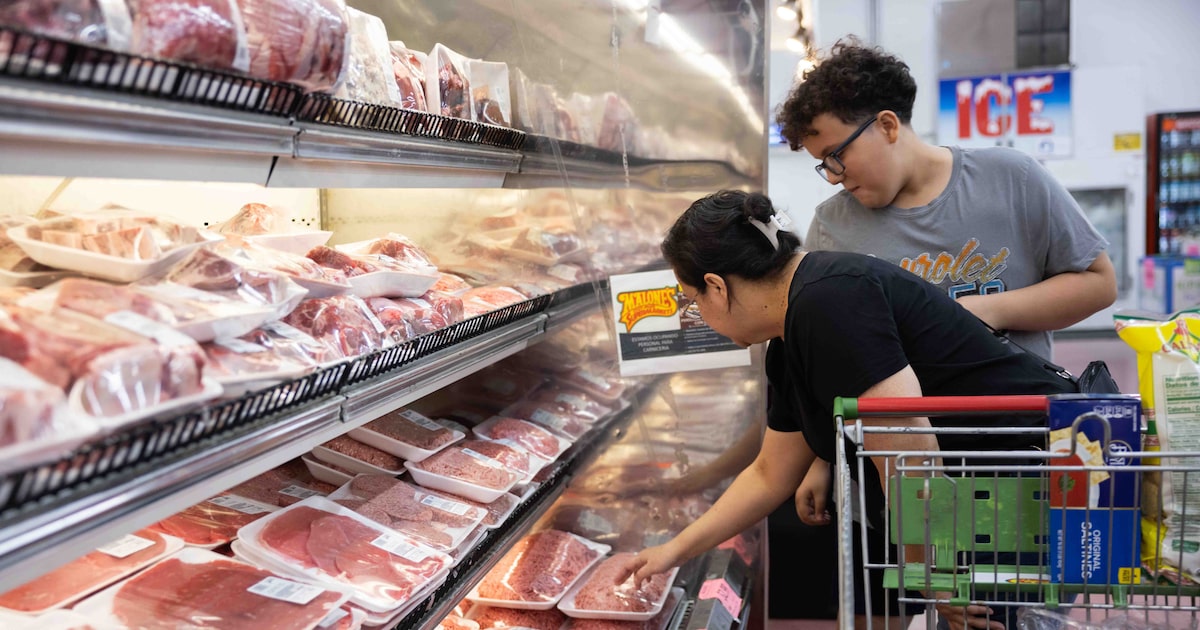
Martha Lozano pushed a grocery cart through the meat aisle Monday morning, eyeing prices and contemplating her shrinking bank account.
With the future of federal food benefits still uncertain, Lozano could not afford to overspend at Malone’s Cost Plus in Dallas. She just paid rent her $1,380 rent and was down to $120 in her account. Due to the government shutdown, Lozano did not receive her usual $500 in food assistance on Nov. 1.
“What are we going to do?” she said while shopping with her 12-year-old son, Julio Jr. “I don’t know how we’ll survive if this keeps going.”
Lozano is among the millions of Texans and Americans figuring out how to pay for groceries in coming days. The Trump administration said Monday it plans to partially fund the Supplemental Nutrition Assistance Program after two federal judges ruled it must use contingency funds to pay for the benefits during the shutdown.
D-FW Public Health Alerts
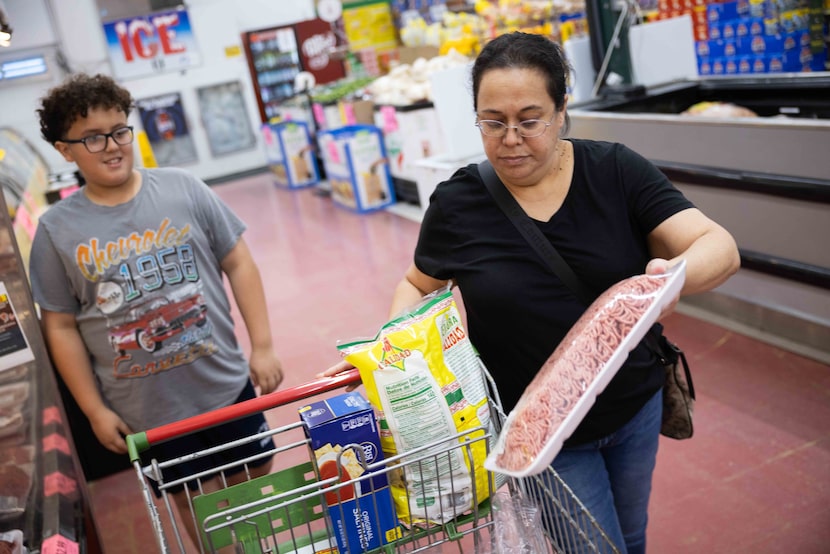
Martha Lozano puts ground beef in her cart while shopping with her 12-year-old son, Julio Jr., at Malone’s Cost Plus in Dallas’ Pleasant Grove neighborhood on Monday, Nov. 3, 2025. Due to the government shutdown, Lozano did not receive her usual $500 in food assistance on Nov. 1.
Juan Figueroa / Staff Photographer
Roughly half of the usual $8 to $9 billion will be made available, leaving many recipients with less money than they are accustomed to getting . It remains unclear when recipients will receive their November aid. The Trump administration had previously warned that it could take weeks to distribute benefits on a partial basis.
Exhausting the fund potentially sets the stage for a similar situation in December if the shutdown isn’t resolved by then.
“Everyone is worried,” said Maria Solis, manager of Malone’s Cost Plus in Dallas’ Pleasant Grove neighborhood.
On a typical Morning morning at the beginning of the month, shoppers flock to the store to pick up staples like milk, bread and eggs because Texas issues SNAP benefits between the 1st and 15th of each month. But on this Monday, the store was noticeably quieter than usual, Solis said.
SNAP serves about 42 million people — about 1 in 8 Americans — and is a critical piece of the nation’s social safety net. Some 3.5 million low-income Texans receive the federal food assistance. Of those, 1.7 million are children.
A loss or delay in SNAP benefits is particularly fraught in Texas, which has the highest rate of food insecurity in the U.S., according to the nonprofit Feeding America. More than 5 million people, roughly 17.6% of the population, are considered food insecure.
Recipients are now making difficult choices. Lozano, whose husband died two years ago, said her job at a gas station pays $11.75 an hour, barely enough to pay bills. Rising grocery prices has further squeezed her household, and she struggles to afford basics like toilet paper and laundry detergent.
At her low-income apartment complex, neighbors give one another cans of corn or beans to help out. Her son, Julio, knows not to ask for soda or sweets, but when she spotted juice on sale, she brightened.
“Look, baby,” she told him. “Hawaiian Punch for $2.99.”
Grinning, he placed a jug in the cart.
Related
SNAP is paid for by the federal government, but administered by states. Some states, including Louisiana, New Mexico and California, have allocated state funds to help cover the gap. Texas did not announce such a plan.
As Thanksgiving approaches, SNAP recipients still do not know how much money they will receive in November, and many say they are relying more on food pantries.
As Texans wait on benefits, the Trump administration said it would provide instructions to states Monday on how to calculate the per-household partial benefit. Still, the process of loading the SNAP cards, which involves steps by state and federal government agencies and vendors, could take up to two weeks. In a court filing, the USDA warned that it could take weeks or even months for states to make all the system changes to send out reduced benefits.
Texas officials have not yet said how long it will take to load benefits onto their Lone Star cards. Recipients in Texas receive an average of $379 a month, about $12 a day.
Outside the Malone’s grocery store, Ingris Enamorado loaded her car with bags of milk, corn flakes and oranges.
Enamorado, who has a 2-month-old and 3-year-old, did not receive her usual $306 in SNAP benefits this month. She said she was grateful for the Special Supplemental Nutrition Program for Women, Infants and Children, known as WIC, which helps families with children younger than 5. The government shutdown has not yet affected that program.
Enamorado, 25, said construction work is beginning to dry up for her husband and cousin, and she is anxious how they will afford food in coming weeks.
“I’m worried,” she said. “Everything is going down.”
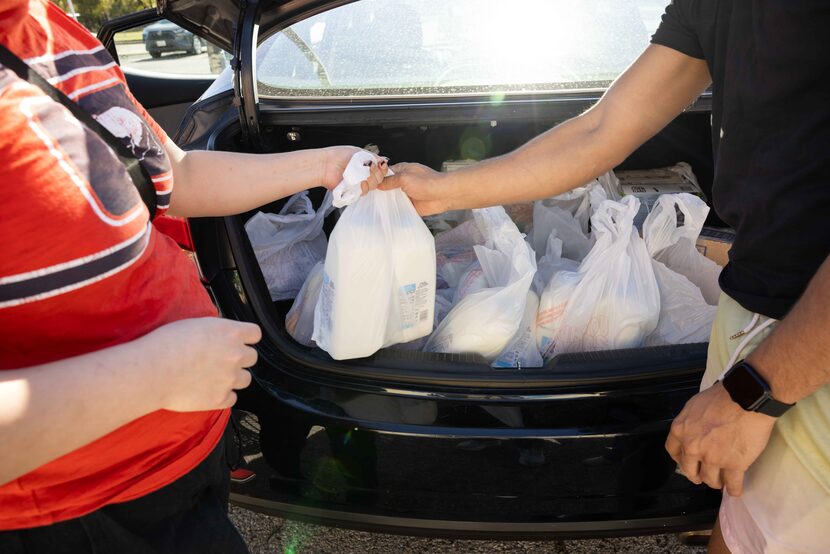
Ingris Enamorado (left) and her cousin load groceries into her trunk after shopping at Grocery Services North, a PWIC store chain, in Dallas’ Pleasant Grove neighborhood on Monday, Nov. 3, 2025. Enamorado, who has a 2-month-old and a 3-year-old, did not receive her usual $306 in SNAP benefits and worries about affording groceries later in the month.
Juan Figueroa / Staff Photographer
Down the street, Janel Reed shopped at a Foodland Market. A friend offered to buy her weekly groceries after she did not receive her usual $800 she uses to purchase groceries for her four children, ages 3 to 18.
Reed, a 47-year-old hairdresser, said she makes more deli meat sandwiches and plain noodles lately instead of her family’s favorites like meatloaf and macaroni and cheese.
“It’s getting kind of scary,” she said. “We’re leaning on friends and family and doing everything we can to make it.”
The Associated Press contributed to this report.