
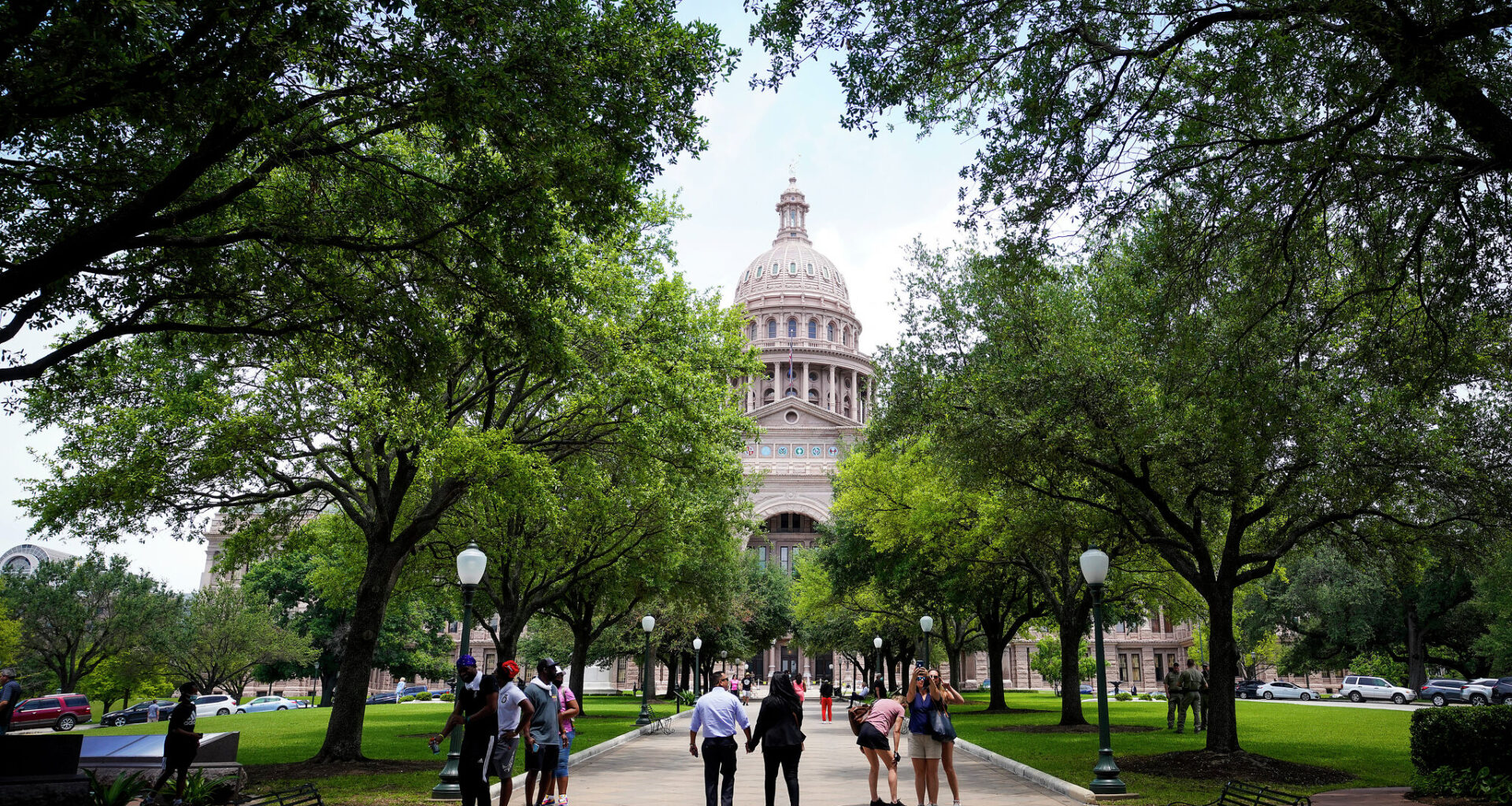
People walk on the grounds of the Texas Capitol during the 87th Texas legislature on Friday, May 7, 2021, in Austin. (Smiley N. Pool/The Dallas Morning News)
Smiley N. Pool/Dallas Morning News
Candidates for Texas comptroller have been debating whether the state budget has become too bloated and riddled with waste, and whether it needs an audit.

Those are fighting words in a state that’s long prided itself for fiscal discipline, limited government and a deep-seated skepticism of the federal government’s bad example.
Article continues below this ad
A new set of “fiscal resilience” rankings, which I recently published for the Mercatus Center, confirms that this reputation is largely deserved. Texas ranks as America’s most prepared state for an eventual, and likely, reduction in federal aid. Scores are based on spending levels, whether long-term benefit obligations are funded, room to raise taxes, rainy-day reserves, reliance on federal dollars and year-to-year revenue stability.
But the rankings also reveal something troublesome: Even disciplined states are deeply dependent on Washington. A comparison with neighboring New Mexico, which ranks dead last, helps illustrate Texas’ strengths and weak spots.
States today are more reliant on federal funds than ever before. Federal grants to states now exceed $1.2 trillion annually and account for roughly one-third of total state revenues. This probably won’t go on forever.
In Washington, interest payments on the federal debt already exceed defense spending. These are projected to become the largest federal budget item by 2048, surpassing even Medicare and Social Security. When that math catches up, something must give.
Article continues below this ad
ALSO READ: Trump signed a law to repay Texas’ border costs. A year later, the money still hasn’t arrived
That’s why states that build budgets around supposedly growing federal transfers are taking a risk they may not fully appreciate. It’s also why every Texan who relies on state services — schools, roads, public safety, even Medicaid — has a stake in remaining prepared.
Texas has a head start because it spends less than most states do, relatively speaking. Its spending profile, at less than $5,000 per person, is one of the leanest in the country. New Mexico spends more than $13,000 per person. That gap matters enormously in a scenario in which Washington tightens its belt.
Big-spending states have fewer options when revenues fall short. Every line in the budget has a constituency, and any cut can become politically excruciating. Texas has retained room to maneuver. New Mexico has not.
Article continues below this ad
Texas’ low taxes also carry an advantage, though one that should not be overstated. If federal aid is reduced, Texas has room to raise revenues without maxing out what its economy can provide.
While the state constitution bars many broad-based taxes, some politically difficult options are still on the table, such as raising or broadening the state sales tax. Fiscal space is a form of insurance. Texas has some, though not as much as the headline numbers suggest.
On pensions, Texas has assets to cover about 77% of its long-term promises to state employees — above average and meaningfully better than New Mexico’s 66%. Many states sit at about 60 cents on the dollar. Yet 77% is not a truly secure position. Unfunded pension liabilities are slow-moving fiscal problems that feel manageable until they suddenly aren’t.
Here the comparisons become more nuanced. Both states hold enough rainy-day reserves to finance more than 100 days of spending, above the average of around 60 days. That’s prudent reserve-building. If federal aid dropped by 20% or 30%, 100 days could buy valuable time for policymakers to address the funding gap.
Article continues below this ad
On one measure — reliance on federal dollars — New Mexico actually edges out Texas slightly. About 31% of its revenues come from Washington, compared to just under 33% for Texas — a useful reminder that no state is uniformly prepared.
That’s a number worth sitting with. Texas, for all its fiscal conservatism and top ranking, still relies on Washington for roughly one-third of its revenues. Utah (ninth overall), another dynamic economy, comes in below 27%. Texas has the economic base and political culture to push further in the same direction, and it should.
The lesson isn’t complicated. Federal fiscal stress is not a point to be argued; it’s an accounting fact. Texas has built a stronger foundation than any other state, and this should serve as motivation, not comfort.
The work now is to close the remaining gaps. The challenge is to make sure Texas can stand when Washington cannot.
Article continues below this ad
Jack Salmon is a Gibbs Scholar and research fellow with the Mercatus Center at George Mason University. He is the author of a new set of state fiscal resilience rankings.
Have a response? Send us a letter to the editor.