
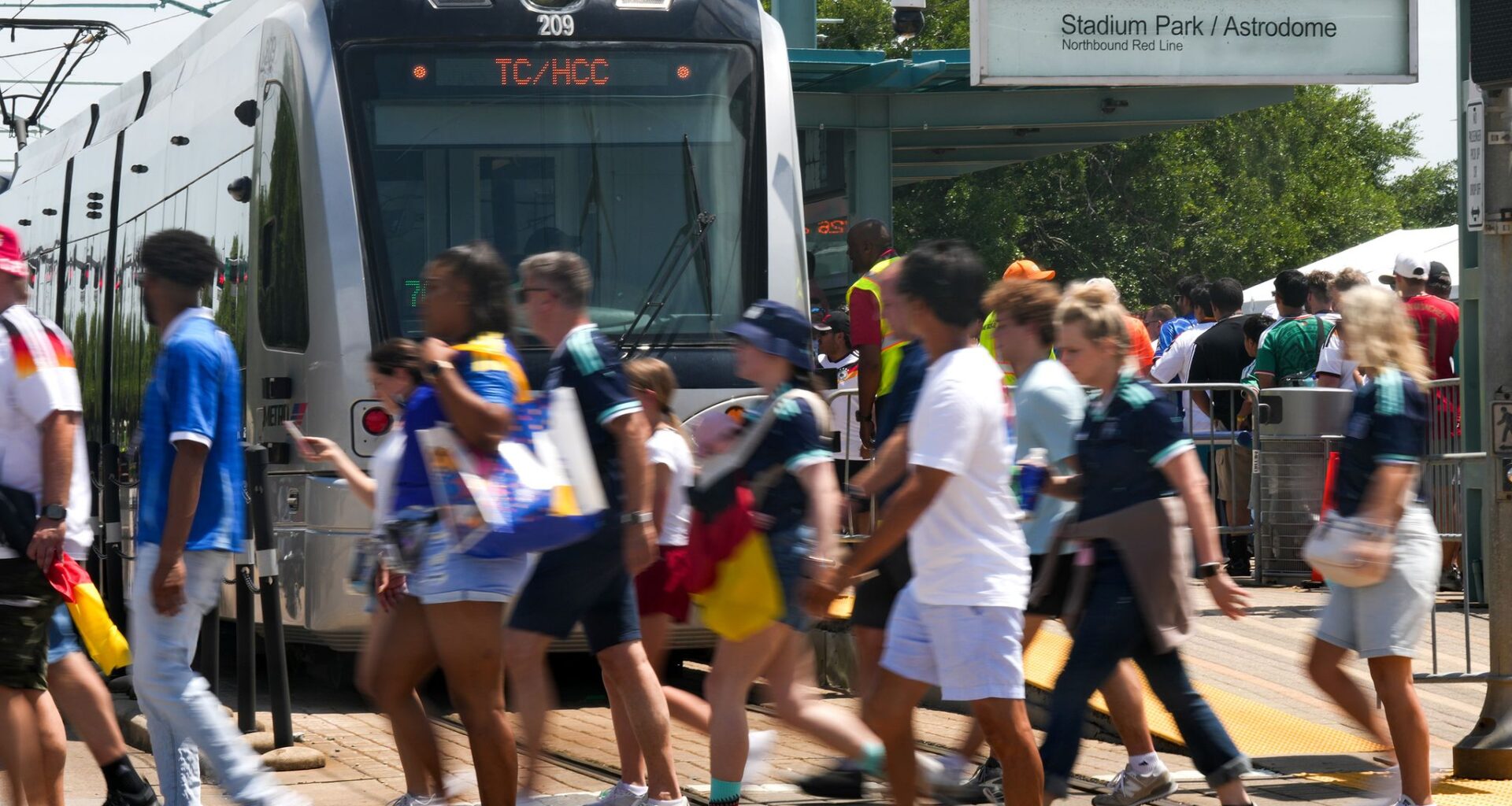
After they emptied out of Houston Stadium on Sunday, throngs of World Cup fans stood sweltering at the Stadium Park/Astrodome Metro stop as they waited to squeeze onto a MetroRail car and head home.
Even though trains were arriving every few minutes, thousands were still waiting outside the Metro stop nearly two hours after the match between Germany and Curaçao ended. Feels-like temperatures topped 100 degrees. A Houston Fire Department engine and an ambulance responded to a few minor heat-related incidents.
More than 20,000 fans were expected to use public transportation to leave the stadium where Houston hosted its first of seven 2026 FIFA World Cup matches, Metro Police Chief Ban Tien said Sunday. The Red Line was operating at maximum capacity after Houston Metro opted to boost its light rail and bus service for the influx of World Cup fans, according to news reports.
German tourist Lyssane Muckenhaut needed to step out of the long Metro line after feeling faint in the crowded tent where fans were waiting for the train.
“I felt pretty bad in there,” she said, holding a cold water bottle to her forehead. “It was very humid, very crowded in there so there was no fresh air.”
Many gave up and started walking toward Metro stations down the line. Some fans complained about others skipping lines.
“We waited in a tented cow line for over 30 minutes and then realized they were just letting people in from outside,” one fan visiting from Chicago said. “What a mess.”
Meredith Johnson, Houston Metro’s executive vice president of communications, said the agency was working with FIFA to improve transportation and crowd flow after matches. She added that fans used the transit system “safely, efficiently and without incident.”
“One challenge is that when there are more than 70,000 people leaving the stadium at the same time, there are limits to how quickly any transit system can move that volume of passengers, even with every available train in service,” Johnson said in a statement to the Chronicle.
Earlier in the day, fans packed the rail cars as they rode to the noontime match and seemed to have positive feedback at the time, calling the transit system “secure,” “comfortable” and “orderly.”
Among them was Houston Controller Chris Hollins, a former Metro board member who hopes for greater transit investment and ridership after the World Cup.
“I’m excited that so many people are leveraging Metro and our public transit system to get into the World Cup,” Hollins said. “It always plays a big factor for the rodeo and other major events, but, oftentimes, Houstonians leave these assets underutilized.”
Metro’s next major test will come on Wednesday, when Houston Stadium hosts its second World Cup match between Portugal and the Democratic Republic of the Congo.