
Some 160 years later, neither Galveston nor Houston has trouble planning enough Juneteenth celebrations to go around. This year, for example, the “Juneteenth: the Reunion” festival returns to Houston’s Emancipation Park for its fifth edition, while other weekend concerts include the Voices of Houston gospel choir at South Main Baptist Church and R&B legends Maze at Miller Outdoor Theatre.

Galveston, meanwhile, will host its traditional daylong festival at Menard Park, along with screenings of the documentary Juneteenth: The Galveston Story and the Oscar-nominated 2016 film Hidden Figures. The Grand 1894 Opera House and the Galveston Symphony Orchestra will present the musical production Her Voice, Her Story, while the Juneteenth and Beyond van tours allow guests to experience the island’s rich history on a more bespoke level.
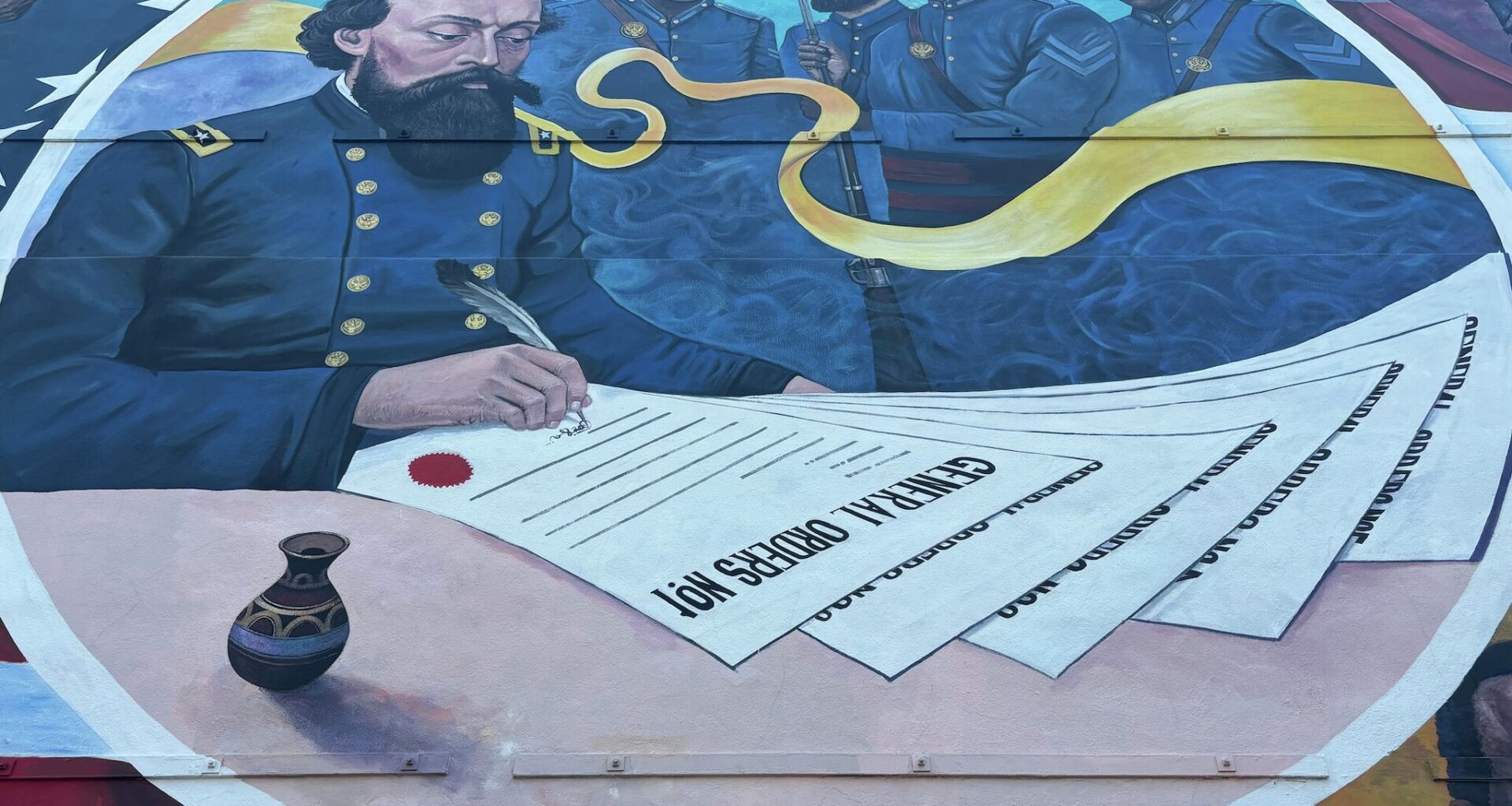
In the months immediately after the events that led to what we know today as Juneteenth—primarily U.S. Army Gen. Gordon Granger’s issuance of General Order No. 3 in on June 19, 1865, which definitively abolished slavery in Texas—this was not the case. But, as Rice University historian Caleb McDaniel writes in the latest issue of the Journal of Texas History, a fateful gathering organized by Houston ministers Sandy Parker and Elias Dibble on June 19, 1866 played an “equally foundational” role in how the nascent holiday would come to be celebrated.
Article continues below this ad
The climate around Juneteenth in the 1860s
After Granger’s order took effect, McDaniel told Chron last week, early public observances of this newfound freedom took place in an environment fraught with racism and risk.
“Claiming the streets and public space for a protest or parade is always a political act,” McDaniel, the Mary Gibbs Jones professor of humanities, said. “For Black Texans to do so during Reconstruction in particular took tremendous courage in the face of risk. Violence was endemic in Reconstruction Texas, especially violence against freedpeople and their white allies in the Republican Party.”
Houston Artist Reginald Adams’ “Absolute Equality” mural was dedicated in June 2021, days before Congress passed a law declaring Juneteenth a federal holiday.
Visit Galveston
At least at first, the anniversary Texas’ freedpeople wanted to celebrate was the Emancipation Proclamation, which had freed all U.S. slaves, including those in Confederate-occupied territory, as of Jan. 1, 1863. Granger’s order, issued from the Army’s Galveston headquarters at 22nd and Strand streets, explicitly cites the Proclamation as the basis for establishing “an absolute equality of personal rights and rights of property” between Texas’ former slaves and the state’s white population.
Article continues below this ad
Didn’t move the needle immediately?
However, as University of Arkansas-Little Rock Professor Emeritus Carl H. Moneyhon argued in the July 2024 edition of Southwestern Historical Quarterly, Granger’s order—though reportedly read aloud at multiple locations around Galveston in the hours after the general signed it, including the historic Reedy Chapel—may not have been enough to move the needle for many people right away.
“Most people did not know about it until Galveston newspapers published the order on June 21,” Moneyhon wrote. “It also is not clear that Granger viewed the order as particularly earth shaking, since he published it along with three others on the same day.
Article continues below this ad
“Granger’s order did effectively end any remaining speculation that slavery might somehow be preserved in Texas,” Moneyhon continued, “but, on the other hand, it simply confirmed what everyone already knew.”
Former U.S. President Joe Biden, who signed the law making Juneteenth a federal holiday in 2021, visited Galveston’s historic Reedy Chapel last year, his first Juneteenth out of office. At left is Reedy pastor Rev. Lernette Patterson.
Michael Shapiro/Chron
Accordingly, public gatherings to celebrate emancipation in Galveston and other Texas communities were held on New Year’s Day 1866 and ’67, organized by local pastors (some of whom were white Northern missionaries). At the time, according to McDaniel, the Baptist Parker and Methodist Dibble (a future founder of Emancipation Park) were both working to establish their own congregations no longer controlled by those denominations’ white leadership.
Dibble had recently succeeded, acquiring a piece of land for his new church in present-day Midtown. Plans quickly came together to celebrate with a march from the new church to a wooded plot of land in Second Ward a mile or so away. But bad weather foiled those plans, twice, so as the anniversary of Granger’s order approached, the announcement of a new celebration explicitly tied to “the first annual round of the day on which the colored population of Houston were proclaimed free” sent anticipation higher still.
Article continues below this ad
Forgotten Houston ceremony
For decades, this gathering—which wound up drawing up to 4,000 people, both Black and white, from as far away as Galveston—and its impact on the Juneteenth tradition had almost been lost to history, McDaniel writes. The missing link was a report about the “Freedmen’s Celebration” that he found in Houston’s long-defunct Evening Star newspaper. During the Great Depression, the Works Progress Administration hired researchers to write a history of Houston, who mentioned the event in their notes but failed to follow up.
“The WPA history didn’t share the details of that June 19 celebration in the work they published, and the original copies of the Evening Star remained in the state archives in Austin,” McDaniel said. “So anyone who wanted to see them had to go there, which I was able to do last year. Thankfully, as of February of this year, the paper has been digitized on the Portal to Texas History so anyone can see it.”
In June 1865, Gen. Gordon Granger, head of the U.S. Army detachment then occupying Galveston Island, signed a series of orders that officially ended slavery in Texas. The mural is on the building that served as his headquarters.
Chris Gray/Chron
Another reason McDaniel believes Parker and Dibble’s June 19 gathering carried so much weight is that it came on the heels of the so-called “Fireman’s Celebration,” a pro-Confederacy march by Houston’s fire companies that had taken place just five days before. That demonstration “made it newly important for Black Texans to make a show of strength in Houston on June 19 [of] that year,” McDaniel said.
Article continues below this ad
“This was a celebration, but it was also a demonstration, and so people from multiple communities showed up to march and make their presence felt,” he added.
McDaniel believes it was “not inevitable” that Juneteenth would catch on until years afterward; the holiday was not widely known by that name until the 1880s. Yet despite the intervening years, Elias and Dibble’s initial celebration might have looked remarkably similar to the countless celebrations that will be held in Houston, Galveston, and elsewhere across Texas and the nation this weekend. Friday is the fifth anniversary of Juneteenth becoming a federal holiday.
“One thing they definitely shared was food and fellowship,” McDaniel said. “There was barbecue. There was music. There was commemoration. And, then as now, the celebration of Juneteenth involved keeping both the past and the present in view. It wasn’t just about celebrating freedom, but about the struggle for ‘absolute equality.'”
Article continues below this ad