
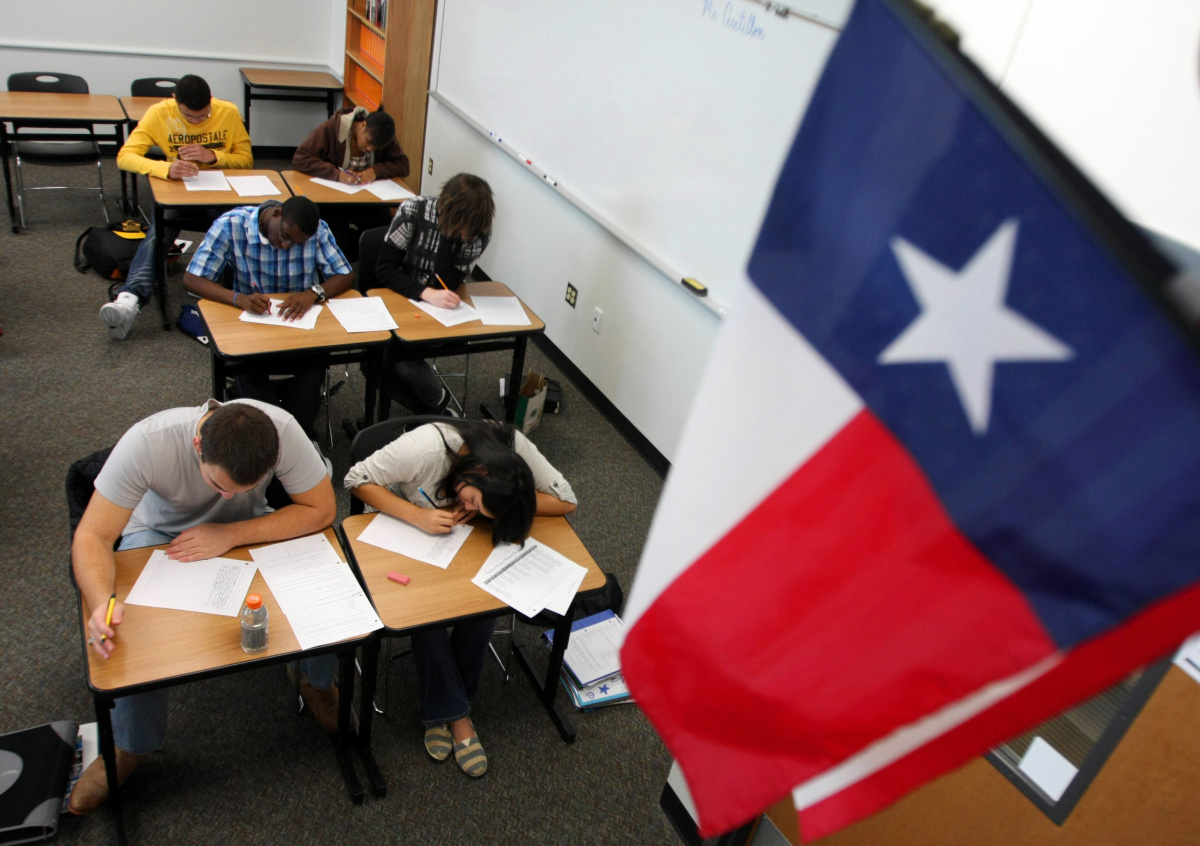
Students wrote English essays during a practice test for the STAAR exam in February 2011.
The results of this year’s STAAR exams for third through eighth grades present something of a mixed bag in Dallas ISD and across the state, according to results released Tuesday.

The annual State of Texas Assessment of Academic Readiness tests third through eighth graders in reading, math, social studies and science.
Both the state as a whole and Dallas ISD, the second largest district in Texas, made gains in math, and middle schoolers gained ground in reading.
Article continues below this ad
Related: See how Dallas ISD and Texas high school students did on STAAR
But fewer than half of third graders tested on grade level in reading. Experts say third grade is a critical milestone for reading because students who can’t read on grade level by the end of that year are more likely to struggle later on.
In third and fourth grade, Dallas ISD lost a bit of ground in reading. This year, 49% of third graders were on grade level in reading, down from 50% last year. Half of fourth graders tested on grade level in reading this year, down from 52% last year. But the district either held steady or gained ground in reading in grades five through eight.
Across Texas, reading scores climbed in seventh and eighth grades. Otherwise, scores held steady across all grade levels except third.
Article continues below this ad
STAAR math scores
In math, Dallas ISD students across all grades either held steady or gained ground compared with last year. In third grade, the percentage of students meeting grade level in math climbed seven points, from 35% last year to 42% this year.
Statewide, math scores either held steady or improved across all grade levels except seventh, where the percentage of students testing on grade level declined by two points. But TEA officials said that decline is related to a recent change in state policy. In 2023, lawmakers passed a bill that expanded access to advanced math classes, automatically enrolling top-performing middle schoolers into advanced math classes instead of asking their parents to opt in. That means top-performing seventh graders are more likely to take the eighth grade math test.
Related: Here’s what to know about STAAR results and how to find student scores
Both Dallas ISD and the state as a whole also gained ground in eighth grade social studies. Across Texas, 32% of eighth graders scored on grade level in social studies this year, compared with 30% last year. In Dallas ISD, 30% were on grade level this year, up from 27% last year.
Article continues below this ad
TEA officials didn’t release science test scores Tuesday. In a statement, TEA officials said the delay was related to the state’s updated standards for science, which resulted in updated content on the assessment.
“To ensure the updated content on the science assessments does not increase or decrease the difficulty level of the tests, standard-setting processes are being conducted, and science results will be released on July 31, 2026,” officials said.
In a statement, Texas Education Commissioner Mike Morath said the results reflect both the progress that students are making, and the fact that there’s still more work to be done.
Related: Search for your Dallas-area high school and district STAAR scores
“We are encouraged by continued gains in mathematics, especially with the growing number
of students participating and succeeding in advanced mathematics courses,” he said. “The gains in middle school reading are also notable, as it may be associated with the statewide ban on the use of cell phones in schools.”
Dallas ISD’s loss of ground in third and fourth grade reading is a small departure from what district leaders had expected. At a board meeting last week, Superintendent Stephanie Elizalde presented preliminary results that showed gains across all grade levels in reading and math. At the time, Elizalde cautioned that the results didn’t include students who transferred into the district during the school year, meaning they could change once the official scores were released.
Article continues below this ad
Elizalde: Dallas ISD closing the STAAR gap
Elizalde noted that the district was closing its performance gap with the rest of Texas — and in some subjects, the district outperforms the state as a whole. She credited the district’s academic gains to the hard work of teachers and campus leaders.
Early literacy has been a key focus for state education leaders and policy makers for the past several years. In 2019, lawmakers passed a bill requiring teachers and principals in kindergarten through third grade to complete specialized training on the techniques they’re required to use to help students learn to read. The requirement was a part of a larger shift toward the Science of Reading, a research-backed model of literacy instruction that emphasizes phonics and an awareness of how groups of sounds go together to make up words.
Last year, lawmakers passed a similar requirement for teachers and principals in those grades to attend training on techniques for math instruction. School districts are beginning to roll that training out in the upcoming school year.
Parents can find their child’s individual STAAR scores at TexasAssessment.gov. High school test scores released last week indicated that students in Dallas ISD and across Texas posted gains compared with last year.
Article continues below this ad
Related: Texas will drop the STAAR test. Here’s what families need to know about what will replace it
The DMN Education Lab deepens the coverage and conversation about urgent education issues critical to the future of North Texas.
The DMN Education Lab is a community-funded journalism initiative, with support from Bobby and Lottye Lyle, Communities Foundation of Texas, The Dallas Foundation, Dallas Regional Chamber, Deedie Rose, Garrett and Cecilia Boone, Judy and Jim Gibbs, The Meadows Foundation, The Murrell Foundation, Ron Steinhart, Solutions Journalism Network, Southern Methodist University, Sydney Smith Hicks, and the University of Texas at Dallas. The Dallas Morning News retains full editorial control of the Education Lab’s journalism.