
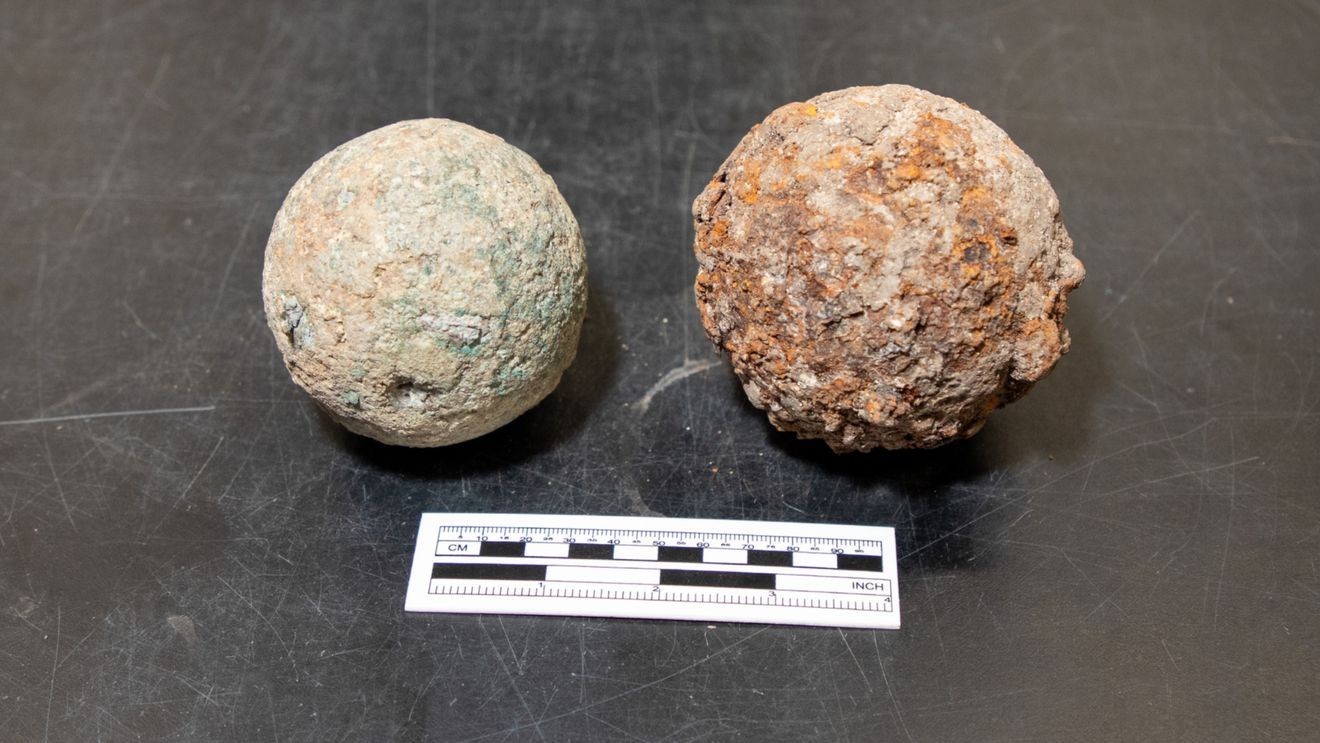
SAN ANTONIO – Archaeologists working at the The Alamo uncovered a second intact cannonball tied to the Battle of the Alamo era, a discovery that came just months after the first find and deepened what researchers describe as an unusually rare excavation streak at the site.
The latest cannonball was unearthed on June 2 during ongoing digs near the northeast corner of the Alamo Church, in nearly the same area where a previous artifact surfaced on March 5, just ahead of the 190th anniversary of the battle.
Both objects were found at roughly the same depth, preserved in what archaeologists call undisturbed soil layers.
A cannonball is maybe a once-in-a-lifetime – or in my case, a twice-in-a-lifetime – discovery. It’s really exciting,” said Dr. Tiffany Lindley, the Alamo’s Director of Archaeology. “It’s the best job in the world.
The March discovery was made of solid bronze. The newer cannonball is solid iron. Despite the difference in material, both artifacts appear to be closely linked in size and weight, and researchers say they may have been fired from different sides during the 1836 conflict.
Dr. Lindley said both items were recovered from “clean deposit,” a term used to describe soil layers that have remained relatively undisturbed over time.
What that tells us is that they were in likely their original deposition,” she said. “So whenever they were dropped, the very first time – possibly in 1836, probably – they haven’t been touched since. And that’s what makes them extra special.
The artifacts are now being studied alongside other materials recovered during excavation work tied to both preservation of the church and the larger redevelopment effort underway at the site.
Researchers are still working to determine the exact size and origin of each cannonball. According to the Alamo’s senior researcher and historian Kolby Lanham, early analysis suggests the newest iron cannonball may have been fired from a six-pound cannon.
Though the cannonballs are of different material and they weigh roughly the same size, the newest one is slightly larger and likely was fired from a six-pound cannon,” Lanham said. “The likelihood is that the bronze one belonged to the Mexican Army and the iron one belonged to the Texans at some point.
Lanham said both artifacts appear consistent with weapons used during the Siege and Battle of the Alamo, though further analysis is still underway using soil context and historical records from the period.
“The first one we found, I thought, there’s no way in the world we just found a cannonball from 190 years ago. And then fast forward just a couple of months, and we found a second one,” Lanham said. “It’s just a huge kind of once-in-a-lifetime deal – but obviously it’s happened twice.”
The Alamo remains an active archaeological site, where researchers continue to work alongside preservation teams focused on the Alamo Church and Long Barrack as part of the ongoing $700 million Alamo Plan.