
After storms and flooding swept across South Texas earlier this week, the weather pattern is now shifting toward a more familiar summertime threat: extreme heat.
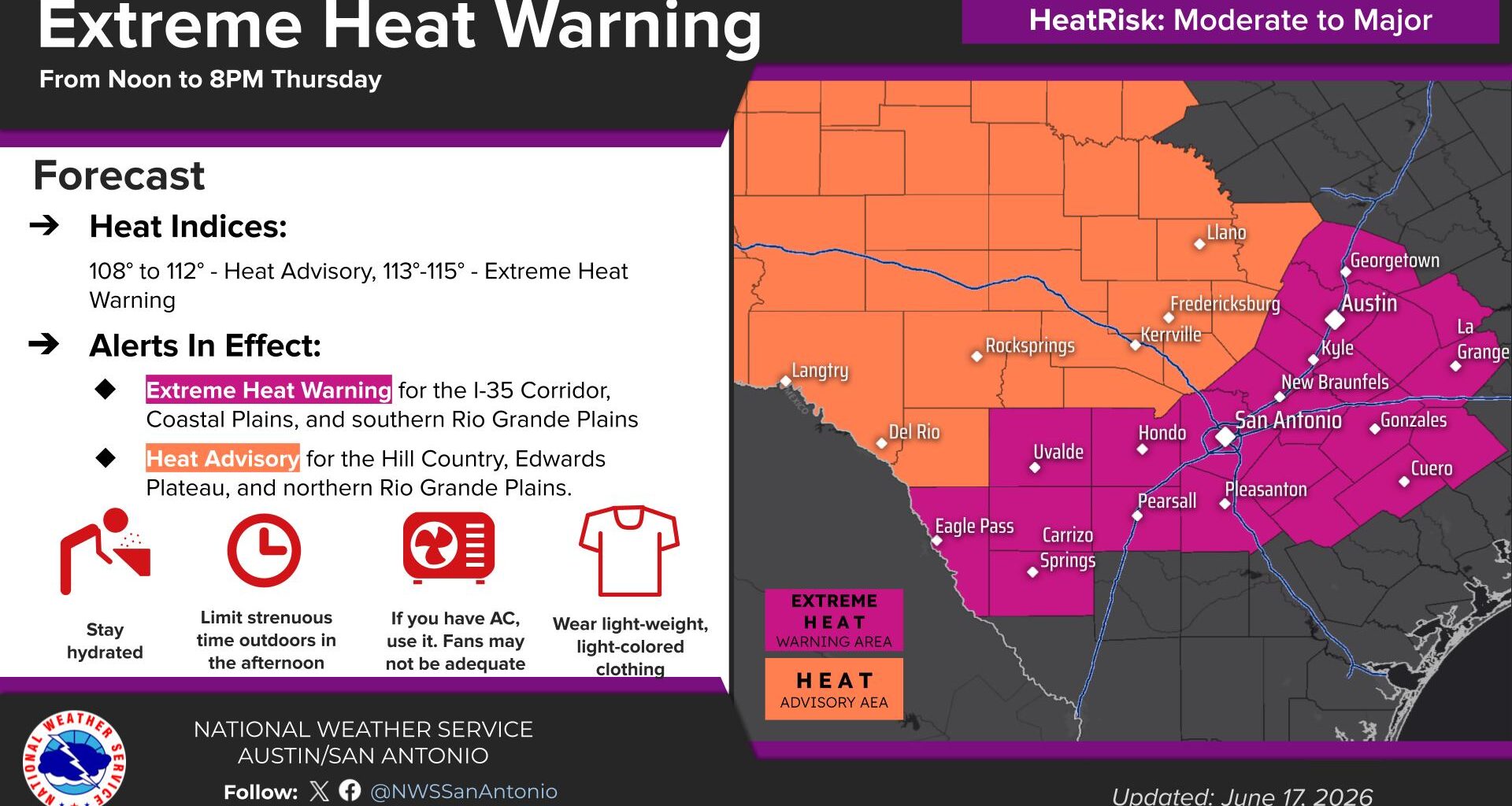
The weather will turn hotter on Wednesday, but Thursday is expected to bring the most dangerous heat. As a result, the National Weather Service has issued an extreme heat warning for much of South and Central Texas, including San Antonio, New Braunfels, San Marcos and Austin. The warning, which will be active between noon and 8 p.m. Thursday, is in response to projected heat index readings of at least 113 degrees.
The Texas Hill Country is under a heat advisory, as temperatures will be just a few degrees lower, likely 108 to 112 degrees.
Humidity levels also will be elevated because of the heavy rainfall that fell earlier this week. San Antonio recorded a daily record of 2.6 inches of rain Monday, and some of that moisture will contribute to oppressively humid weather over the next several days.
Wednesday: High temperatures are expected to reach the low 90s across much of South Texas, with San Antonio most likely topping out near 92 degrees. While that may not sound extreme, elevated humidity levels will result in “feels-like” temperatures between 101 and 104 degrees through the afternoon and early evening in the city.
Thursday: South Texas is likely to experience one of its hottest days of the entire summer, at least in humidity-driven heat index values.
Temperatures in San Antonio will climb to around 90 degrees by noon before reaching afternoon highs between 95 and 97 degrees. When incorporating the extreme humidity, maximum “feels like” temperatures are expected between 112 and 115 degrees.
The weather will be even hotter farther south and west of San Antonio. Temperatures are forecast to reach the triple digits in Eagle Pass, Laredo and the Rio Grande Valley, where heat index values could climb to between 115 and 119 degrees.
This mix of high temperatures and especially high humidity can be dangerous, particularly because South Texas has not yet experienced this kind of heat so far this year. As a result, many people might not be fully acclimated to this kind of weather.
On hot days, we rely on the evaporation of the sweat from our skin to cool down. But high humidity makes that process less efficient because the air is already filled with water vapor. The heat index takes this into account, so it gives a more accurate description of what the body experiences, at least better than what the actual air temperature would suggest.
Because your body’s ability to cool down is compromised, humidity-boosted heat can become dangerous for those performing strenuous activity outside. You risk heat exhaustion or heatstroke if you don’t take adequate precautions for the heat.
Limit time outdoors on Thursday whenever possible. If you must be outside, drink plenty of water, wear loose-fitting and light-colored clothing, and take frequent breaks in air-conditioned spaces. Also, never leave children or pets unattended in a vehicle, even for a minute or two.