
TEXAS — After decades of being eradicated in the United States, the New World screwworm (NWS) has returned to Texas.
According to a dashboard from the U.S. Department of Agriculture’s (USDA) Animal and Plant Health Inspection Service, there are at least 11 active cases in the United States: 10 in Texas and one in New Mexico.
The first case of NWS was confirmed on June 3.
As officials monitor recent screwworm developments in the state, one University of Texas at Austin professor thought back to when the New World screwworm was the “talk of the town” during his childhood.
“I have a memory of the late ‘40s and ‘50s,” said Lawrence Gilbert. “That was a big drought in South Texas. I remember the screwworm issue was considered to be one of the big problems.”
The NWS, however, has a long history before Gilbert’s childhood. Gilbert said that even before it was first documented in 1858, it has always been a part of the ecosystem.
“Now, we have humans here, and they’re worried about it because of the economy, but this is a natural part of the system,” he said.
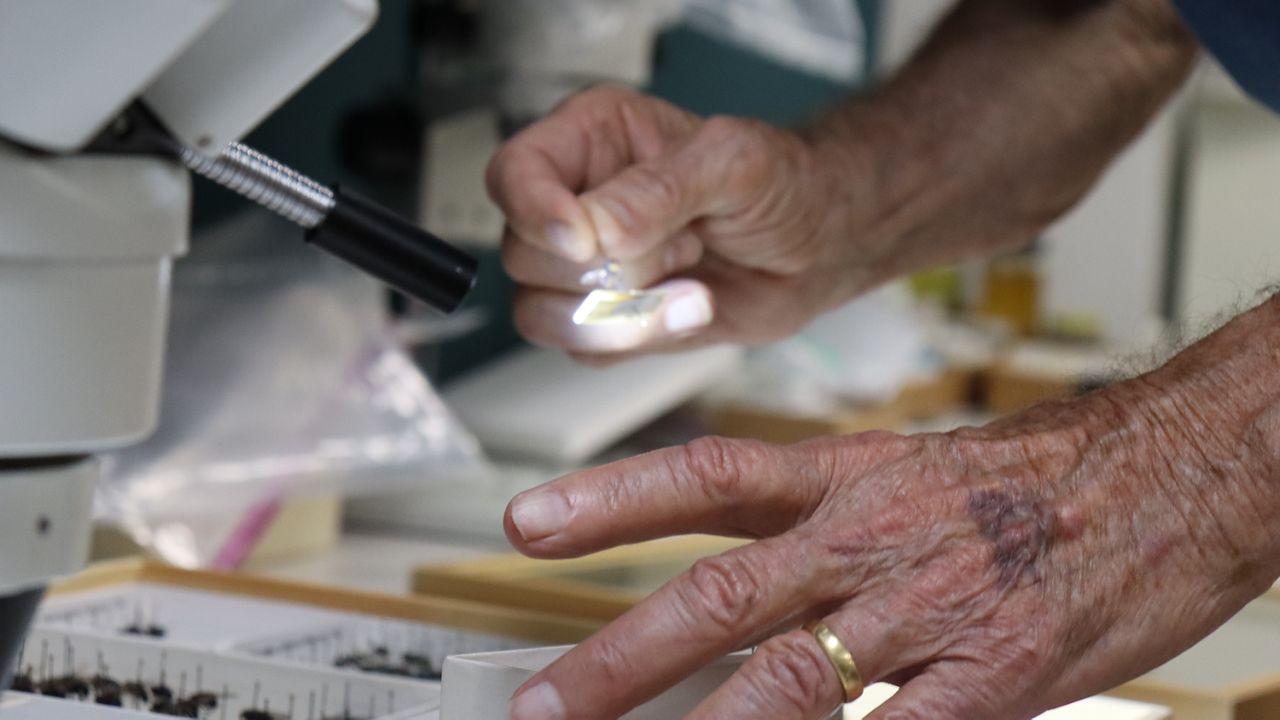
Gilbert is the faculty director at UT’s Brackenridge Field Laboratory, where his team focuses on invasive species and their effects. There, they also identify natural predators that specifically target invasive species.
Among the thousands of insects stored at the lab is the NWS, first documented by French entomologist Charles Coquerel in 1858. According to Gilbert, identifying the NWS fly is a difficult task as opposed to identifying the pest in its larvae state.
“You’d have to kind of be a specialist and put it under a [micro]scope and look at the structures,” he said.
Gilbert also touched on how the NWS was dealt with before modern methods were developed.
“You had basically direct on-wound treatments of cattle,” he said. “In the past, there was a lot of cheap that could do stuff like that.”
The hands-on approach was recommended by the USDA in the 1920s.
A 1920 film from the USDA archival library shows how ranchers were advised to deal with NWS, including hand-applying medicine directly onto the wound of a living, affected animal, and burning the carcasses of infected dead animals.
An accidental discovery by an Austin-based scientist paved the way for modern methods to take over, like Sterile Insect Technology (SIT).
“There was a guy, Hermann Muller, [who] was recruited here from Columbia University, from a fruit fly genetics lab,” Gilbert said. “And he was playing around with X-rays, causing mutations. And then he discovered some of his X-rayed flies produced sterile males.”
Scientists from the USDA working on a solution to eradicate NWS in the 1940s through the 1950s communicated with Muller via letters to discuss applying Muller’s X-ray method to NWS.
In a March 10, 1950, letter to the USDA, Muller’s first sentence read in part, “I think that your very ingenious idea for reducing and perhaps eventually eliminating the blow fly in the southern states might work.”
The group of USDA scientists tested the theory, and the result was a batch of sterilized male flies — and thus Sterile Insect Technology (SIT) was created. A 1960 film from the U.S. Department of Energy shows the process of scientists testing the theory.
The first country to use SIT was Curacao, effectively eradicating NWS in the country by 1954. The United States followed, using SIT in the ‘50s and ‘60s and completely eradicating NWS by 1982. Other countries have also used SIT and found success.
Today, with the return of the NWS, officials heavily rely on SIT to mitigate the issue. Gov. Greg Abbott on June 5 called for a rapid response of SIT teams to control the NWS and even called for a new SIT facility.
“I authorize the use of all available resources of state government to respond to this disaster and reassign all resources from across the state as needed to address the NWS,” Abbott said.
“Along those lines,” he continued, “I’m making available any and all of our state personnel, including our university systems, to accelerate the movement of sterile flies into the state of Texas, and to accelerate the construction of the new sterile screwworm facility in Edinburgh.”