
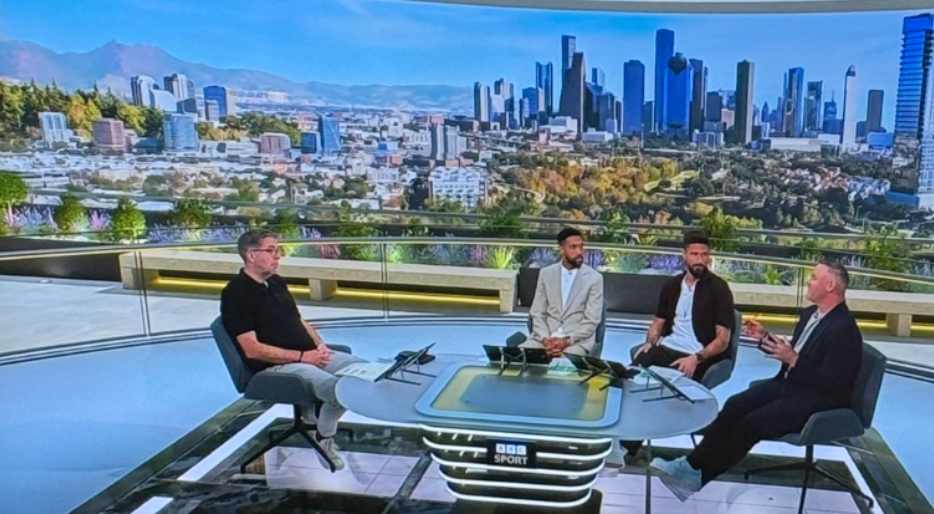
One international news outlet added one other feature to Houston during its broadcast of the 2026 FIFA World Cup on Wednesday: majestic mountains.
No, that’s not a typo. BBC, the British news outlet, hosted a World Cup studio show on Wednesday shortly after the completion of DR Congo‘s 1-1 draw against Portugal in the second 2026 World Cup match held at Houston Stadium. The studio show broadcast an AI-generated image of Houston’s skyline in the background as analysts discussed the match, featuring a largely accurate depiction. One issue with the AI image? The left side of the screen was adorned with rolling foothills and mountains, depicting a scene more fit for Los Angeles, Salt Lake City or Phoenix than Houston.
Yes, Texas is the Wild Wild West. But Houston is more than a stone’s throw away from West Texas and the western half of the United States, a fact not exactly accounted for by BBC set designers. Houstonians made sure to call out the BBC for their error on Wednesday.
BBC’s gaffe was a minor mistake in its otherwise sterling soccer coverage. But the mistake points to a larger problem in our current media ecosystem. Wouldn’t a traditional photo of Houston’s skyline suffice during the post-match recap? Was it really necessary to use AI generation? ESPN made a similar mistake with AI-generated content during the 2026 NBA Finals, causing an uproar from San Antonio Spurs fans with an AI-generated photo of Spurs legend Tony Parker.
AI is already encroaching on our lives plenty. Can’t sports be one sacred safe space from the slop?
Houston will host its next World Cup match on Saturday when the Netherlands faces Sweden. Let’s hope the BBC alters its background image of the Houston skyline, replacing out-of-place mountains with a six-lane highway, or, even better, a giant, splendorous Buc-ee’s.