
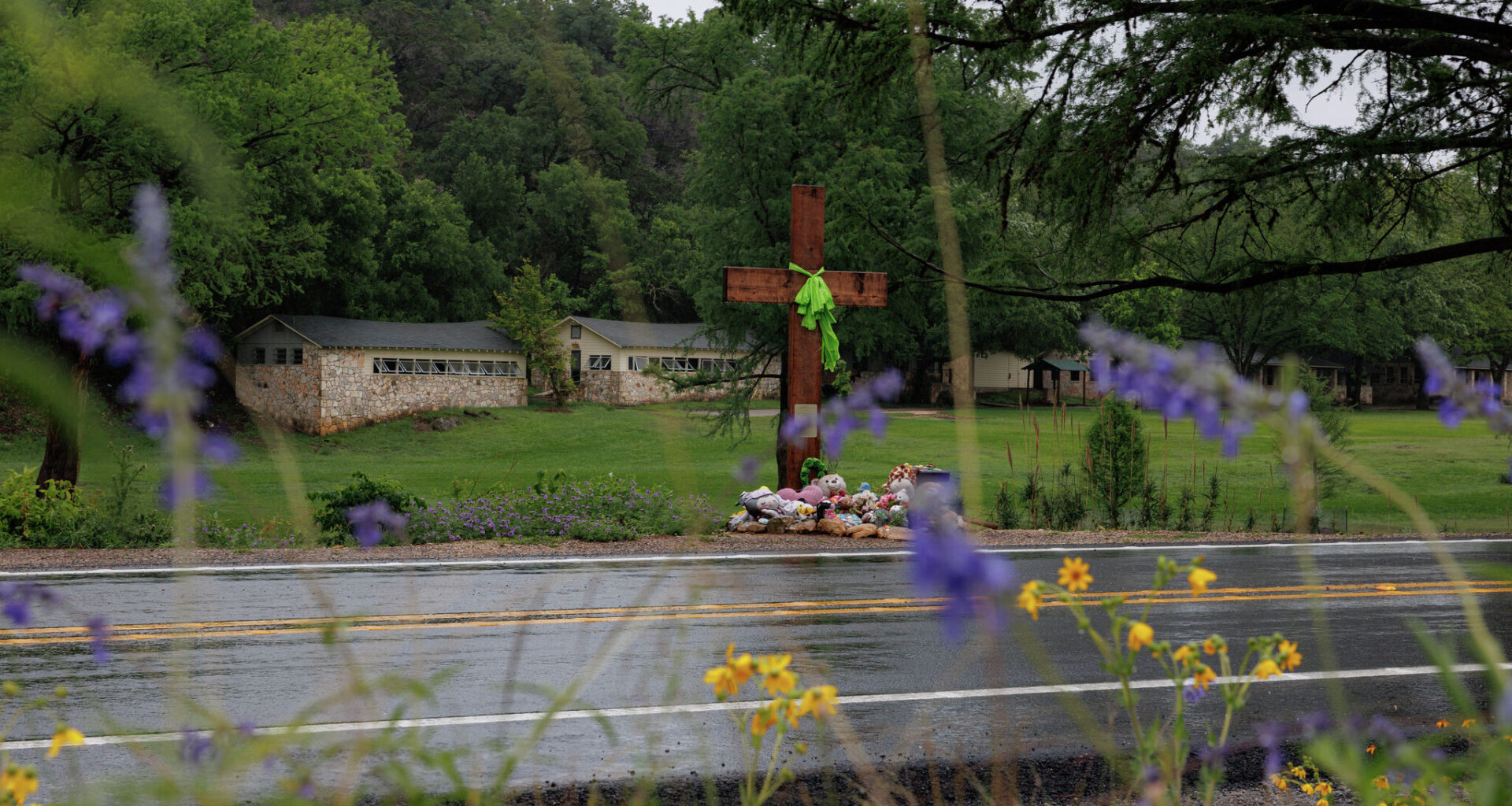
Wildflowers bloom along Highway 39, near a memorial honoring those killed in the July 4 floods, beside the Guadalupe River in front of Camp Mystic in Hunt, Texas, on Monday, April 20, 2026.
Sam Owens/San Antonio Express-News
Texas state lawmakers serving on general investigating committees examining the July 2025 flooding walk the grounds of Camp Mystic during a site visit in Hunt, Texas, on Monday, April 20, 2026.
Sam Owens/San Antonio Express-News
Camp Mystic’s leaders failed at almost every step to prepare for and respond to the devastating July 4 floods that ultimately killed 25 campers and two counselors, according to a report delivered Thursday to a special legislative committee formed to investigate the tragedy.
The report concluded that the Hill Country Christian camp did not have written emergency plans in violation of state requirements; did not adequately prepare for the floods, despite storm warnings; and did not evacuate campers in advance of the flash floods, despite “ample opportunity” to do so.
“There was no plan,” said Michael Massengale, a former district judge and one of the investigators hired by the committee. This lack of planning violated state licensing requirements for camps and led to preventable deaths, he said.
Article continues below this ad
READ MORE: Camp Mystic failed to train teenage counselors for floods, expert tells lawmakers
“A plan that existed only in Dick Eastland’s head is not a plan that satisfied the state’s rules for camps like Camp Mystic,” he said, referring to the camp’s longtime leader who died in the floods.
The release of the report marks the end of a months-long investigation that lawmakers said was needed to fully understand what went wrong at Camp Mystic and offer families a chance to share their experiences.
Camp Mystic had initially planned to reopen this summer, but abandoned those plans at the end of April after fierce opposition from lawmakers and families who lost their daughters. The camp is still facing several wrongful death lawsuits.
Article continues below this ad
At a hearing in April, members of the Eastland family who ran the camp said they were still grappling with grief and had done the best they could under the circumstances.
READ MORE: Attorneys for Camp Mystic families ask judge for ‘severe sanctions’ in lawsuit fight
For the report, investigators reconstructed a detailed timeline of the early morning hours of July 4th. They noted that camp operators were well aware of the dangers posed by flooding – some of the cabins sat on the banks of the Guadalupe River – and had failed to train counselors how to respond.
On Thursday, investigator Casey Garrett, a Houston attorney, noted that the lack of training extended to the many “able-bodied adults” at the camp who could have assisted with evacuation, but didn’t know what to do or what was happening.
She said she recently interviewed a camp nurse whose daughter was a camper. “She described to us that if I had known the extent of what was happening just 100 feet from me … I would have swam to my daughter’s cabin,” she said.
Article continues below this ad
“Nobody had any instruction whatsoever about what to do in an emergency,” Garrett said.
Camp officials have acknowledged that the camp did not have a detailed flood evacuation plan in place when the storm hit, even though one is required to have a state license.
State Sen. Charles Perry noted that the legislature had already addressed many issues raised by the report, which was adopted unanimously by the committee, but that there was still more to do. He said he would refile a measure that died in conference committee in August “for political reasons,” which would have expanded rapid response training for local officials and established a statewide volunteer database managed by the Texas Department of Emergency Management.
The report not only documented what went wrong, but “what must go right” in the future, said state Rep. Morgan Meyer, a Dallas Republican and the committee’s co-chair.
He described those things as “strong emergency planning requirements, real training, and regular drills, clear lines of authority in a crisis, better warning systems, and oversight with the authority to enforce it.”
Article continues below this ad
He addressed the families who lost children in the floods, many of whom were in attendance:
“Nothing this committee has done, and nothing it can do, will return what was taken,” he said. “We know that, but the account now stands in the public record, because you insisted that it should. The standards that protect other children this summer exist because you refuse to let these failures be forgotten.”