
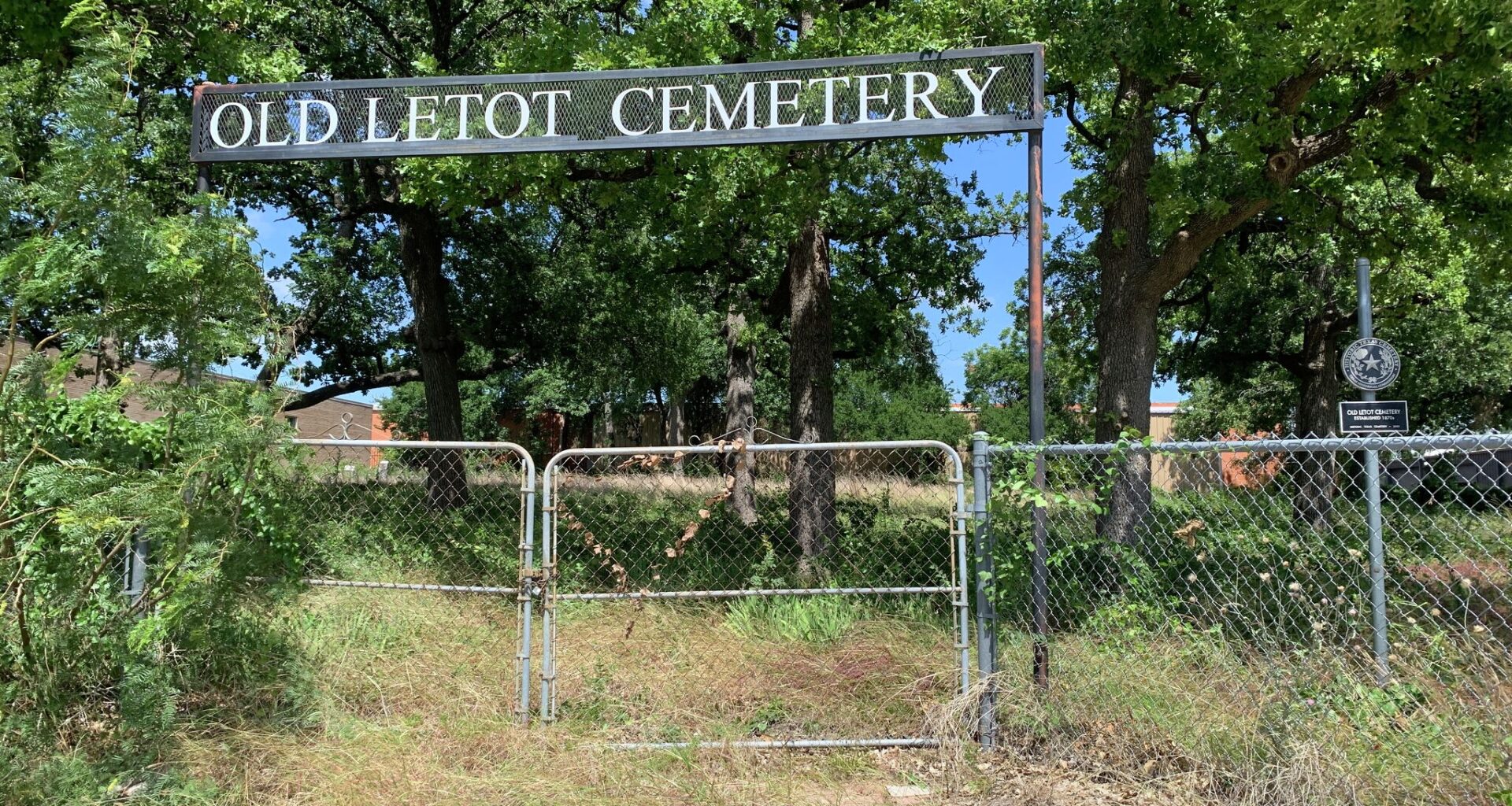
I got tired of dealing with the living Wednesday, after the City Council took another step toward a Dallas City Hall exit, so I went to visit the dead. Except I couldn’t find them behind the tall grass behind the locked chain-link fence. On land owned by the city of Dallas. Of course.
A text message earlier in the day suggested I pay a visit to the Old Letot Cemetery, the Texas Historical Commission-marked circa-1870s cemetery amid the warehouses and showrooms at the busy intersection of Shady Trail and Manana Drive in northwest Dallas. “High weeds,” said the message, which was an understatement.
Some 100 people were buried there – the first, a 26-year-old named Mary Marks, in 1884 – but only a handful of headstones are visible, and barely at that. The only one I could read belongs to 34-year-old Calletano D. Revillas, who died in 1942, his tombstone shrouded by the tall grass along the chain link.
Old Google Maps show the cemetery has been occasionally tended to in recent years. But the woman working at the shingle and solar-panel distributor next door to Old Letot said she can’t remember the last time crews were out there. She suggested I call Wendi Ashcraft, who works for the owner of the Solartek warehouse. Ashcraft said that in four years, she’s seen someone mowing twice. Give or take.
Article continues below this ad
To whom the duty of keeping those graves clean belongs has long been something of a frustration and a mystery, documented in a handful of news stories dating back to the 1960s. But questions concerning its ownership appear to be settled.
The Dallas Central Appraisal District shows the city of Dallas has owned this cemetery since at least 2022. But also, possibly, since 1932.
Yet, the Old Letot graveyard is not counted among the 11 disused cemeteries maintained by the city’s Park and Recreation Department at the cost of around $100,000 annually. Those include the paupers’ cemetery tucked behind a nearby Shady Trail warehouse, which is now tended to by volunteer Daniel Babb.
Article continues below this ad
We do know to whom it once belonged: its namesake, Clement Letot, born in Burgundy, France, in 1836 and, according to the Texas State Historical Association, “the only citizen of Dallas County to serve in the Crimean War.” The “Fiery Frenchman,” they called Letot, for whom much in this town was named, including a bar, a church and Dallas County’s juvenile intervention center on Denton Drive, which operates not far from where there was once an elementary school bearing his name.
You can’t actully get into the Old Letot Cemetery. But if you somehow do, you won’t be able to walk in it, thanks to the thigh-high weeds that cover most of the tombstones in a cemetery Dallas’ leading health official closed in 1954 because it was too crowded.
Robert Wilonsky/Staff writer
In her 2007 book Dallas County History – From the Ground Up, cemetery historian Frances James wrote that Letot came to Dallas in 1874 and bought some 1,000 acres in what’s now northwest Dallas. He built a train depot along what became the Missouri, Kansas and Texas Railway line; then, a cotton gin, a corn mill, a general store, a post office, a school.
Hundreds of families eventually settled this part of town, in a community also named for its founder, until the land called Letot was absorbed by the city in the 1930s.
All of that history is now buried beneath the industrial boxes and retailers and taquerias and strip clubs covering this part of town, along and just off Harry Hines Boulevard. Whenever I start researching these old burial grounds, each one tied to famous and forgotten founders of a fledgling city, I am reminded of how little we remember about Dallas beyond the day before yesterday.
Article continues below this ad
We seldom talk about it or think about it or do anything about it, except when it becomes neglected or endangered. The condition of this old graveyard is emblematic of Dallas at this very moment in history: Nothing of yesterday matters because tomorrow is gonna be so much better, trust us.
Letot didn’t actually bury his family in this cemetery: They were laid to rest in what’s known as the Letot Cemetery, now part of the Calvary Hill Cemetery and Mausoleum on land the Catholic Diocese of Dallas bought from Letot in 1924. Those buried in the Old Letot Cemetery were among the community’s earliest settlers, including at least two Civil War veterans.
Burials ended here in July 1954, after the city’s health officer, Dr. J.W. Bass, told the Dallas City Council that “lack of adequate space at the cemetery site made further burials unsafe,” according to the Dallas Times Herald. Wednesday night, Daniel Babb sent me a memo from the 1960s in which the city’s director of health ordered the city’s disused cemeteries fenced “to exclude winos [and] transients looking for a place to spend the night.”
One of the few gravestones visible in the Old Letot Cemetery, just because it’s against the fence line along Shady Trail
Robert Wilonsky/Staff writer
A 1967 brief in the Herald noted that maintenance of Old Letot “depends upon the volunteer services of Boy Scouts.” But two years later, a front-page Herald story reported the cemetery had “all but gone to seed,” with waist-high weeds, trash and “underbrush too thick to walk through” – plus ça change!
Article continues below this ad
As a result, the Herald noted, 125 residents, including several relatives of the deceased, met to begin a perpetual care fund at a Farmers Branch bank and lobby the city to “remove the condemnation.” Its would-be caretakers included aging relatives of those buried there as early as 1910. They spent the morning of the 1969 Texas-OU game cleaning the cemetery with the intention of rededicating Old Letot.
But by 1997, it was again “weed-choked,” The Dallas Morning News reported. So there was another effort made to clean it up, thanks to a 16-year-old Boy Scout from Allen named Matt Sutherland, who said, “You don’t even know it’s a cemetery unless you see the sign.” It took a day to clean. Then the weeds and trash returned. So, too, did more Boy Scouts, until 2002, at least, the last time this paper ran a story about the condition of a cemetery only the kids seemed to care about.
In her book, James wrote that the nearby John Deere distribution company on Harry Hines helped fix the fence and pave the entrance. Wendi Ashcraft said that when they acquired the next-door building about four years ago, they were led to believe John Deere also maintained the land. But I could find no one at the tractor company to confirm that.
Ashcraft said the building’s owner “was not happy about the cemetery’s condition when he purchased the building, and, of course, it hasn’t gotten any better over the last few years.”
Warehouses and showrooms surround the Old Letot Cemetery along Shady Trail near the busy Manana Drive intersection. It’s not the lone cemetery in that industrialized section of northwest Dallas, either.
Robert Wilonsky/Staff writer
For years there used to be a sign out front that said you were supposed to call Forest Lawn Cemetery on Harry Hines and Walnut Hill Lane with complaints. DCAD also shows Forest Lawn as the property’s owner until the city took possession a few years back – or repossession, based on DCAD’s notation of a February 1932 deed transfer to the city.
Article continues below this ad
County deed records show the city even put a lien on the property in 2020, demanding $210 from Forest Lawn for high weeds. Victor Rodriguez, the cemetery manager at Forest Lawn, remembers getting that letter from City Hall. Except: “Our president, who’s been here more than 30 years, has no knowledge of us ever maintaining the ground out there.” Or owning it. Nonetheless, he said, the park department called a few months ago to ask when they planned on mowing and maintaining the graveyard.
I guess, eventually, Code Compliance will wind up out there. But unless Old Letot can find a champion like Daniel Babb, or until there’s another Boy Scout in need of a project, the buried will again get lost in the weeds.
“It’s sickening, the way we treat our dead,” Babb told me this week. “But the city can’t even take care of their own buildings, much less the dead.”
Article continues below this ad
Probably because they complain far less than the living.