
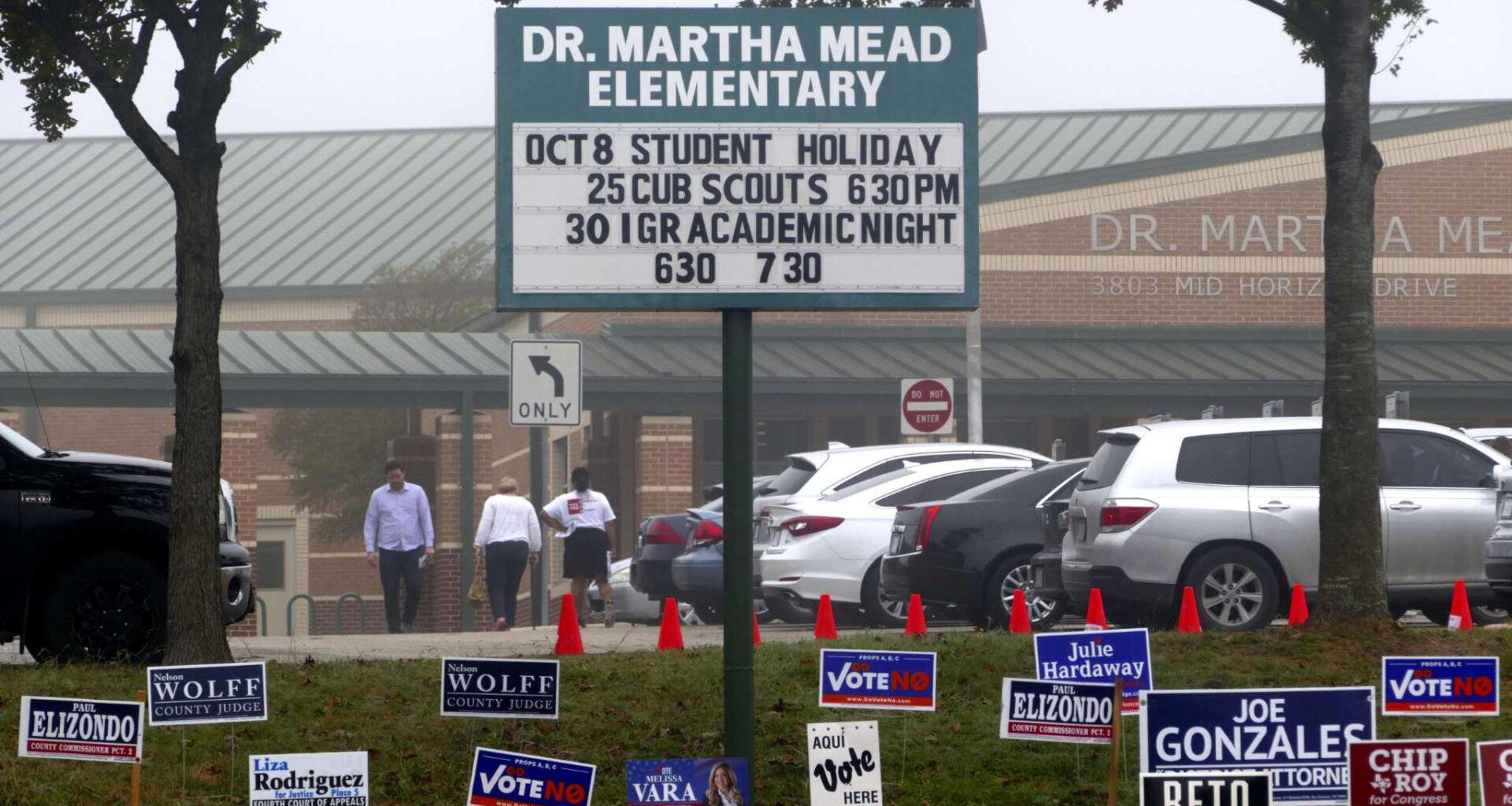
Mead Elementary students posted major improvements on math and reading STAAR tests this year, according to district officials.
Billy Calzada, Staff / Staff Photographer
When the Texas Education Agency released campus letter grades for public schools last August, Northside Independent School District’s Mead Elementary School received disappointing news: the campus had earned its third consecutive F grade from TEA.

In the year since, Northside ISD has launched a districtwide effort to improve the struggling campus, said Janis Jordan, the district’s deputy superintendent for curriculum and instruction. This included coaching up Mead’s teachers and adding support for students learning English. The district also reworked after-school programming to grow students’ math and reading skills.
Article continues below this ad
“We really like to focus on growth, because we think that tells the story. You can’t have achievement until you have growth,” Jordan said. “In our schools that have more challenges, you’ll see tremendous growth, and then achievement is not quite there yet. But you know it’s coming, because of that growth.”
When the state released students’ 2026 state test scores on Tuesday, Northside saw that growth reflected. District officials predict a massive jump in Mead’s state letter grade, mitigating the district’s risk of state intervention — for now.
Other districts in the area, however, don’t appear to have had similar success.
The State of Texas Assessments of Academic Readiness, or STAAR, scores are a benchmark for student performance and a major factor in TEA’s letter grades for elementary and middle schools. Exam results often provide a preview of a campus’ accountability rating come August.
Article continues below this ad
The letter grades can bring major consequences for an entire district. If a campus receives five consecutive “unacceptable” ratings, the state must either close the struggling school or take over the entire district. Schools with multiple years of failing grades also must implement stringent academic improvement strategies, called turnaround plans.
The Express-News analyzed scores at the nearly 20 San Antonio-area campuses that have scored three years of unacceptable ratings since 2023, putting their districts at risk of future state intervention.
In the past school year, some districts have made changes that buy them more time to boost student learning or moved to shutter schools altogether. In other cases, they hope retesting or additional data will propel their schools’ performance scores back in line with state standards.
STAAR scores for struggling campuses
Mead is one of 17 San Antonio-area schools across four districts that received a third consecutive year of academically unacceptable ratings from the state in 2025.
Article continues below this ad
Three of the 17 chronically struggling campuses closed permanently at the end of 2025-26. Another four campuses will see major changes as their districts transfer day-to-day operations to an outside campus operator with a proven record of rapidly improving students’ test scores in the coming academic year.
Going into the spring 2026 STAAR tests, San Antonio ISD had nine campuses with three years of unacceptable scores, Edgewood ISD had four, Judson ISD had three and Northside ISD had one — Mead.
Of the 17 campuses, 12 improved or maintained the number of students in grades 3-8 who passed their reading tests between 2025 and 2026. Thirteen campuses saw improvements in the number of elementary and middle school students passing math. Students don’t need to meet grade level standards to pass the test; they just need to “approach grade level.”
Meanwhile, other long-struggling schools stumbled. Four schools saw reading scores remain largely stagnant, while two saw students’ proficiency drop by 9 or 10 percentage points. In math, only one campus, Judson ISD’s Park Village Blended Learning Academy, had student passing rates plummet. It will be closed in the fall.
Article continues below this ad
Oftentimes, students’ academic performance can mirror the economic adversity they face outside the classroom, and schools with higher numbers of children from low-income backgrounds typically don’t perform as well as their more affluent peers.
At each of the 17 campuses examined, more than 78% of students are low-income, and at 14 schools, that figure is more than 90%.
Northside ISD
At San Antonio’s largest district serving nearly 100,000 students and operating more than 100 campuses, Northside ISD, staff are celebrating massive student growth.
Article continues below this ad
Jordan said three of four campuses on improvement plans are expected to boost their accountability scores and no longer have a mandated “turnaround plan” this year. Turnaround plans require districts to lay out a clear path for how they want to boost student outcomes.
The improved performance includes what happened at Mead, which, according to initial district projections based on the new STAAR data, could improve from an F to a B come fall.
The campus posted massive improvements in both core subjects. It marked a 15-percentage-point jump to 58% of students passing reading and a nearly 25-percentage-point boost in math. Roughly 62% of the school’s students are now passing math.
“We are so proud of those students, those teachers, the community and the staff, because it’s been a district-wide effort (to improve Mead), and we’re very, very excited,” Jordan said.
Article continues below this ad
Of the three other campuses on a turnaround plan, all of which received their second F rating last year, two are expected to boost their campus scores based on the data. The district requested a STAAR rescore for the final campus, Glass Elementary, which could be on the verge of a third unacceptable rating.
Jordan’s team will now dig into the data and student demographics to identify outliers and understand whether performance drops differ from statewide scores. The team will then try to address any learning challenges and make tweaks to the instructional plan for next year.
She emphasized that while grades and accountability scores are highly important, they don’t show the entire picture of each student or their growth. The goal for the district is to move each student forward, she said — whether forward means passing the STAAR exam or moving from a passing score to meeting or mastering grade level standards.
Judson ISD
Going into STAAR testing, Judson ISD had three campuses with three consecutive failing grades from the state: Park Village Elementary, Kirby Middle and Metzger Middle.
Article continues below this ad
Metzger had a modest 2-percentage-point gain in reading scores, while math scores remained largely flat. The district is still waiting for additional data from TEA before projecting a letter grade for the school, said Mary Duhart-Toppen, Judson’s deputy superintendent of teaching and learning.
The data she’s waiting on looks at how much students’ academic achievement increased — rather than just who passed their exams. Student growth plays a major role in a campus’ accountability score.
“That is going to tell us how many kids actually grew in a year’s time, and we’re able to move the needle on where they are, and you get points for that,” Duhart-Toppen said. “That will help you determine whether or not you’re going to be a D, an F campus, or a C.”
If the slight increase in passing rates, coupled with campus-wide academic gains, is not enough to raise Metzger to a C this year, the school will receive a fourth consecutive unacceptable rating.
Article continues below this ad
Park Village is among four schools the district plans to close in the coming school year as it faces a $35 million budget shortfall. The elementary school saw significant declines in students’ reading and math scores.
The nearly 19-percentage-point drop in math scores and a roughly 9-percentage-point decline in reading proficiency can be attributed to high turnover among teachers during the school year, said Kristin Saunders, Judson’s assistant superintendent of curriculum and instruction.
To counter those challenges, Saunders said central office employees were sent to the campus to teach full-time.
“When you’re looking at teachers leaving the classroom for whatever reason … we have to respond immediately. We can’t just float a sub in there for six weeks,” Saunders said. “And if that means, again, leveraging people that are in the curriculum and instruction hallway to make sure that students are receiving top-tier instruction, that’s what we need to do.”
Article continues below this ad
While the district did not see the gains it hoped for at Park Village, it is looking to expand support for those students as they move to other campuses. But Saunders added that the new schools many Park Village students are now zoned to attend have “really highly effective leaders.” Students from Park Village are likely to attend Hartman, Paschall and Woodlake elementary schools.
Though the schools are not as close to triggering a state takeover, district officials said they were encouraged by gains in scores at Masters Elementary and Kirby Middle schools, where they also deployed turnaround efforts.
Despite small drops in third- and fourth-grade scores, Masters saw a 33-percentage-point jump in fifth-grade students’ math scores and a 19-percentage-point uptick in fifth-grade reading proficiency. Kirby saw gains of 7- and 6-percentage-point improvements in eighth-grade math and reading, respectively.
Kirby is transitioning to become Kirby STEM Academy, with a greater focus on science and technology curriculum. Recognized as a new, separate school from the original Kirby, the STEM campus had its inaugural school year in 2024-25, meaning the traditional school is in its final year.
Article continues below this ad
Saunders and Duhart-Toppen attributed Kirby’s gains to effective campus leadership, the reshuffling of a handful of principals and the creation of positive school cultures.
“How can we make this a place that kids want to be, and start putting in different things, making a place where teachers want to be?” Duhart-Toppen said, adding that in addition to academics, the district looks at opportunities to boost morale, like campus assemblies or spirit week activities.
Interim Superintendent Robert Jaklich said the administrative team is already looking at ways to improve in the coming year.
“We took a look at where we were and what we needed to do; we also know we’re under a sense of urgency,” Jaklich said.
Article continues below this ad
Tafolla Middle School on San Antonio’s West Side pictured Monday morning. The campus is one of four that Third Future will begin operating in next school year.
Noah Alcala Bach
San Antonio ISD
San Antonio ISD has nine schools at risk of receiving a fourth F rating with district officials projecting roughly one-third of campuses would receive a D or F in 2026.
During the past school year, SAISD leaders chose to close Carvajal Elementary and Rhodes Middle and give a charter control over another three schools, starting next year.
Article continues below this ad
The campuses continuing to operate without closures or third-party intervention include Herff and Graebner elementaries and Poe and Davis middle schools. The two middle schools outpaced the elementaries in both reading and math performance gains. Herff’s reading scores remained steady as the scores at Graebner dipped slightly in both math and reading.
Poe and Davis both improved average reading scores by about 2% across the campuses. However, the average student passing rate in reading remains below 60% at both schools.
Davis marked the largest improvement in math — a 31-point jump in the percentage of students passing — among all 17 of the long-struggling campuses across the region. The percentage of Herff and Poe students passing also rose. But at 63%, 39% and 48% passing respectively, the scores don’t ensure the three campuses will be spared from another unacceptable rating.
Next year, Third Future Schools, a Colorado-based charter, will run the day-to-day operations at Tafolla Middle and Ogden and Hirsch elementaries. The partnership will give the schools more money per student and a two-year “pause” on accountability ratings.
Article continues below this ad
According to 2026 STAAR results, Tafolla Middle School posted significant gains in reading and saw a jump in math: growth of almost 17 and 9 percentage points, respectively. Nearly 60% of its students passed the reading exam, while around 30% were on par in math.
Ogden Elementary had stagnant reading scores from 2025 to 2026, but jumped 10 percentage points in students passing math. Meanwhile, Hirsch saw a modest dip in math and a 10-percentage-point drop in reading.
SAISD did not make district staffers available for an interview on Wednesday.
Edgewood ISD
Edgewood ISD will also hand over control of Brentwood Middle School to Third Future next year. This year’s STAAR scores showed Brentwood’s reading scores staying flat as students posted a 3-percentage-point improvement in math.
Article continues below this ad
The three other district campuses with three years of unacceptable ratings include Roy Cisneros Elementary School, Las Palmas Leadership School for Girls, which serves students in grades K-8, and Roosevelt Dual Language Academy, which enrolls students in grades K-3.
Among the area’s largest performance improvements in reading, Roy Cisneros boosted its percentage of students passing the subject by 16 percentage points. The other two schools maintained their reading performance but both improved in math by nearly 6 percentage points.
Edgewood ISD spokesperson Lauren Blevins said no district staffers were available to speak about the newly released scores until next week and did not comment on the results. TEA is expected to release A-F grades in mid-August.
Article continues below this ad