
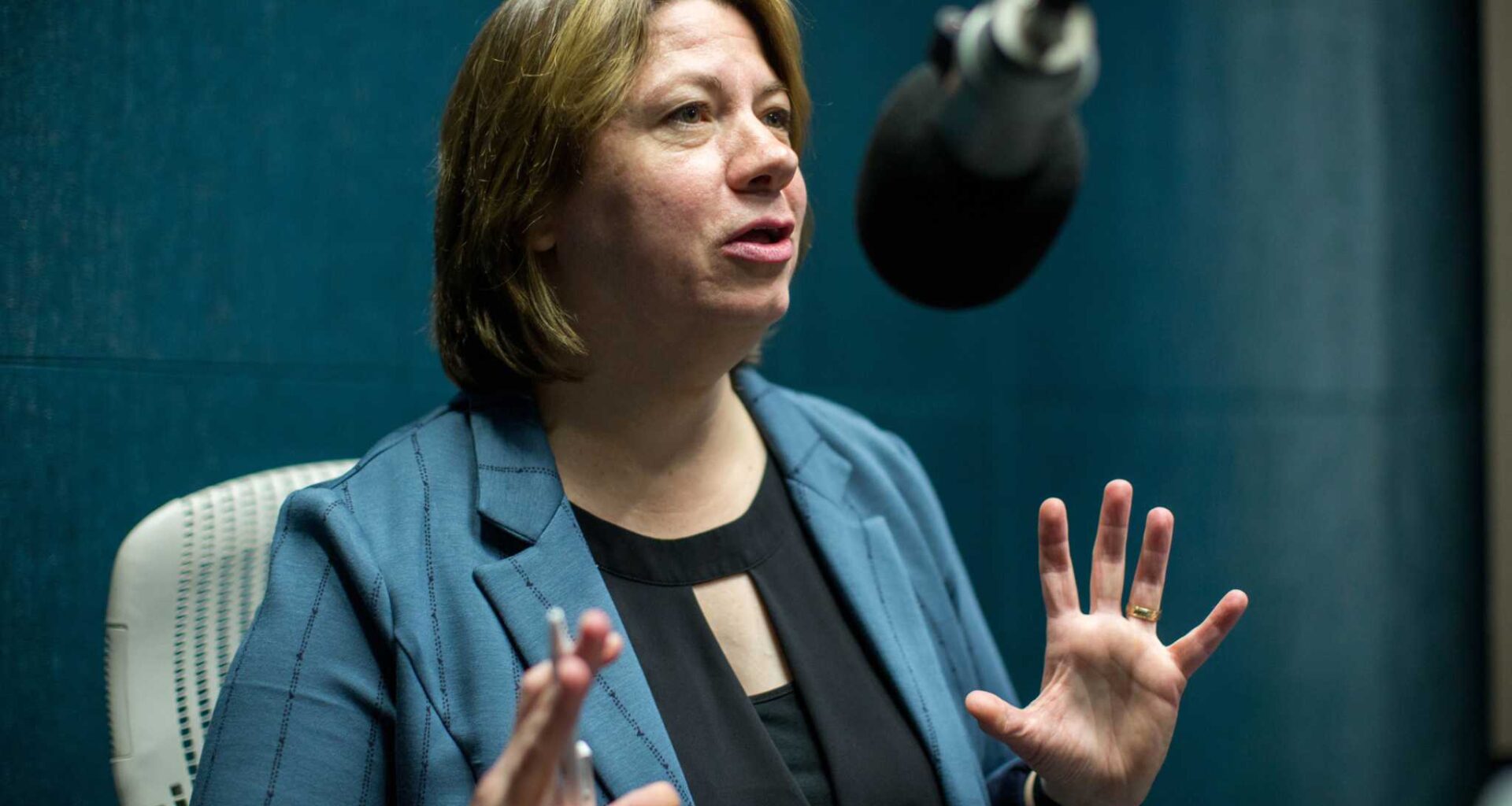
The firing this week of KUT general manager Debbie Hiott exposed a growing conflict between a university shaped by politics and a newsroom dedicated to public accountability, the Editorial Board writes.
Courtesy of KUT/ Gabriel C. Pérez
KUT, the public radio station serving Texas’ capital city, is a public trust.

So is the University of Texas, the flagship institution that has housed KUT on campus for decades.
Article continues below this ad
But they have different missions that appear increasingly at odds after the termination this week of KUT general manager Debbie Hiott, who was fired after a dustup with UT over the radio station’s first community festival.
Hiott’s departure highlights the tension between two public-facing institutions — and underscores one important conclusion. It is time for UT to untangle itself from the licensing and operations of KUT, a media outlet that needs independence to serve the community.
It is deeply troubling that UT would dismiss a leader with Hiott’s well-earned reputation for candor, integrity and dedication to serious-minded journalism, the very qualities that drive KUT’s coverage (and, we should note, Hiott’s long career at the Statesman before that).
UT’s dispute with Hiott over special event planning — an 11th hour spat that prompted the radio station to move last month’s KUT Festival off-campus — sparked concerns about whether the political pressures clearly being exerted on UT might now be reaching KUT as well.
Article continues below this ad
ALSO READ: UT didn’t sign Trump’s higher ed compact. But it’s acting like it did
While UT isn’t commenting on Hiott’s departure, the university has claimed its festival concerns were driven by safety and logistics, not politics. Yet emails obtained by the Statesman show UT Provost William Inboden — university’s chief academic officer, who does not oversee public safety or communications — was involved in drafting the language explaining the changes to the KUT Festival, raising questions about the true scope of the university’s objections to the event.
The political pressures shaping UT are undeniable, with the Legislature banning diversity initiatives and sidelining faculty councils — diminishing the opportunities for different voices to be heard. Over the past year, UT has limited how controversial topics can be taught, consolidated its gender and ethnic studies departments, and handed greater power to the university president to eliminate faculty or academic programs.
All of which creates a conflict for UT and KUT: The university takes its directives from a state Legislature and political appointees of the governor who are significantly reshaping higher education — in our view, for the worse — while KUT is committed to independent journalism that unearths information and asks difficult questions.
Article continues below this ad
The friction between those missions is becoming harder to ignore. UT and KUT are driven by different priorities, and neither benefits from being intertwined with the other.
Spinning off KUT (and sister music station KUTX) from UT would require a new community owner for the broadcasting license that UT has held since 1958. That new owner would need to pick up about $1 million worth of in-kind services currently provided by UT, including facilities, IT support and payroll, according to financial statements.
But the bulk of KUT’s funding — about 86% — is already independent of the university, coming from listener contributions and sponsorships. Ensuring KUT’s financing and operations are 100% independent would protect the radio station’s work from political pressures, perceived or otherwise.
The university would also benefit from being untethered to a media organization, eliminating speculation about whether UT is influencing decisions at the radio station. (UT did not respond to our questions about whether it is reassessing its relationship with KUT.)
Article continues below this ad
SIGN UP FOR THE AUSTIN ANGLE and get Statesman commentaries in your inbox
Hiott’s departure is a loss for KUT, for UT and for the Austin community both institutions serve. But the larger issue remains: the increasingly untenable arrangement in which a university governed by state politics has any oversight of a news outlet committed to independent journalism.
Both institutions are public trusts. Each depends on public confidence to fulfill its mission. Austin will be served best when each stands on its own.
Article continues below this ad